
Prayers, twerking and hundreds of millions of dollars: Pope Leo XIV and Bad Bunny become the latest explosive combination for Madrid
The pontiff’s first major public event in Spain, next to the Santiago Bernabéu stadium, will coincide with one of the Puerto Rican artist’s concerts
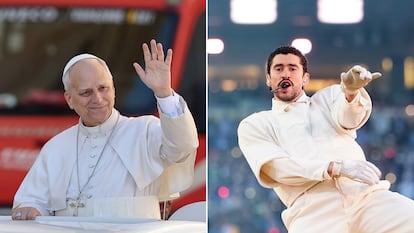
They say that sinners who pray are even. Everything points to this being the plan for many in Madrid on the weekend of June 6 and 7. On the one hand, they’ll unleash their party side at one of the 10 concerts Bad Bunny will be performing in the capital; on the other, they’ll find time for prayer and contrition, taking advantage of Pope Leo XIV’s visit, scheduled for the same dates. The coincidences are striking: the pontiff’s first major public event, near Real Madrid’s Santiago Bernabéu stadium, will happen on the same day and in the same city as one of the Puerto Rican artist’s concerts, which will be held at the Metropolitano stadium, home to Atlético Madrid. And hotels are already starting to rake in the cash, even though there are still two and a half months to go before the events.
Experts who study the impact of this kind of event predict a city packed to the brim with both the faithful and fans of hard‑core reggaeton — two groups that are by no means mutually exclusive. The result: hundreds of thousands of international visitors booking hotels that are already nearly full, hoteliers rubbing their hands in anticipation, millions of dollars in expected revenue, and the Spanish capital under unprecedented pressure.
“They attract different profiles and different consumption patterns, but there is also a clear saturation effect,” explains Albert Guivernau, professor of urban economics at OBS Business School and director of the Civismo Foundation. The official agenda for the papal visit to Spain, scheduled between June 6 and 12 — he will spend four days in the capital — has been released gradually, because the Vatican wants to be the one making the announcements.
🔴YA ES OFICIAL | Madrid se prepara… ¿te lo vas a perder?
— Archidiócesis de Madrid (@archimadrid) April 16, 2026
El Papa llega y tú puedes vivirlo desde dentro:
6 de junio - Vigilia de jóvenes
7 de junio - Santa Misa y procesión del Corpus Christi
👉 Inscríbete: https://t.co/Qy6pbjvbyW
👉 Compártelo con tu gente#ConElPapaMadrid pic.twitter.com/e0xSBqdV4M
The first of the two major events announced will be a Mass with young people on Saturday, June 6 at 8:00 p.m. in Plaza de Lima, next to the Santiago Bernabéu stadium. At the same time that the pope is addressing his flock, Bad Bunny will be doing the same for his fans, but at the Riyadh Air Metropolitano stadium. Hundreds of thousands of excited young people will be watching their idols perform on stage.
The Spanish Episcopal Conference (CEE) also presented, in addition to the official slogan and logo, the first figures for the cost of the papal visit: a minimum of €15 million ($17.7 million). Part of the expense is expected to be covered by private benefactors who will pay up to €1 million for a meeting with the pope, and another part by public funding. This money covers the visits to all the planned cities: Madrid, Barcelona, Las Palmas de Gran Canaria, and Santa Cruz de Tenerife. Coordinators expect the visit to bring in more than €100 million ($118 million).
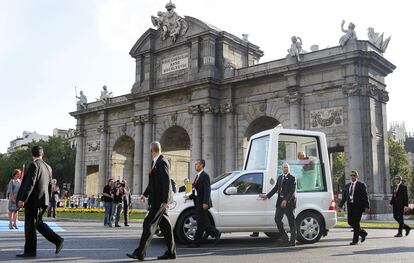
Meanwhile, Bad Bunny will perform 10 consecutive concerts at the Metropolitano. Each night, approximately 50,000 tickets will be sold at an average price of €150 ($177). Gross revenue from ticket sales alone is estimated at around €75 million ($88.5 million). These calculations come from Carlos Balado, professor of economics at OBS Business School and director of Eurocofin, after studying the economic impact of similar Bad Bunny concerts in other cities around the world. “The average expenditure per person is €278 [$325], considering that the average ticket price is €150 [$175] plus accommodation, transportation, and food for each attendee,” says Balado, who sees these figures as events that have a significant impact on the local economy.
“Madrid has established itself as one of the leading hubs for Latin music in Europe thanks to a very clear combination: demand, venues, international connectivity, and cultural affinity,” says Nacho Córdoba, promoter for Live Nation Spain, which is representing Bad Bunny. “Furthermore, concentrating the dates allows us to optimize production, reduce the logistical footprint, and improve the audience experience. There are two concerts in Barcelona beforehand, and the tour will then travel to Portugal, Germany, the Netherlands, the United Kingdom, France, Sweden, Poland, Italy, and Belgium.”
Two and a half months before the dates, the effect is already noticeable. Madrid hotels are reporting occupancy rates close to 80%, and recent searches on platforms like Booking, Expedia, and Trivago showed that 76% of accommodations were already fully booked for those dates. If the maximum budget is €100 per night, 95% of options are already gone.
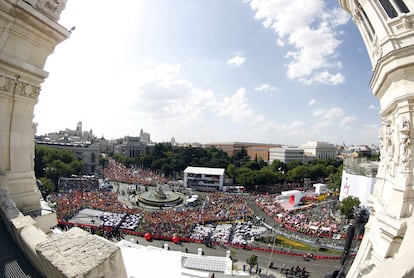
In June last year, Madrid registered 914,496 travelers staying in hotels, according to municipal data. Some 60.4% were international tourists, and overnight stays exceeded 1.85 million. The city has more than 75,000 hotel rooms, and during comparable major events — such as the Champions League final or Pride — occupancy rates have exceeded 90% and approached full capacity. All of this occurred without a papal visit or a reggaeton festival. This year, in addition to the usual tourists, the first weekend of June will also see an influx of Bad Bunny fans and other worshippers. The last papal visit to the capital in 2011 drew more than 1.5 million people to the closing Mass.
On that occasion, Pope Benedict XVI visited for World Youth Day, and the city was completely sealed off for the pontiff. Entire streets in the city center were closed to traffic for seven days. The largest event during this year’s visit will be held in Cibeles Square, in front of City Hall, where 85,000 people gathered last Saturday for a Christian festival. It was precisely at this event of music and faith that the Bishop of Madrid, José Cobo, revealed that the vigil with Leo XIV — expected to be massive — will be held in the same location. For now, little is known about the traffic management plan devised by the City Council, other than that it will deploy 10,000 personnel during the four days of the visit.
Madrid Mayor José Luis Martínez-Almeida announced on April 16 that, according to his approximate attendance estimates, the city anticipates around 500,000 people for the youth vigil and approximately 1.5 million for the Sunday mass. “It’s a gigantic logistical challenge. I don’t recall such a large gathering of people,” he commented. Among the aspects to be managed are the buses arriving in the capital from various parts of Spain and Europe, where to park them, and how to redirect them to avoid gridlock. In addition, Metro Line 10 remains closed for construction at the Santiago Bernabéu station.
The Archdiocese of Madrid is also seeking 10,000 volunteers to help with preparations. “The needs are many, so we need a lot of people. You can volunteer in both the preparation work and support tasks, offering accommodation, transportation, or supplies,” they explain on the website conelpapa.es, created for the occasion. The appeal extends to those who, in addition to being believers, are influencers: “If you are a digital missionary or content creator and want to participate more actively in spreading the word about Pope Leo’s activities and messages, fill out this form and we will contact you soon.” TikTok will be filled for several days, though it’s unclear if equally, with clips from Bad Bunny concerts and videos so you don’t miss anything the pope does.
What does the city gain from these types of events? “The big winners are usually accommodation, restaurants, and transportation, although the order changes depending on the event’s profile,” Guivernau points out. “At large-scale concerts, restaurants and hotels capture around 60% of the spending; at events with a greater proportion of international visitors and longer stays, hotels gain ground. Here we’ll see a mixed distribution: price pressure on accommodation, high turnover in bars and restaurants, and a significant increase in mobility.”
But this isn’t good news for everyone. Jorge Nacariano, president of the Regional Federation of Neighborhood Associations of Madrid (FRAVM), warns that the coincidence of the papal visit with Bad Bunny’s concerts at the Metropolitano stadium poses a serious risk of overwhelming the city, especially in terms of mobility, public services, and security. Nacariano also points out the shortage of Municipal Police officers, the impact on public transportation and traffic, and the danger of neglecting other neighborhoods by concentrating resources on poorly designed mega-events. He calls for a serious reflection on the continued commitment to mega-events in venues that are not always suitable, reminding everyone that Madrid must prioritize the well-being and daily lives of its residents over a policy of constant events.
Cardinal Cobo said in a recent interview that “the first temptation” regarding the pope’s visit to Spain is “to make a big spectacle of it.” He cautioned, “It will be a spectacle, but not among us.” Of course, he wasn’t referring to Bad Bunny.
Sign up for our weekly newsletter to get more English-language news coverage from EL PAÍS USA Edition









































