
The Vatican embraces Catholic influencers: ‘We are the gateway to the faith’
This week, Rome welcomes 1,000 creators of religious content on social media. They are attending a Jubilee on July 28 and 29, part of a Holy Year that focuses on the digital environment
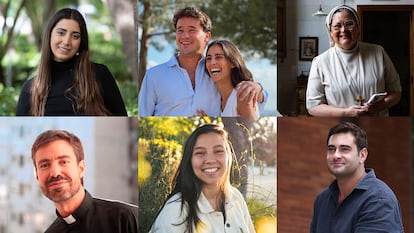

Paula Vega went viral in 2023 when she decided to spend her honeymoon with her husband in Rome to visit Pope Francis. They arrived dressed as bride and groom and carried their marriage certificate. “We wanted his blessing. I told him I was a digital missionary, and he told me to give it a go,” she says. This 30-year-old from Málaga, Spain, rediscovered her faith almost a decade ago and now shares religious content on Instagram, where she has more than 56,000 followers. She’s already packing her bags to return to the Vatican. For the first time in history, a Jubilee is being celebrated with 1,000 Catholic influencers from 46 countries in a Holy Year that focuses on the virtual world. “The Church realized that young people aren’t in parishes, although they are on social media. We are the gateway to the faith. We have the best message in the world, but we have to know how to sell it,” she says.
The event, which will take place on July 28 and 29, takes place in a context where data shows that society is becoming less religious. The percentage of Catholics in Spain is just over half of the population, although only 18.8% are practicing, according to the latest Centre for Sociological Research survey, conducted in April. Among those aged under 24, the number of believers barely exceeds one-third, and church weddings are less popular, having declined by almost 39% since 2015. Two decades ago, 90.2% of the population considered themselves Catholic. It is a rapid and significant shift.
Xiskya Valladares, better known as the “Twitter nun,” is self-critical: “Masses no longer attract young people, not even me. They do have faith, but if they don’t go to parishes, it’s our fault. We must connect with reality and offer the message of Jesus in a renewed language.” She lives in Palma de Mallorca, is 56 years old, and is a nun in the Purity of Mary congregation, a philologist, a doctor in communications, and a digital missionary.
She has 782,000 followers on TikTok, although she started on X (formerly Twitter) 15 years ago. “I was very interested in the 15-M movement; I wanted to learn about citizens’ concerns, and I discovered the power of social media. I joined all the new ones that were emerging,” she says. As a pioneer in this sector, she is part of the Jubilee organization for Catholic content creators. “There will be a meeting with the Pope, training with communications professionals, workshops, a concert, a Mass, and a scavenger hunt,” she says.
She asserts that the event would not be possible without the work of Pope Francis, who placed importance on this issue. “He gave me the opportunity to participate with my voice and vote in the 2023 Synod of Synodality. I was one of the 54 women who, for the first time in history, were fully included in a bishop’s forum,” she says.
In her initial intervention, she recalled, they laughed at her, but in the second assembly, they listened to her and drafted the first official document on digital mission, which led to a 2024 World Youth Day in Lisbon with Catholic content creators, supported by the Holy See’s Dicastery for Communication.
“Digital missionaries are a place for understanding the reality of the Church, of faith experiences, and of exploring the existential questions that concern us all, although of course they are not the only ones,” says Pablo Velasco Quintana, national communications secretary of the Association of Catholic Propagandists.
Sofía Alas, another of the Jubilee organizers, acknowledges from Rome that the Church increasingly values “communicating the word of God in a more intimate way, not as theological as we were used to.” She believes the anonymity that social media offers users favors a closer approach to the faith because it eliminates the fear of being judged, reports Íñigo Domínguez in Rome.
Laura Pérez, head of talent management at the influencer marketing agency MB TalentsGroup, agrees. She says her company employs several religious content creators. “It’s a growing niche; people are interested in their lifestyle,” she says. She asserts that they have a significant capacity to capture and retain audiences. “They’re not a showcase selling a product; they’re diverse profiles that interact in a very human way with their community.”
Paula Vega: “The internet has great evangelizing potential”

Paula Vega studies theology, and her classmates are seminarians. She believes that “a digital missionary must be trained.” She knows the Church is working to provide support for content creators like her: “The internet has great evangelizing potential. Of course, screens will never replace physical contact. We bring young people closer to the parishes.”
On Wednesdays, she dedicates a section on Instagram to “making visible the silenced women of faith within the Church and recognizing their work.” She knows that women have encountered difficulties within the institution, including herself. “A priest told me to leave theology behind and start teaching catechism,” she says.
Quique Mira: “What used to be an ambo for giving a homily is now an Instagram video”
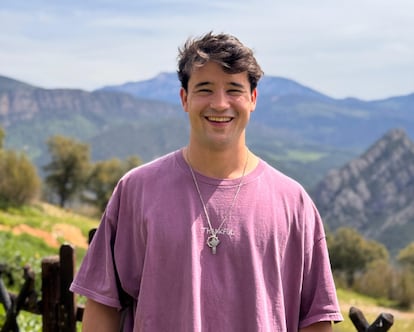
Quique Mira lives in Valencia. He’s 27 years old and creates Catholic content on social media. “My family didn’t practice the faith; for me, it had nothing to do with the meaning of life until I met a priest at 19 who transformed me,” he confesses. He left the nightlife scene where he worked and began to invest more in parishes. “I started an Instagram account to share this experience,” he says.
Some of the topics he addresses on Instagram, such as waiting until marriage to have sex or gender identity according to religion, cause a stir, but they reach millions of views. He recently married María Lorenzo, also a digital missionary: “We explain what it means to live in a three-way relationship, including God.”
He has more than 200,000 followers across all his social media platforms and is the founder of Aute, “an organization that brings young people closer to the faith” and which has a mobile app, a clothing brand with garments containing Christian messages, and numerous events. “What used to be an ambo in the Church for giving a homily, today is an Instagram video. Now all the attention of young people is on social media, and we have to be there,” he says.
Paola Pablo: “It goes beyond going to Sunday Mass with the family; it builds community”
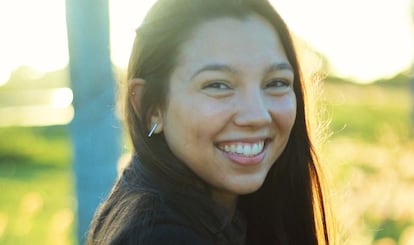
Paola Pablo, a 30-year-old Dominican resident of Madrid, is a singer: “I evangelize through music on social media; I’m on YouTube and Instagram.” In 2018, she released her first song dedicated to Jesus, and between this and her latest single, she has already written 18 songs. “I’m present on all the major platforms like Spotify. Most Catholic ministries have a music distributor,” she explains. She has more than 100,000 followers on Instagram.
She believes songs have the power to connect, especially with young people. “It touches the heart and opens doors,” she says, referring to Hakuna Group Music, the Christian youth band that has sold out Madrid’s WiZink Center on several occasions. Retreats, spiritual exercises, and concerts are increasingly popular, in her opinion. “It goes beyond going to Sunday Mass with the family; it builds community.”
Xiskya Valladares: “Churches are empty or filled with elderly people, we have a lot at stake”
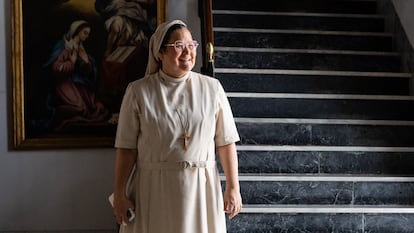
Valladares believes that religion must be present in all spheres and recalls that Benedict XVI noted that a Gospel verse is as long as a tweet. She compares the internet to a field hospital, paraphrasing Pope Francis: “There are many people alone and wounded, sometimes by the Church itself. We can give them hope.”
She believes that Catholic content creators favor survival. “Churches are either empty or heavily populated by older people; we have a lot at stake in our digital mission,” she warns. She doesn’t see the need to pray the rosary on TikTok and share photos of angels. “Parishes are already there for catechizing. I speak to atheists and believers alike because I don’t measure a person’s worth by their faith,” she clarifies. Valladares speaks openly, defends the right of a homosexual person to be a catechist, and joined a youth movement on social media that in April called on the cardinals for a pope for the 21st century, not the 19th.
Carlos García: “The internet is a place for missionary work; there are no borders”
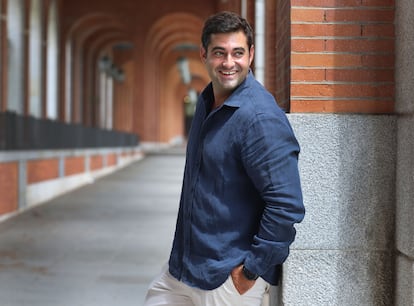
Carlos García, a 33-year-old Madrid native, is a digital missionary and part of the communications team for the Children and Youth Delegation of the Archdiocese of Madrid. “I grew up in a family where faith wasn’t observed, but after the age of 27, I became closer to the Church after leaving a toxic relationship,” he says.
He began sharing on Instagram the work he does with the non-profit organization Misión Hatari, which operates in Spain and Peru, and it began to generate interest. He has more than 20,000 followers. Now he’s introducing new content, such as his excitement about his upcoming wedding, pilgrimages, and his work in parishes. “The internet is a place for missionary work; there are no borders,” he summarizes.
Joaquín Hernández: “If a newspaper only publishes on paper, it’s lost”
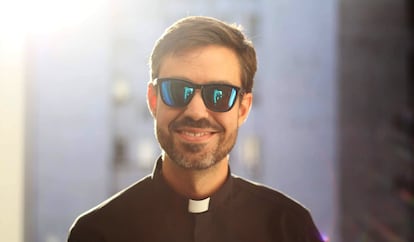
Joaquín Hernández, a 47-year-old priest in the Madrid neighborhood of Villaverde, started using social media in 2017. “These platforms disgusted me a little, so I decided to make something useful out of them,” he recalls. During the lockdown, he streamed Mass and amassed 10,000 followers. He now has over 78,000 on Instagram.
He created the weekly podcast Al Lío about spirituality, faith, and lifestyle. “My goal isn’t to talk about prayer all the time. I can address Christian values, even if I don’t mention God,” he summarizes. He positively values the Vatican’s commitment to a digital presence: “Today, if a newspaper only publishes on paper, it’s lost. The same thing is true in the Church; we also keep up to date.”
Sign up for our weekly newsletter to get more English-language news coverage from EL PAÍS USA Edition









































