
UN coordinator in Venezuela: ‘Their own resources will not be enough’
Gianluca Rampolla warns that rebuilding after the earthquakes will require unlocking frozen assets, restoring access to multilateral financing and deciding which areas should not be rebuilt
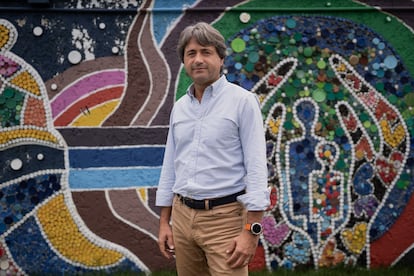

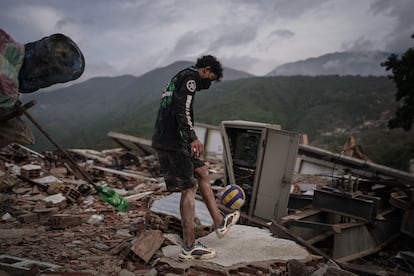
Gianluca Rampolla, 52, is confronting his third major earthquake. The first was in Haiti in 2010. The second came in Papua New Guinea in 2018. The third is the one he is dealing with now: the earthquake that struck Venezuela on June 24, when two consecutive tremors measuring 7.2 and 7.5 hit the country, the deadliest disaster of its kind Venezuela has experienced in more than a century.
More than 3,000 people have died, tens of thousands have been left homeless, and the disaster struck a country that was already in a fragile state: without a robust healthcare system, without reliable power infrastructure, and with millions already living in conditions of chronic hardship.
In that context, Rampolla occupies a unique position. As the United Nations humanitarian coordinator in Venezuela, he has spent the past five years navigating relations between a government that until recently branded him a “hypocrite” and threatened him, and an international community often reluctant to engage with Caracas. His term should have ended by now, but one crisis after another — the prolonged humanitarian emergency, the political turmoil and now the earthquake disaster — has kept him in the country while a successor is found. He does not seem particularly bothered by the delay: “My affection for Venezuela is infinite.”
Question. What is the scale of this catastrophe? Is it comparable to any other you’ve experienced?
Answer. I can’t give a definitive answer yet. One dimension to consider is that we already had a preexisting humanitarian crisis: in the affected states there were around 700,000 people in need. In our response plan, La Guaira was not a priority area, but its residents have limited capacity to absorb external shocks. If your house collapses, your world collapses.
Q. There has been criticism of the Venezuelan government’s handling of the first hours after the disaster. Would this have happened in any country?
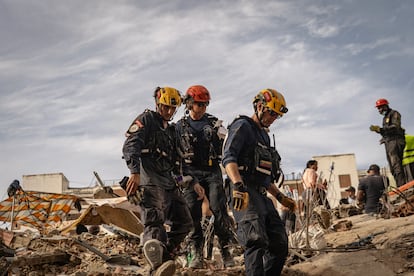
A. It’s not the first time I’ve faced this. I was in Haiti in 2010; it was horrible. I was in Papua New Guinea after a 7.5 quake in 2018; I followed the quakes in Turkey and Syria. What I’ve always seen is that in the first phase there is confusion; there is no organized response. Here we are also talking about a country in a state of structural weakness, to the point that part of the United Nations’ work, with their agreement, is and will continue to be institutional strengthening. It was, sadly, confusing, but totally normal. In what tragedy is the local community not the first to respond? The first international team arrived in less than 24 hours — it was the Swiss. Delcy Rodríguez called me to mobilize all international rescue capacity, and within the first 12 hours the second request arrived: we need your help with shelter.
Q. Some international rescuers wondered what would have happened if the earthquake had occurred under Nicolás Maduro. How do you think it would have been managed?
A. I can’t tell you how it would have been, only how it has been. We’ve been asked to do something that hadn’t happened before: co-lead the establishment and management of camps, with the full range of services that entails, and provide technical assistance throughout the recovery phase. Having the international community, through the U.N., serve as the main channel for international support has been something entirely new.
Q. Do you think the earthquake could create any opportunities?
A. Finding opportunity within a tragedy is obviously difficult. But I hope this accelerates the reopening of cooperation channels with multilateral development banks, that the reconstruction process results in something better than what existed before, and that the government becomes even more comfortable seeking outside support. They have shown they are ready to open to the world. I also believe it offers a political opportunity: that the process of rebuilding institutions can move forward in a spirit of national unity, without confrontation, and with a focus on finding solutions that allow people to coexist.
Q. NASA estimates 58,870 buildings were damaged or destroyed. What is a realistic timeframe for reconstruction?
A. It depends on the level of damage to each building; you need to determine which can be saved. The way to reduce pressure on temporary camps is to identify which buildings remain usable and what interventions they need so people can return. Those that collapsed or are unusable must be demolished, and solutions must be defined for those people. And where do you rebuild? When I talk about rebuilding better, I also mean deciding where reconstruction makes sense and where it doesn’t.
Q. Do you think La Guaira should be rebuilt as it was?
A. I’m not a geologist or seismologist, but it’s obvious they will need to determine why some areas collapsed and others did not. I come from a country [Italy] where, every time there is a disaster, we realize we built where we shouldn’t have. How long will it take? A long time. How will it be financed? That’s the question. They will need access to international financing at a time when it is already facing enormous challenges, including one of the world’s largest unresolved debt restructurings. I’ll be frank: with access to their assets frozen abroad — frozen by sanctions — with cash flow that allows them to invest with their own resources and with international support.
Q. Has the United Nations tried to mediate with the United States so that Venezuela can access that frozen revenue?
A. We will keep insisting, as we always have, that sanctions have had a negative impact.
Q. Venezuela’s oil revenue is held in accounts in the United States and is released only in limited amounts. Have you made a formal request for the country to regain access to those funds?
A. We have not. A key principle of the United Nations Charter is sovereignty, and that principle includes control over one’s own resources. But it is absolutely necessary that the country have adequate resources to deal with this situation. And their own resources will not be enough: they weren’t before, and they won’t be now.
Q. Is it possible to revive the economy despite the earthquake?
A. It is entirely possible, but it will not be achieved by focusing only on the oil sector. It is necessary to support industry and business across the board. A country whose GDP today is a quarter of what it was in 2012 needs to rebuild financial muscle to invest in basic services: health, education, water, sanitation. A country without those services is not sustainable.
Q. You were “the U.N. hypocrites,” according to the president of the National Assembly, Jorge Rodríguez. Now the government cites the U.N. in its press conferences to back up its handling of the crisis.
A. I have been called everything from across the political spectrum, and it wasn’t just “hypocrites.” The U.N. is often instrumentalized everywhere in the world. On social media, they have called me Venezuela’s garbage collector, fascist, puppet, depending on what suits them. But now is not the time for reproach. It is time to work hand in hand and in coordination. The government has asked us for help, and we are here to support the Venezuelan people.
Sign up for our weekly newsletter to get more English-language news coverage from EL PAÍS USA Edition









































