
Venezuelans search for relatives among unrecognizable bodies: ‘I can’t say for certain it’s my niece’
At Caracas’s main morgue, families are identifying loved ones using photos of hundreds of victims
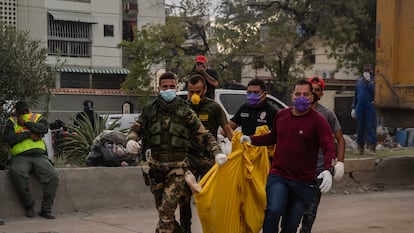

The Hernández family has gone through every album of unidentified bodies compiled since June 24, when two powerful earthquakes struck Venezuela. They have visited the morgues in La Guaira and Caracas, as well as hospitals and shelters. “The ones we thought might be them weren’t, because their families had already claimed them,” says Elide Hernández, who is searching for her niece, who died along with three other family members. “I can’t say for certain that it’s my niece,” she said as she left the National Service of Forensic Medicine and Sciences in the capital.
At the country’s main morgue, a long row of chairs has been set up for those waiting to find their relatives or finally collect their remains and begin to bring closure to days spent digging through the rubble. There is tea and coffee. And psychological support. Funeral vehicles stand ready to carry out burials and cremations. Some companies are offering those services free of charge, while insurance firms have created joint funds to cover funeral expenses for victims of what could be the worst tragedy Venezuela has experienced in the past 20 years.
The paperwork has been streamlined. Yet nothing seems enough. Gianluca Rampolla, the United Nations resident coordinator in Venezuela, has announced that 10,000 body bags will be brought into the country to support the emergency response.
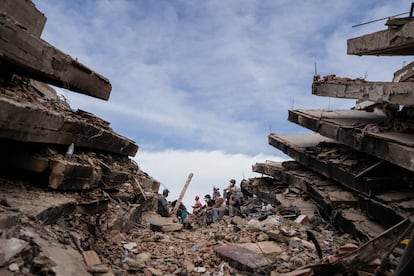
Another aunt waiting for answers is Yamileth Hernández. By phone, she is asked to describe a tattoo on the waist of Eudis Cisneros, her nephew César Flores’s wife, who was seven months pregnant. Staff at the morgue are requesting more details to help identify her. The couple died in the Oasis Beach apartment building in Catia La Mar. According to relatives, many of the bodies are swollen or crushed, some are incomplete, and almost all are in an advanced state of decomposition after spending hours beneath the rubble under a relentless sun.
“You have to look at your own loved ones and everyone else’s too,” says Yusbely Hernández, visibly shaken by the task of identifying bodies. She still has not found her sister. Neighbors, however, say she was recovered dead alongside her husband. The couple’s daughter and the children’s grandfather also died. The family has no information about their whereabouts.
The relatives have been recording identification numbers of bodies that bear some resemblance to their loved ones among those they have examined in La Guaira, at the two hospitals treating the injured, at a makeshift morgue set up at the port facilities, and now in Caracas. In its latest update, released Tuesday, the government confirmed 1,943 deaths. But the family remains doubtful. Many people are still trapped beneath the rubble, and it is unclear how many can still be recovered.
“My husband was inconsolable because he said he had known our niece since she was born and now he couldn’t recognize her,” Elide says from the morgue, tears spilling down her face. Her relatives died in OPP 33, a building from the government’s Misión Vivienda housing program.
“At the morgue they told me that at some point they will have to begin burying them in mass graves because it is becoming a public health problem,” she adds.
For now, the family can only wait and hope they will somehow be able to identify the bodies of the relatives they are searching for.
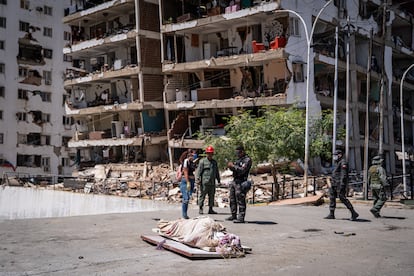
Some bodies have been identified through fingerprint analysis, others through forensic examination of dental records. That is how Esmeralda Gómez was able to identify her uncle and aunt, Seistres Yaguaranay, 48, and Jacqueline Parra, 41. They lived in one of Petare’s informal settlements — where damage was relatively limited — but on June 24 they were working to clean out a vacant apartment in the Obelisco building in Altamira, Caracas. Their bodies were recovered on Sunday, four days after the twin earthquakes.
“Yesterday they were able to identify them through their teeth. The bodies were in a very advanced state of decomposition,” says their niece.
The family threw itself into the rescue effort, moving rubble by hand. The first thing they found was Seistres’s wallet, containing his identification documents. That was how they learned the couple was no longer missing. They left behind four orphaned children.
“As a mother, I grieve not only for my daughter, but for everyone’s children who have died,” says María del Carmen Parra, who traveled from Mérida state in western Venezuela to search for Jacqueline.
“We are at peace because we were able to bring the bodies home,” says Millán Hernández, who personally recovered the bodies of his two nieces, aged 16 and 5, as well as their father. The family worked through the early hours of Tuesday. Extracting the last body they transported to Caracas — where they were assured it could be properly refrigerated — took more than 14 hours of labor.
The family came from Maracay and brought tents, cordless drills, a Starlink antenna and a power generator. “We set up a command center,” says Hernández, who is a police officer. “From there, we also coordinated aid for everyone in the building.”
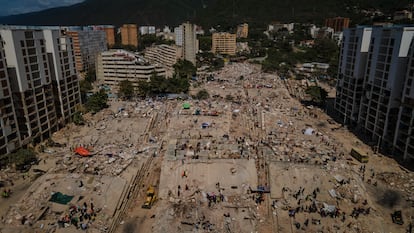
At one point, they crossed paths with U.S. rescuers who helped complete a tunnel through the center of the collapsed building so that they could recover their relatives. Theirs was one of many family-run command centers that sprang up in the disaster zone, searching for survivors and bodies amid overwhelmed — or sometimes indifferent — security forces.
Millán rode more than 60 miles on a motorcycle to reach the disaster area in the first hours after the quake, though he initially went to the wrong address.
“They told me they lived in the Villa Mar building, so that’s where I went. In the end it was Vista Mar. But at least at the first building I reached, I pulled out two people alive,” he says, his face marked by exhaustion as he sits near the phone-charging stations that have been set up at the morgue.
People now call him Topo — “Mole.”
Cousins, siblings and grandchildren stay together as they near the end of an exhausting ordeal that has lasted almost a week. They are waiting for the bodies of their three relatives before making the journey back to Maracay.
Sign up for our weekly newsletter to get more English-language news coverage from EL PAÍS USA Edition









































