
Grief turns to rage amid the rubble of Venezuela’s earthquake zone
Five days after the disaster, tensions between residents and authorities are escalating in the hardest-hit areas
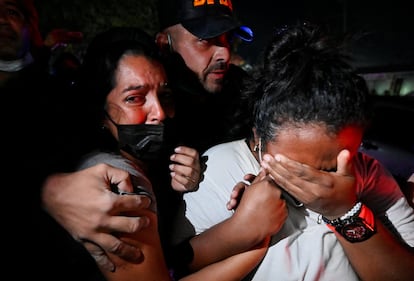

Rage is beginning to eclipse pain. Five days after the twin quake that shook northern Venezuela, chances of finding signs of life beneath the concrete slabs are slim, and residents feel abandoned. Exhausted and powerless. Many have not left the buildings where they know their loved ones remain trapped. Now, likely dead. Frustration — toward the rescuers who have not arrived and the authorities — is intensifying. As is frustration with the government of Delcy Rodríguez, which has been running the country in tandem with the United States since the fall of president Nicolás Maduro.
Venezuela has not even begun to mourn because it remains in survival mode. The scale of the catastrophe is still impossible to calculate, but it is enormous. The two earthquakes — magnitudes 7.2 and 7.5, occurring less than a minute apart on Wednesday afternoon — are the most destructive the country has suffered in more than a century. On Monday, the official death toll stood at 1,719 with nearly 13,000 families affected, but the real number will be far higher. The United Nations estimates that more than 50,000 people are still missing, and the opposition, which has compiled its own registry, puts the figure above 55,000. Those registers include duplicates, but no one doubts that thousands more fatalities remain uncounted. The twin earthquakes have once again devastated La Guaira, the coastal state buried by Ávila landslides in 1999.
The magnitude of the tragedy is reflected in one of La Guaira’s parking lots that authorities turned into an improvised outdoor morgue. It remained in use until residents themselves, suffocated by the stench, demanded the bodies be removed. “It was affecting the elderly and children; it had become very dangerous. It was horrible,” says Génesis, who lives next door. Images she shared with EL PAÍS show dozens of swollen, naked bodies laid out in rows across an entire lot. The resulting public health crisis has become yet another challenge for Venezuela.
“Machines! We want machines! We’re tired! My son is in there!” The man, covered in dust, his filthy mask hanging at his chin, screams hoarsely with his fist raised. He is beside himself. On Sunday, absolute desperation gripped residents of a forgotten corner of La Guaira, the area hardest hit by the disaster.
It is a poor neighborhood where the towers do not have sea views or pools but public housing units for humble families. For five days, residents of the building known as Oppe33 tower have kept vigil. They do not shower and barely eat. They sleep at night in an open lot and dig by day.
The first excavator appeared only on Sunday and began removing rubble, but what’s needed is machinery capable of lifting and breaking apart the reinforced concrete floors that have collapsed onto one another, folded like an accordion. A second machine arrived later, though it was of little use: in a country sitting on the world’s largest oil reserves, there was no fuel to run it.
Fuel shortages and a power outage that plunged much of the coastline into darkness have hampered rescue efforts from day one. “This is anarchy, no one has shown up here,” says teacher Brencis Hernández, whose son remains buried beneath the rubble.
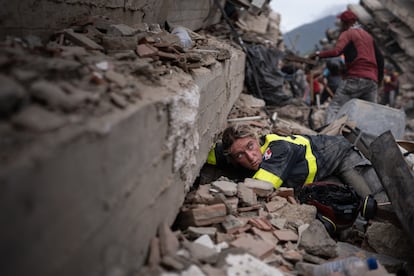
International aid has arrived in force. Nearly 3,000 foreign rescue workers — from Turkey, Chile, Mexico, El Salvador, Spain, the United States and Qatar — have been deployed across the rubble, bringing specialized equipment and expertise. The Qatari teams have even brought gleaming fire engines, a stark contrast to the battered ambulances navigating the streets of La Guaira. El Salvador’s president, Nayib Bukele, has been providing live updates on social media each time his country’s rescue teams locate a survivor.
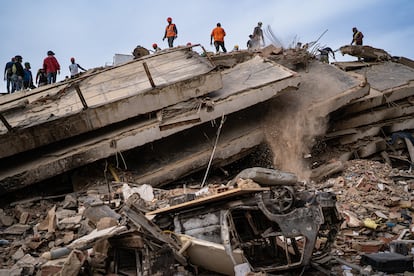
On Sunday, a French firefighter lay face down on the debris, guiding a camera through a narrow opening in one of the earthquake’s most harrowing scenes: a cascading collapse of apartment towers that flattened an area roughly the size of three football fields. Her face was flushed, her blonde braid coated in dust. When she pulled her head back from the hole, her expression said it all: despair.
Videos of confrontations are spreading across social media. Above all, they show people’s rage at the military, who are seen directing traffic and patrolling the streets rather than digging through the rubble alongside residents, and ultimately, at any authority. Public outrage has only deepened with incidents such as the televised appearance of Delcy Rodríguez, who interrupted a group of international rescuers. “We wanted to pull them away from their tasks, which we know are vital, to thank them,” she said — while people were still trapped beneath the rubble.
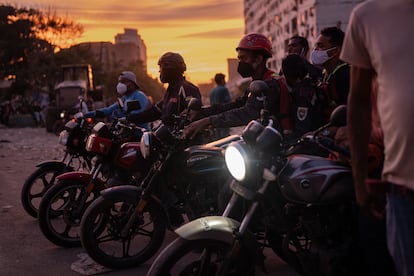
In one widely shared scene, a line of riot police attempted to block dozens of motorcyclists from accessing the road to La Guaira — officially closed to prevent further collapses, though in practice it has become relatively easy to reach. One rider tried to force his way past by driving directly at an officer.
In another video, a young man in an orange safety vest confronts soldiers and police officers, shouting: “There are more rifles here than shovels, brother!” The officers looked at him without reacting.
Tensions threaten to flare at any moment. “I pulled my daughter out in pieces. No one is leaving here until they take her away—I have nothing left to lose!” another distraught man shouted as he joined a residents’ picket aimed at preventing rescue teams from withdrawing from the site.
Tensions are also rising among residents themselves. On Sunday, one family spotted the legs of a relative protruding from the rubble and insisted on retrieving the body at any cost. Nearby, a neighbor was pleading for rescuers to clear a path to her own loved ones and bring in an excavator. The two women eventually ended up shouting at each other.
“I also want to find my family!” she yelled at the family. But if the excavator plunged its bucket into the ruins, it could bring down what little structure remained standing and crush those legs — the only part of the victim that was still visible.
Delcy Rodríguez’s government remains focused on the emergency response while beginning to consider the next challenge: what to do with the tens of thousands of people left homeless. One humanitarian crisis is now layered on top of another.
Jorge Rodríguez, president of the National Assembly and the president’s brother, delivers a daily update, but what many feel is missing is a more technical briefing detailing the vast logistics operation and resources being deployed, the coordination between domestic and international teams, and basic information such as what machinery is operating, where shelters are located and how many people they can accommodate, and where food and water are being distributed.
Interior Minister Diosdado Cabello, who oversees the civilian security forces, has been a visible presence in the disaster zone. The defence minister, by contrast, has been nowhere to be seen. In a country where many remain deeply distrustful of the Chavista leaders still in power, criticism of the government’s handling of the crisis is mounting. Privately, official sources acknowledge that the response has fallen short — and will continue to do so: “The scale of the disaster is so vast that it overwhelms any response capacity.”
Amid the chaos, another uncertainty threatens to introduce a new variable: María Corina Machado. The opposition leader and Nobel Peace Prize laureate, who left Venezuela clandestinely in December to receive the award in Oslo, announced on Fox News on Sunday that she would return to her country “very soon.” “The time has come. It is my duty to accompany my people,” she said.
It is not the first time she has made such a promise since Maduro’s fall in January, but this time she came close to fulfilling it. According to Bloomberg and Reuters, she attempted last week to travel from the United States to the island of Curaçao accompanied by private security contractors, with a team already in place on the island to facilitate her entry into Venezuela. She abandoned the plan after the Donald Trump administration made clear that it would not support her return in the midst of the emergency.
Washington — which has not ruled out her eventual return but has been urging patience for months — fears that her arrival could further destabilize the situation and heighten tensions during the disaster response. Complicating matters further, Machado does not have a valid passport.
Whether she follows Washington’s advice or returns and throws herself into the relief effort remains to be seen. How Delcy Rodríguez continues to manage the catastrophe — and what her rival decides to do next — will shape Venezuela’s immediate future.
Sign up for our weekly newsletter to get more English-language news coverage from EL PAÍS USA Edition









































