
Sidelining María Corina Machado, US supports a new opposition figure to negotiate the transition in Venezuela
Dinorah Figuera, who was president of the parallel opposition National Assembly of 2015, returns to Caracas from her exile in Spain to meet with Chavista leaders and the U.S. envoy
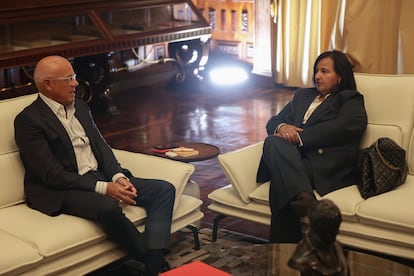
An unexpected figure has emerged in the ongoing efforts to achieve a political transition in Venezuela following the capture by U.S. forces of President Nicolás Maduro in January and the ensuing U.S. tutelage of the country. Dinorah Figuera, an exiled lawmaker and elected president of the parallel opposition National Assembly that emerged after the 2015 parliamentary election, returned to Caracas this Thursday after living abroad for eight years. Her return, one of the goals of which is to push for the renewal of the National Electoral Council (CNE), is backed by U.S. President Donald Trump and has the approval of Delcy Rodríguez’s government in Venezuela. This move shifts the spotlight away from the opposition’s leading figure, María Corina Machado.
After landing at the airport, Figuera told reporters that she had come at the invitation of the U.S. State Department “to take on the challenges of resolving differences, while seeking common ground and consensus on the issue of establishing a credible CNE.” She also stated that the work entrusted to her is “for all the candidates,” thereby avoiding answering whether the initiative had been coordinated with Machado.
The first meeting of these negotiations took place this Thursday. It was held at the National Assembly, presided over by its chief, Jorge Rodríguez, who was appointed by his sister Delcy to initiate a “political dialogue.” An official statement reported that a “joint technical and political committee” was created with representatives of opposition lawmakers from the 2015–2020 Assembly, which Chavismo has refused to recognize and has been boycotting for years. The statement adds that there is an agenda with specific milestones and timelines for the “strengthening of democracy, the consolidation of peace, and the pursuit of a future of well-being and prosperity.” Figuera also met with U.S. Chargé d’Affaires John Barret.
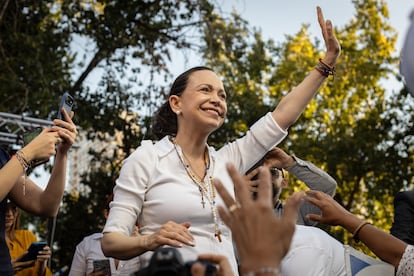
Figuera arrived in Caracas just a few weeks after the Plataforma Unitaria—which brings together the main opposition parties—had decided that Machado, the country’s most popular opposition figure, would lead negotiations with the Chavistas to call for elections. The return of Figuera has taken by surprise members of that platform—of which Primero Justicia is also a member—and Machado’s inner circle. The move, carried out without the knowledge of some of the opposition allies, appears to reinforce the strategy by Washington and Caracas to initiate a political opening with other sectors of the opposition without involving Machado.
Two other statements have been issued regarding this meeting. The 2015 National Assembly explained in seven paragraphs that the central objective of the process will be “the construction of a shared vision of the future.” The U.S. State Department, for its part, welcomed the meeting and stated that it represents “a first step” toward ensuring a “free Venezuela” and a “roadmap for a democratic transition.” “The cornerstone of any transition is inclusive dialogue,” states the text by Thomas Pigott, spokesperson for Marco Rubio. “We hope that in the coming weeks, talks will continue between Venezuelan political parties and the interim government in Caracas to begin their work.”
Figuera’s arrival comes two months after the Primero Justicia party leader met with Michael Kozak, the Senior Bureau Official for Western Hemisphere Affairs, to discuss “pathways toward a stable, orderly, and consolidated democratic transition” in Venezuela. Various sources in Caracas interpret this move as a strategy by Chavismo—with Washington’s approval—to promote an alternative opposition leadership to Machado’s and thereby weaken her role as a negotiator.
The United States maintains ongoing negotiations with the government of Delcy Rodríguez, which began after the January 3 military operation when U.S. special forces captured Nicolás Maduro and his wife Cilia Flores.
Both the Unidad Platform and Machado have demanded that an electoral timetable be announced, a matter that Chavismo has postponed while it focuses on opening the country to foreign investment and meeting Washington’s demands. The path to free elections, as the opposition demands, involves renewing the electoral arbiter and legalizing political parties that Chavismo removed from the playing field through the courts. Machado herself has estimated that 40 weeks are needed to organize presidential elections capable of unblocking the political crisis.
Henry Alviárez, a leader of Vente Venezuela, Machado’s party, told EL PAÍS he does not know the terms of the talks with Figuera but maintains that the negotiation process can have several layers and interlocutors. “None of the parties —not even María Corina Machado herself, with all her legitimacy and the respect she commands— is in a position to go against what the Venezuelan people want: understanding, democratic expression and resolution of the conflict through elections,” he said. In that sense, he argued that the emergence of a possible new electoral arbiter helps dispel uncertainty about whether Venezuela can achieve change within “a framework of peace and understanding.”
Figuera was one of the lawmakers elected in December 2015, when the opposition won its first electoral victory over Chavismo with a qualified majority in Parliament. She is part of the institutional remnants of Juan Guaidó’s interim government, which in 2019 set up a parallel management structure backed by the powers of that National Assembly. Faced with Maduro’s illegitimacy — re-elected in polls not recognized by the international community — that Parliament received the endorsement of the first Donald Trump administration to administer some Venezuelan assets frozen abroad. They represented the only authority considered legitimate — the last elected in polls validated by all parties — and acted on matters such as preserving Citgo, PDVSA’s U.S. subsidiary, against pressure from the creditors of a country in default.
Although Guaidó’s interim government disintegrated after failing to remove Maduro from power, the 2015 National Assembly continued to hold sessions in exile via Zoom through its delegated commission, a reduced committee in which only three lawmakers are currently active. In Venezuela, meanwhile, Chavismo renewed Parliament twice to place it under its control. In the current situation, with debt renegotiation and the recovery of Venezuelan assets on the table, resolving the legal tangle left by those years of dual administration is crucial.
Figuera remains president of the delegated commission of that National Assembly elected more than a decade ago. For years, the Assembly elected in 2015 was targeted by Chavismo: the Supreme Court blocked its functioning by declaring it in contempt, investigations were opened, parliamentary immunities were lifted and arrest warrants were issued against several of its members, accused of having appropriated Venezuelan funds abroad.
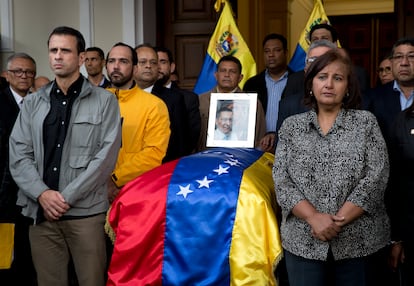
Figuera had been in exile since 2018. The custodial death of her party colleague Fernando Albán at the hands of the Bolivarian Intelligence Service affected her personally: he was godfather to her daughter. According to the official version of events, Albán “fell” from the 10th floor of the agency’s headquarters. Amid protests over that death, Figuera sought refuge in the French embassy and later fled to Spain, where she was granted asylum. The politician has since worked in Valencia, caring for elderly people.
Delcy Rodríguez faces a constitutional hurdle in a few weeks: July 5 marks 180 days of her government, the Constitution’s deadline for an interim administration. Rodríguez, who had been Maduro’s vice president until January 3, was appointed president by the Supreme Court, which avoided declaring a permanent vacancy — since it would have required calling elections — and ruled Maduro’s legal situation to be an “forced absence.”
Sign up for our weekly newsletter to get more English-language news coverage from EL PAÍS USA Edition









































