
Trump’s paradox in Venezuela: Supporting a regime he promised to overthrow
Washington has blocked opposition leader María Corina Machado’s return after the earthquake while backing the controversial handling of the disaster by Delcy Rodríguez’s government
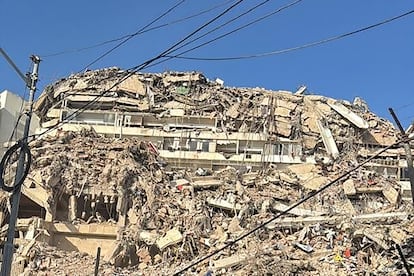

The U.S. State Department was unequivocal in its statement last week regarding the Venezuelan government’s response to the earthquakes that have claimed more than 2,300 lives. “The interim authorities have fully complied to accelerate this massive humanitarian response,” the statement said, despite sharp criticism from citizens over obstacles and delays in rescue operations and the entry of humanitarian aid.
Six months after the military operation that captured Nicolás Maduro in January and installed his former vice president, Delcy Rodríguez, as Venezuela’s leader, U.S. President Donald Trump faces an apparent paradox. He regards the intervention in the South American country as the crowning achievement of his foreign policy and a possible model for future actions, including in Cuba. Yet in shoring up that supposed success, he has increasingly aligned himself with the very Chavista regime he had targeted since his first term, as cracks in his relationship with María Corina Machado — the opposition leader who, according to Washington, won the 2024 election — are growing more evident.
Gone are the early days of the intervention, when Trump warned Rodríguez that if she did not follow Washington’s orders to the letter, she would face a “worse” fate than Maduro, who is now awaiting trial in a New York jail.
Over the past six months, the Republican administration and Trump himself have become convinced that the regime is willing to bend to their wishes to remain in power and accept Venezuela’s status as a supervised state. Such an outcome would have seemed impossible during Operation Southern Lance, when the United States targeted Venezuela with airstrikes against alleged drug-trafficking boats and urged Maduro to step down and go into exile.
Now, Venezuela has been turned into a “de facto protectorate,” says Francesca Emanuele of the think tank Center for Economic and Policy Research (CEPR).
The country’s oil sector, the engine of its economy, is now under Washington’s control. Oil exports are managed through an account at a U.S. bank in New York. Trump, who boasts that “people are dancing in the streets” in the parts of the country unaffected by the earthquake, has publicly claimed that the share of the proceeds received by the United States has already repaid the cost of the January 3 operation several times over.
Meanwhile, official Venezuelan figures show that oil revenues in the first quarter of the year amounted to roughly $5.5 billion — slightly more than in Maduro’s final years in power, but still below the levels reached before the sanctions era.
In addition, Caracas is preparing to restructure its enormous sovereign debt — around $240 billion, the largest debt restructuring since Greece’s in 2012 at the height of the financial crisis. The move is seen as essential to returning Venezuela to international capital markets.
But the debt sustainability analysis is not being carried out by experts from the International Monetary Fund (IMF), as would normally be the case. Although the IMF says it remains in technical contact with Caracas, the assessment is being prepared by a U.S. consulting firm, Centerview Partners, which has been hired as adviser. That has fueled concerns among members of the Venezuelan opposition that the process could leave the country more vulnerable to its creditors.
Emanuele also points to the military operation on Venezuelan soil that killed the leader of the Tren de Aragua gang, known as “Niño Guerrero,” which Trump himself said had been carried out on his orders.
“That highlights the degree of subordination that exists in Venezuela,” says Emanuele.
Even in Trump’s own view, Venezuela has become the most extreme example of the so-called “Donroe Doctrine” embraced by the United States — a reference to the Monroe Doctrine, which was historically used to justify U.S. interventionism in its “backyard.”
Under the Trumpian interpretation, the doctrine treats the Americas as “their” continent and makes the region the central priority of U.S. foreign policy. Friendly leaders and governments are rewarded, while regimes regarded as hostile are threatened with the possible use of military force.
“Trump’s alignment with the new dictator follows the logic of his America First philosophy, which leaves little room for democratic values,” says Benjamin Gedan, director for Latin America at the Stimson Center and former head of South America affairs at Barack Obama’s National Security Council. “After all, what matters to Trump in Venezuela is not the freeing of political prisoners or a democratic transition, but an obedient government that facilitates oil and mining projects controlled by U.S. companies. In other words, a fusion of the Chamber of Commerce and Southern Command.”
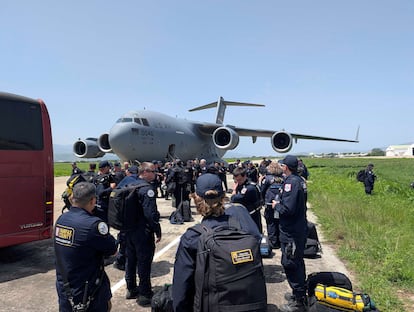
As a showcase for that policy, the United States has sought to throw its full weight behind Venezuela following the two earthquakes of June 24. The Republican administration has delivered aid quickly and on a large scale. It has pledged $300 million in humanitarian assistance. The Pentagon deployment involves around 2,000 personnel, focused on rescue operations and the distribution of essential supplies. According to the head of U.S. Southern Command, General Francis Donovan, the operation is likely larger than the one mounted after Hurricane Melissa struck Jamaica last November, though smaller than the response to Haiti’s 2010 earthquake.
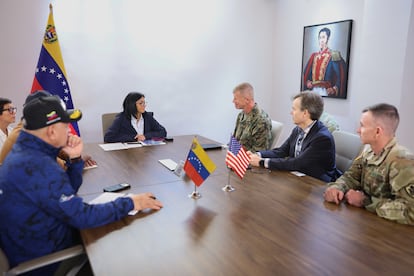
At the same time as it deploys — and publicly promotes — its aid effort, Washington has backed the performance of Rodríguez’s government in Caracas.
“I saw before the earthquake a willingness by the interim government to cooperate with us. That has not changed after the earthquake,” defended the chargé d’affaires heading the U.S. Embassy in Venezuela, John Barrett, in a televised interview. Barrett also said Washington had “a great deal of confidence” in the Venezuelan authorities, which he said had shown “great transparency.”
Meanwhile, General Donovan has excused shortcomings in Caracas’s response on the grounds that the current government is contending with “decades of underinvestment.”
The U.S. administration has been as effusive in its praise of Rodríguez’s government as it has been critical of Machado’s attempts to return to Venezuela at this time. The opposition leader, who has been living in exile since secretly leaving the country last December to collect her Nobel Peace Prize in Oslo, has made two attempts to return since the earthquakes.
Machado and her team insist that she does not intend to campaign, but rather to help coordinate relief efforts. The Trump administration, however, opposes her return for now.
“Adding politically sensitive matters to this situation at this time is counterproductive to our response efforts after this tragedy,” a State Department spokesperson said last week.
“Trump is delighted to deal with an authoritarian government that accedes to every demand and has no interest in changing that for the unpredictability of a political transition that would likely lead to a more independent Venezuela,” says Phil Gunson, Crisis Group’s chief analyst for the Andean region.
But Gunson, who is based in Venezuela, adds that “Washington’s refusal to approve Machado’s return at this time, even if motivated by self-interest, is not necessarily a bad thing. The immediate focus now should be rescue work, and Machado’s interests are primarily political.”
The United States says its plan for Venezuela consists of three phases: stabilization, economic recovery and transition. Free elections will be held only in the final phase.
According to Barrett, the plan continues despite the earthquakes. “It looks a bit different now, of course, given the destructive quakes, but economic recovery had already begun,” he said at a conference call press briefing this past Wednesday. “Right now I am focused on saving lives, but we will return to phase 2 and to Venezuela’s economic recovery.”
“There is no doubt that Trump has been generous in his earthquake response. But everything indicates his primary goal is to preserve a supposed foreign policy victory, measured in barrels of oil per day and new investments,” Gedan says. “For Trump, María Corina Machado’s return would jeopardize all of that, by introducing the possibility of political violence or at least the uncertainty inherent in any truly democratic process. Under these circumstances, Trump prefers the stability of strongman rule, despite the repression, corruption, incompetence and Delcy [Rodríguez]’s very low popular support — his ‘new friend and partner.’”
For the time being, Gunson notes, public opinion in Venezuela remains favorable toward the United States. Trump and his secretary of state, Marco Rubio, are far more popular there than Rodríguez.
“For now, the general perception of the United States and its relief work appears positive, in stark contrast to how people view the government’s lack of response. Machado, meanwhile, has lost some support, though she remains by far the most popular politician,” the analyst says. “How things will develop as we return to a more normal situation remains to be seen. But if the United States is perceived as propping up Delcy Rodríguez in power indefinitely, those opinions could change.”
Sign up for our weekly newsletter to get more English-language news coverage from EL PAÍS USA Edition









































