
The United States on María Corina Machado’s attempts to return to Venezuela: They are ‘counterproductive’
Edmundo González, the opposition candidate in the 2024 election, insists the Nobel Peace Prize laureate has the right to return
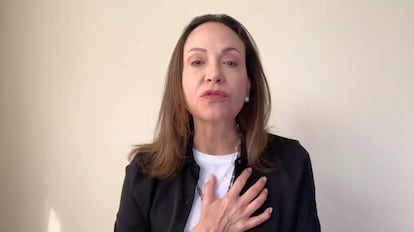

Friction between the Donald Trump administration and María Corina Machado is becoming increasingly apparent. The Venezuelan opposition leader is intent on returning to her country — especially now after the earthquakes that have left nearly 2,300 dead and 11,000 injured. The U.S. government has aligned itself with acting President Delcy Rodríguez and insists this is not the time. Attempts by the Nobel laureate to return now are “counterproductive,” a State Department spokesperson told this newspaper.
The opposition, meanwhile, insists that Machado must be allowed to enter her country. In a social media post, Edmundo González, the opposition movement’s presidential candidate in the July 2024 election, argued that “there are principles that are not open to negotiation.”
“Every Venezuelan’s right to enter, remain in and return to their own country does not depend on authorization from those in power,” he said, in an apparent reference to the ban that Machado says Caracas has imposed on her return. Machado, he added, “has the right to enter Venezuela.”
Hay principios que no admiten negociación.
— Edmundo González (@EdmundoGU) July 2, 2026
El derecho de todo venezolano a entrar, permanecer y regresar a su propio país no depende de una autorización del poder. Es un derecho reconocido por la Constitución y por el derecho internacional de los derechos humanos.…
Machado had attempted to return to Venezuela the previous weekend. Her plan was to travel first through the island of Curaçao, essentially retracing the route she took in reverse when she left Venezuela last November on her way to Oslo to receive her Nobel Peace Prize. But the private plane she was travelling on was ordered to turn back while still in U.S. airspace.
“Dutch authorities, who handle Curaçao’s foreign affairs, initially believed the U.S. backed her trip but withdrew permission for the plane to land” after Washington made clear it did not back it, The Wall Street Journal reported, citing “people familiar with the matter.”
After that failed attempt, U.S. Secretary of State Marco Rubio relayed the Trump administration’s view to Machado: that while they would not prevent her return, it was not the moment to try, since all attention and resources needed to be dedicated to rescue efforts.
“The Trump administration is focused exclusively on continuing our efforts to respond to the devastating earthquakes in Venezuela,” a State Department spokesperson said Thursday about Machado’s attempts to return. “Adding sensitive political issues to this situation at this time is counterproductive to our relief efforts following this tragedy.”
Despite the U.S. position, Machado decided to try again. This time she flew from Panama last Sunday. There, Copa Airlines refused to let her board, fearing potential reprisals from the Venezuelan government. From the Central American country, the Nobel laureate posted a video on social media in which she expressed her determination to return to Venezuela. She said she wanted “to face this catastrophe together as a united family would when one of its members suffers.”
“Very soon I will be back in Venezuela, alongside the Venezuelan people,” she said, and added that she could not reach her country because the government in Caracas had closed airspace to prevent her entry.
Since the U.S. military operation that captured Nicolás Maduro on January 3, Machado has spoken often of her desire to return to Venezuela as soon as possible, both in public statements and in meetings with a range of figures in the United States: from President Donald Trump, to whom she gave her Nobel medal in January, to lawmakers of both parties, including Rubio and other administration officials. But the response has consistently been the same: it is not yet the right time; the situation is not sufficiently stable. “Her timetable is not the administration’s timetable,” admit members of Congress who support the opposition leader.
The White House has chosen to back Delcy Rodríguez, Maduro’s former vice president, despite the unpopularity of the Chavista regime and the criticism Caracas has faced over its handling of the disaster response. The U.S. administration believes that supporting the former vice president is, for now, the best way to preserve stability in Venezuela. Trump has publicly said that, at present, Machado does not have enough domestic support to lead the country in this phase, while he has praised Rodríguez for following Washington’s instructions.
The U.S. government says it supports holding elections in the South American country, but insists that political and economic stability must be restored first so that the vote can be conducted with adequate guarantees.
In the immediate aftermath of last week’s earthquakes, Trump promised swift and substantial assistance to Venezuela. Washington has since announced $300 million in humanitarian aid — double the amount initially pledged — deployed search-and-rescue teams with highly trained dogs, and established a Disaster Assistance Response Team (DART), among other measures.
“This is, by really any estimate, at this point the largest response to any natural disaster the United States has mounted in this century in terms of personnel on the ground, money out the door [and] speed,” said Jeremy Lewin of the State Department’s Office of Humanitarian Assistance. That office has taken over functions previously carried out by the U.S. development agency, USAID, which the Trump administration dismantled last year.
Speaking during a conference call with reporters on Wednesday, John Barrett, chargé d’affaires at the U.S. Embassy in Caracas, defended the Venezuelan government’s handling of the disaster, saying that “local authorities have fully complied with our requests and have accelerated this massive humanitarian response.”
Sign up for our weekly newsletter to get more English-language news coverage from EL PAÍS USA Edition









































