
Germany divided over proposals to outlaw the far right
Regional election campaigns have revived efforts to seek a declaration that AfD is unconstitutional
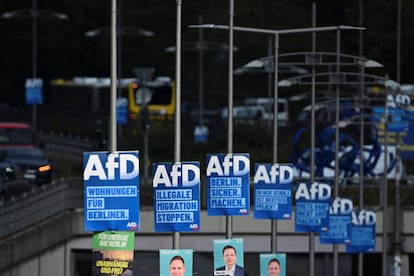

Can Berlin declare Alternative for Germany (AfD) unconstitutional? What would be the consequences of banning the far-right party, the Bundestag’s largest opposition force? Those questions have recurred in Germany in recent years as the radical party has grown electorally. Upcoming regional elections in the east of the country, where polls give AfD a chance to govern for the first time, have revived the debate among politicians and jurists about the options for containing a party they regard as a threat to democracy.
The Social Democrats (SPD), which govern Germany in coalition with the center-right CDU and CSU, reopened the issue this August in an article by SPD co-leader Lars Klingbeil in the weekly Die Zeit. “Independent scholars have shown that AfD is planning to destroy our democracy and rule of law,” Klingbeil wrote. “The banning of the party is not only an option, it is a democratic duty to protect our country.”
The SPD leader was referring to conclusions in a report published in June by eight jurists from the NGO Society for the Protection of Freedom Rights (Gesellschaft für Freiheitsrechte, GFF), which finds that AfD violates this clause of Article 21 of the Basic Law: “Parties that, by reason of their aims or the behaviour of their adherents, seek to undermine or abolish the free democratic basic order or to endanger the existence of the Federal Republic of Germany shall be unconstitutional.”
GFF collected 2,500 pieces of evidence, including party documents, statements by its representatives, and social media posts, which the organization says prove that “it is a party that deliberately works to dismantle the liberal democratic order.” GFF asserts that AfD has explicitly stated in multiple messages that, if it comes to power, it will persecute political opponents, the Muslim population, Germans with foreign roots, and the LGBTQ+ community.
AfD’s rise to power appears close — at least in the government of the state of Saxony-Anhalt, which holds elections this September and where polls suggest the extremist party could even win an absolute majority. It could also be the victor in September’s vote in Mecklenburg-Western Pomerania, although in that case it is unlikely to secure a large enough majority to form a government.
Germany is watching the far right’s potential rise to power with concern. One sign is an article published this August by Sven Hüber, vice president of the Police Union (GdP), in the union’s magazine. Hüber called on the Saxony-Anhalt state police to be prepared to refuse to follow orders from a possible AfD government if it believes those orders violate democratic principles. Hüber cites Article 91 of Germany’s Basic Law, which states that it is the police’s duty, with support from the federal government, “to avert an imminent danger to the existence or free democratic basic order of the Federation or of a Land.”
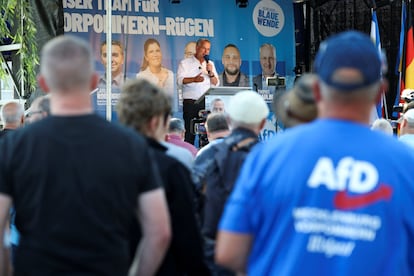
The September elections (the Berlin executive is also being chosen) have revived calls for the federal government or the Bundestag to refer an application to the Federal Constitutional Court to ban AfD. Under German law, either the executive or the legislature can file such an application. If the legislature files it, only a simple majority is required. The main obstacle is that the CDU, Chancellor Friedrich Merz’s conservative party, opposes a ban. Without the CDU, there is no majority to take the matter to the Constitutional Court.
“Victim myth”
The CDU’s position is that a hypothetical ban on AfD, besides being extremely difficult, would do little to solve the problem and could even make it worse, and as such it is better to fight AfD’s ideas politically. One of the clearest exponents of the Christian Democrats’ argument is MP Christoph Ploss: “There are many constitutional hurdles to outlawing a political party, and a ban proceeding, especially if it ultimately fails, would further reinforce the victim myth nurtured by AfD, which could ultimately benefit them politically.” Ploss’s remarks were made on the citizen watchdog site Abgeordnetenwatch.
Federal Germany has outlawed only two political organizations in its history. In 1952 the Constitutional Court banned the Socialist Reich Party (SRP) as it was considered the successor to the NSDAP, the Nazi Party; and in 1956 it declared the Communist Party illegal. The most recent attempt to ban a party failed in 2017, when the Constitutional Court did not ban the NPD, an extremist party with neo-Nazi origins. The court found that, while the NPD held unconstitutional positions, it did not constitute a sufficient threat to democracy.
More than 1,000 jurists signed a letter in July addressed to the government and the Bundestag calling for them to file a ban request with the Constitutional Court. Led by the Republican Lawyers Association (RAV), the document says the GFF report contains enough evidence to warrant such a move.
Germany’s domestic intelligence service, the Office for the Protection of the Constitution, presented a report to the Bundestag in 2025 concluding that AfD was a “right-wing extremist” party. That designation allowed authorities to monitor the organization’s meetings and events. But last February a court ruled that AfD could not be classified as such. The judge stressed in the ruling that, based on the evidence presented, “there is sufficient certainty” that AfD shows “efforts against the liberal democratic order,” but not as a premeditated strategy by the organization as a whole, rather by some of its members.
Both the Republican Lawyers Association and GFF criticize the Office for the Protection of the Constitution’s report as incomplete. The jurists say the intelligence service focused only on AfD’s Islamophobia and its racially charged, Nazi-adjacent use of the concept Volk, or “people.”
GFF proposes broadening the allegations of AfD’s anti-democratic behavior to include an alleged strategy to persecute political rivals, ethnic groups, and other minorities. Its study compiles numerous far-right messages calling for the imprisonment of former chancellor Angela Merkel for allowing the admission of Afghan and Syrian refugees, or calls for jailing members of former chancellor Olaf Scholz’s government over alleged fraud schemes or for supposedly placing the public interest at the service of pharmaceutical companies during the second phase of the Covid pandemic.
Vague criteria
There are political opponents of AfD and academics who warn that these messages, without concrete actions, are not enough to outlaw the party. “The criteria for determining whether a party is unconstitutional are still not sufficiently defined; specifically, there is no clear distinction between the unconstitutionality of individual political demands and the unconstitutionality of the party itself,” write Elisa Hoven, a law professor at the University of Leipzig, and Frauke Rostalki, a professor at the University of Cologne, in an essay published this August.
“Very often, statements by a politician are limited to listing positions that may be politically reprehensible, but that do not meet the high constitutional standards required to deem a party unconstitutional,” the two jurists add. Hoven and Rostalki also warn that banning parties carries “a particularly high risk of instrumentalization for partisan political and ideological ends.”
Banning AfD is not the solution, argues Victoria Gulde, director of studies at the Amadeu Antonio Foundation, in a summer analysis. The foundation is named after an Angolan-born citizen who was murdered in 1990 in a racially motivated far-right attack. Gulde expresses sympathy for banning AfD, but says even then the underlying problem would persist: “Suppose a ban is requested and, after several years, the Federal Constitutional Court rules in favor. AfD and its affiliated organizations are outlawed. All party structures are dissolved, all MPs lose their seats and the party’s assets are confiscated. But that does not make AfD politicians or members disappear. Nor does it eliminate the anti-human rights and anti-democratic attitudes of millions of voters.” “AfD is not the cause of the problem; it is a symptom,” Gulde concludes.
Sign up for our weekly newsletter to get more English-language news coverage from EL PAÍS USA Edition









































