
How could it have happened? The fundamental question about Nazism that continues to haunt Germany
Veteran historians such as Winkler, Aly, and Longerich address in their new books ‘the question of all questions, about the avoidability of the National Socialist dictatorship’
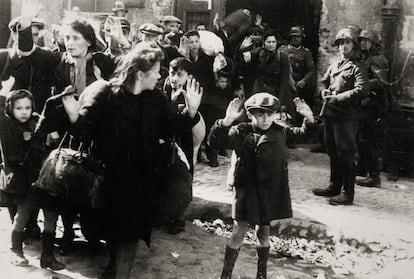

How could it have happened? That is the question. German historians, like Captain Ahab with the white whale, continue to obsessively pursue it. More than 80 years after the end of Nazism, they still haven’t found a definitive or complete answer.
“Any answer to the question of why things happened this way is subject to scrutiny of the sources,” responds Heinrich August Winkler, patriarch of German historiography, with scientific rigor. “If new sources and knowledge emerge that lead to new conclusions, then the answer must be supplemented and, if necessary, corrected.”
Winkler has recently published a memoir entitled, precisely, Warum es so gekommen ist (How did it come to this?), in which he addresses his trajectory as an intellectual, and also the fundamental question, “the question of all questions since my student days.” “It is the question,” he clarifies, “about the avoidability of the greatest catastrophe in German history, the dictatorship of National Socialism.”
Another veteran historian, Götz Aly, has published a similarly titled volume, Wie konnte das geschehen (How could it have happened?). Both new publications coincide in bookstores with another extensive study by Peter Longerich, biographer of Himmler, Goebbels, and Hitler, titled Unwillige Volksgenossen (Reluctant Compatriots). Longerich poses the same question but finds a contrasting answer: Germans were largely skeptical of the Hitler regime and its ideology, and only repression, propaganda, and opportunism can explain the massive adherence.
“Without democracy, there would have been no Hitler,” Aly remarks in his Berlin office, a statement that initially throws his interlocutor off balance. A large window overlooks the fascist-style building that once housed Joseph Goebbels’s Ministry of Propaganda; today it is the headquarters of the Ministry of Labor and Social Affairs. In the imperial era, before the Weimar Republic, or in an authoritarian system, according to this argument, a political entrepreneur like Hitler, who rose from humble beginnings and had no connections, could hardly have successfully founded a movement like the National Socialist German Workers’ Party (NSDAP). He would hardly have been able to seize power. “With the Kaiser, there would have been no Hitler,” Aly says. “Democracy was the prerequisite.”
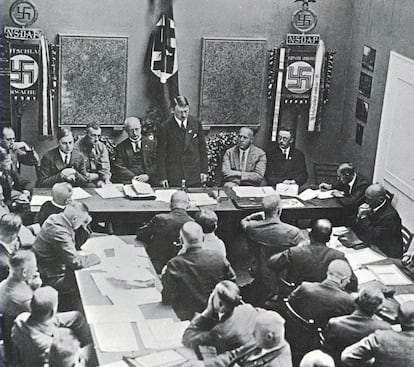
Aly mentions other “preconditions” that explain the rise of Nazism. One is the baby boom between 1900 and 1915, “the largest population growth in German history,” thanks to advances in hygiene and medicine. In 1933, when the Nazis came to power, Goebbels was 35; Reinhard Heydrich, 28; Albert Speer, 27; Adolf Eichmann, 26; and Heinrich Himmler, 32. “It was a young party and a young dictatorship,” he summarizes.
Because of their youth, the generation born between 1900 and 1915 emerged relatively unscathed from the Great War, while their parents were killed or left wounded and traumatized. “Many felt that the NSDAP had educated them,” the book states. “Most young people, on both the left and the right, wanted utopia instead of pragmatism, decisive and unreserved action instead of convoluted and complicated compromises through democratic procedures.”
Another “prerequisite,” according to Aly, is the democratization of education. “Everyone wanted to get ahead,” he explains, referring to this overabundance of young people, better educated than ever before, who migrated from the countryside to the city and rose socially. But the economic crash of 1929 halted this upward mobility, and envy arose toward their Jewish fellow citizens, whom the Nazis identified as competitors.
The historian adds that museums, films, and memorials have tended to focus on the direct perpetrators, such as a criminal gang at the top of the regime, or on the victims, identifying with them. But the rest are usually overlooked: “The millions of active and passive sympathizers, the indifferent, the interchangeable followers, and the hundreds of thousands of active executors at the drawing boards, in logistics, in the administration, and at the sites of mass extermination.”
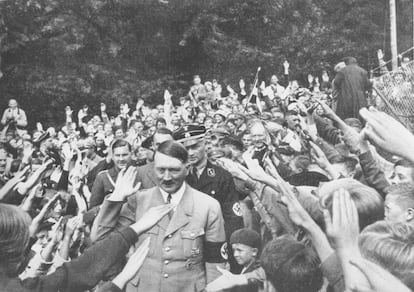
German society is the subject of study in Peter Longerich’s Unwillige Volksgenossen, where he analyzes thousands of documents in which the NSDAP and government administrations gauged public opinion. The reports record complaints on a wide range of issues, from working conditions to fear of war.
“The regime’s racist extermination policy met with mostly negative reactions from the population,” Longerich writes. In his memoirs, Winkler recalls his childhood in a conservative but non-Nazi family, and remembers that after the war his grandmother told him: “We noticed fewer and fewer people in the street wearing the Jewish star, and we suspected something terrible had happened to them.” According to Longerich, “one cannot speak of a generalized Nazification of German society.”
Aly believes it’s a mistake to conclude from the reports that disaffection was widespread, arguing that they served the regime’s purpose of reacting preemptively to potential pockets of discontent. He cites the example of the 15% pension increase in 1941, a pivotal year in World War II. “The measure,” he points out, “wasn’t financed by the working population, but by slave laborers.” The aim was to quell the unrest among pensioners, who had lived through the previous war and didn’t want another one. The message was: Hitler was taking care of them. And it worked.
“The truth is that the NSDAP had more than eight million members, with an average age of 34, and 18 million German soldiers served in the Wehrmacht,” says Aly. “This means that among those of us who were born in 1947, 95% of us had a parent who was in Russia or elsewhere and witnessed war crimes, at the very least, if not participated in them or did nothing to stop them.” The Nazis “found their base at the heart of society.”
Any German can check using the search tool that the weekly newspaper Die Zeit has been offering on its website for the past few days. It allows users to find out if an ancestor was a member of the Nazi party, and for many, it has come as an unpleasant surprise. “I feel betrayed by my father. When he spoke about the Nazi years, it always seemed as if he had been a victim,” says Margrit Braig-Kienzle in one of the testimonies that Die Zeit has collected from those who have discovered, thanks to the search tool, that their parents or grandparents were members of the NSDAP.
In addition to the books by Aly, Longerich, and Winkler, there is another new release: Schreiben in finsteren Zeiten (Writing in dark times), by Helmuth Kiesel, a history of German literature during Hitler’s years in power.
“The twelve years following 1933, under the shadow of the swastika, placed such a heavy burden of political demands, pressures, and hardships on authors that the preservation of literary qualities and the development of narrative, dramatic, and lyrical forms were considerably hampered,” writes Kiesel, professor emeritus at Heidelberg. The great literature of the period was that of the exiles, along with that of Thomas Mann and Bertolt Brecht. “A dictatorship does not produce good literature. It stifles and prevents it,” comments editor and essayist Thomas Sparr, who reviewed Kiesel’s book in the journal Volltext, in an email.
Kiesel describes, at the end of over 1,000 pages, how Nazism is a recurring theme in the postwar period and even today. “It was impossible to escape the sphere of influence of what Thomas Mann called ‘the brief and somber historical episode that bears the name of Hitler,’” he states. “If it truly was an episode, it was one of cultural, social, and historical convulsions of such profound force that historical, political, and ethical reflection necessarily returns time and again to this rupture of civilization and the conditions that made it possible.”
It is the past that never truly passes, and the question remains unanswered. Even as those who lived through it die, the far right continues to echo, and an impossible oblivion seems imminent. “To draw a line under the catastrophe of the years 1933 to 1945 would mean trying to suppress the darkest chapter in German history. The consequences would be catastrophic,” warns Winkler in an email. “The willingness to engage critically with German history is part of our identity. For the Federal Republic of Germany, that this remains the case is a categorical imperative.”
Sign up for our weekly newsletter to get more English-language news coverage from EL PAÍS USA Edition









































