
The abrupt end of the amnesty law frustrates hopes of freedom in Venezuela
Delcy Rodríguez’s announcement has sparked controversy and a widespread sense that the measure fell short
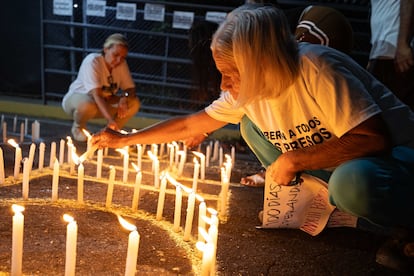
The end of the amnesty law in Venezuela, announced by the acting president, Delcy Rodríguez, last week, has left the country with a balance marked by partial relief, controversy, and a sense that the measure fell short.
Of the more than 12,000 applications received in two months, 8,616 people have benefited from the amnesty, according to the Chavista regime, a figure difficult to verify. The vast majority were people who were free but subject to restrictive precautionary measures. Only 314 people were actually released from prison, according to the government. Independent organizations put that number at 110.
Now, with the amnesty no longer in effect, 473 political prisoners remain incarcerated — 43 of them foreigners or dual nationals — according to the NGO Foro Penal. The civil association Justicia, Encuentro y Perdón (JEP) raises the figure to 676 prisoners, including 187 military personnel and 34 foreigners.
In addition, there are hundreds of people who have to continue appearing in court or are subject to precautionary measures that prevent them from accessing jobs or returning home.
Two months after it took effect, prisoners linked to military rebellions and conspiracy charges in recent years were excluded from the amnesty law. Among the most well-known cases are those involved in Operation Freedom — the April 30, 2019 uprising called by Juan Guaidó and Leopoldo López from the La Carlota air base, which ended without the expected military support — and Operation Gideon — the failed maritime incursion from Colombia in May 2020 aimed at capturing Maduro.
Those accused of operating the drones used in the August 2018 attack against Maduro during a military event have also been excluded, as have police officers imprisoned for the failed coup of April 11, 2002 against Hugo Chávez.
Most of these plots took shape after 2018, when, according to the opposition, the Chavista government began relying on electoral maneuvers to stay in power.
There are also many civilian detainees — mostly unknown to the public — accused of conspiracy, criminal association, or post‑election violence. Others have been charged with promoting foreign intervention in the country, an exception that seemed tailored for opposition leader María Corina Machado and her associates.
“We’re still going through this ordeal, my whole family and I. For now, we can’t do anything; they’ve told us to wait,” says Carla, whose husband, a manager at an oil company, was accused of conspiracy and terrorism and received no legal benefits. “Time helps. It’s happened with other legal cases over the years.” A resident of eastern Venezuela, Carla has had to move to Caracas with her family and hasn’t been able to return home.
The process that led to the amnesty law generated enormous expectations and opened a window of optimism in Venezuelan society. Since January 3, the Chavista government — under pressure from the United States — has made significant concessions to the political opposition and the democratic sector, while also working hard to draw very clear limits to any opening. Delcy Rodríguez’s announcement ending the amnesty has produced sadness and anger, though little surprise.
“The fundamental flaw in this law lies in its exclusion of the crime of rebellion, which is precisely the most important factor to consider in amnesty processes,” says Marino Alvarado, director of the Venezuelan Program for Education-Action in Human Rights (Provea). The end of the amnesty does not necessarily mean that there cannot be more releases, says Alvarado. “Delcy Rodríguez could rely on the presidential pardon, which in the Venezuelan case can be granted at any stage of the judicial process.”
Aurora’s son — who asks that his real name not be published — remains imprisoned and has not benefited from the law. Accused of participating in Operation Gideon in 2020, he is a soldier serving a 24-year sentence for rebellion in El Rodeo prison, under very harsh conditions. “We will continue fighting. We knew this could happen. It has been very hard, but we are not going to give up,” his mother affirms. “Some time ago, we were fighting to get proof of life. At least they listened to us. We will continue here until justice is served.”
Martha Tineo, from JEP, says that the text of the amnesty law was “quite exclusionary” and that “a very high number” of cases were left out. “For the regime, it will always be useful to have a number of hostages: it allows them to breathe during times of maximum external pressure, like those of recent years. The criteria for the amnesty were quite arbitrary,” she maintains.
Tineo insists that the real number of political prisoners in the country is higher than people think: “We have at least 672 documented cases. We have long maintained a figure that differs from Foro Penal, by about 200 cases. This is due to the underreporting of people who didn’t report out of fear and who have come forward since January 3.”
Journalist Carlos Julio Rojas, from the Red de Expresos Políticos (Network of Political Prisoners) — who has been denied full release — has denounced what he calls “a perverse selectivity” in the law’s application. “Waves of denials in the courts, cases shelved for weeks, and new arrests of union leaders,” he says.
Full release was also denied to Javier Tarazona from the NGO Fundaredes; Carlos Correa of the free‑expression group Espacio Público; and journalists Johnattan Carrillo, Luis López, and Rory Branker, among other civil society figures.
In broad terms, public debate has returned to the country and censorship is losing ground. The Chavista government is being openly criticized. There is speculation about election dates, and talk of a political transition is no longer taboo. Opposition politicians have begun organizing tours. The picture, however, is far from uniform: the government continues to fine media outlets, restrict criticism, and repress protesters. Andrés Velásquez, a well‑known opposition leader, reported seeing the National Bolivarian Police once again circling his home in Puerto Ordaz.
Juan Carlos Apitz, dean of the Law School at the Central University of Venezuela, argues that the end of the amnesty law amounts to “an admission of its failure.” These decisions, he says, taken without elections on the horizon and without solutions to the country’s underlying problems, “set the stage for a new round of selective repression.”
The political opening underway in Venezuela — including the amnesty law itself — emerged after Nicolás Maduro’s capture on January 3. The task has fallen to a specific faction within the ruling PSUV party. Figures such as Jorge Rodríguez, his sister Delcy Rodríguez, lawmaker Jorge Arreaza, and former minister Ernesto Villegas have been charged with creating spaces for dialogue, seeking neutral intermediaries, and even offering apologies. This same group has organized the Dialogue for Peace and Democratic Coexistence initiative with tolerated opposition sectors, and, according to Rodríguez, will now be responsible for reviewing the remaining petitions from prisoners still awaiting resolution.
But other factions within the party have very different styles — and far less patience. The party’s orthodox wing, represented by leaders such as Interior Minister Diosdado Cabello, former lawmaker Pedro Carreño, and parliamentarian Iris Varela, firmly rejects any full opening. They argue that the law rewards people who have committed crimes and insist there will be no impunity. Within this group, the conviction is clear: they have already conceded enough to the opposition. There is no interest in apologizing.
“The Amnesty Law has not lost validity; applications will continue to be accepted,” said Jorge Arreaza, a PSUV parliamentarian involved in its drafting, in an attempt to clarify the confusing situation following Rodríguez’s announcement. “The law has benefited virtually everyone it could. For pending cases, the president is opening alternative mechanisms — the Commission for Dialogue for Coexistence and Peace — to review them through other channels.”
Between the formal promise to continue accepting applications and the reality of hundreds of prisoners still behind bars, the end of the amnesty leaves Venezuela with more questions than answers. Amnesty may be ending, but the debt to political prisoners — and to the families who have waited years for them — remains. The question on everyone’s mind is no longer how many people have been released, but how many remain behind bars, and whether they will ever be able to return.
Sign up for our weekly newsletter to get more English-language news coverage from EL PAÍS USA Edition









































