
Venezuela prison riot leaves five inmates dead
Since last weekend, family members and advocates had been denouncing irregularities at the Yare III prison on the outskirts of Caracas
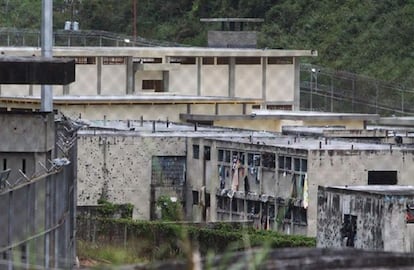

The Venezuelan government has reported the deaths of five inmates during a riot Monday at Yare III prison, located in a town in the Tuy Valley, outside Caracas. The confirmation from the Ministry of Penitentiary Services came a day after the incident, following a weekend in which relatives and human rights advocates had denounced irregularities at the prison.
In a statement, authorities asserted that the “maximum-security” facility is intended to house “leaders and members of criminal gangs.” Several political prisoners awaiting amnesty are also being held there. According to official information, the deceased were identified as Keivin Matamoros, Eliécer Córdoba, Erkin Ramos, José Andrade, and Jean Carlos Jiménez. The causes of death were not specified.
The families of detainees who have been holding vigils outside prisons since January have demanded proof of life for the remaining inmates. The women banged on the gate demanding information and protested at the prison entrance, but to no avail. “They are killing them,” read some of the signs they carried. Late Tuesday afternoon, some of them began receiving calls from the detainees assuring them that they were safe.
Visits were suspended on Sunday and a security perimeter was established around the prison due to a clash between common prisoners over the transfer of a group of detainees to the facility. Sources close to the detainees indicated that the riot also resulted in gunshot wounds.
Before the ministry’s statement, the Public Prosecutor’s Office had announced the opening of an investigation into the events at Yare III prison — without reporting the deaths. The investigation was entrusted to a commission of officials from the Human Rights Directorate. Some sources claim that the tension arose from the transfer of a group of detainees to this area.
The dire situation faced by prisoners in Venezuela has been exposed by revelations from political prisoners released under amnesty, totaling more than 650 since last January. Discontent over prison conditions and mistreatment by guards is on the rise. Last week, the Public Prosecutor’s Office, to which Larry Devoe was recently appointed, visited the Rodeo I Penitentiary Center to verify conditions following a protest by foreign inmates. According to the institution, they confirmed that “the protocols applied in the prison complied with human rights standards.”
The Venezuelan Prison Observatory, however, reported this week that two inmates had died in Module 4 of El Rodeo prison in less than 24 hours due to respiratory failure and lack of medical attention. “Two deaths in the same prison complex, in less than 24 hours, cannot be understood as isolated incidents, but rather as part of a systematic pattern of neglect,” the NGO stated in a press release. “El Rodeo thus joins a prison system marked by extreme overcrowding, where prisoners survive in unsanitary conditions, without regular access to drinking water or adequate food, with nonexistent or delayed medical care, and exposed to diseases that spread uncontrollably.”
The government maintains total control over the country’s prisons, under what it calls the penitentiary regime. Until 2023, some facilities, such as the Tocorón prison — the center of operations for the Tren de Aragua gang — and Tocuyito, were under the control of the leaders of criminal groups, when the government deployed a military takeover of the prisons, although it did not arrest any of their leaders.
In recent weeks, human rights advocates have demanded the dismissal of Minister of Penitentiary Services Julio García Zerpa as well as a general pardon for all remaining political prisoners: between 400 and 600, according to various organizations. Appointed by Nicolás Maduro in 2024, García Zerpa — a former member of the National Assembly — has not been among the cabinet reshuffle priorities of the acting president, Delcy Rodríguez.
His departure was one of the demands made by a group during a meeting last week with the new ombudsperson, Eglée González Lobato, along with the demand for the entry of international organizations such as the Red Cross and representatives of the Office of the High Commissioner for Human Rights, which are based in Caracas. “I was in Yare III and I can attest that it is a camp of torture and cruel treatment. None of the prisoners even had access to a nail clipper. We demand an international investigation,” said lawyer Eduardo Torres, a former political prisoner, by telephone from the vicinity of the prison.
Sign up for our weekly newsletter to get more English-language news coverage from EL PAÍS USA Edition









































