
Venezuela’s National Assembly gives unanimous approval to amnesty bill
The measure passed after two weeks of consultations with the opposition, but nearly 200 members of the military have been excluded from the pardon
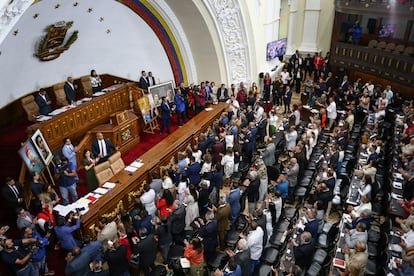

Venezuela’s National Assembly on Thursday passed an amnesty bill that could release hundreds of political prisoners from jail and drop the prosecution of political refugees living in hiding or exile. The bill was approved unanimously after two weeks of consultations with various political and civil society sectors. While the new law incorporates many of the legal points negotiated by opposition lawmakers to ensure broader coverage, it explicitly excludes military personnel — 174 of the approximately 600 political prisoners who remain incarcerated — who are accused of rebellion.
The bill was immediately sent to Miraflores Palace for interim president Delcy Rodríguez to sign. “You have to know how to ask for forgiveness, you have to know how to receive forgiveness,” she said. A parliamentary commission of 23 lawmakers will be responsible for monitoring the application of the amnesty and, in the case of the opposition, fighting for the review of cases that ended up being excluded.
The approved text limits the scope of the amnesty to 13 specific periods of political and social upheaval that occurred between 1999 and 2026, three more than initially proposed. This list includes, for example, the entire period of the National Assembly’s activity between 2016 and 2021, when it was controlled by the opposition and the Chavista regime blocked its functioning and opened investigations into dozens of opposition members. Also included are the events that took place during the selection of candidates in the 2023 opposition primaries. The demonstrations and violent incidents during the elections of July 2024, when the Chavista regime deployed harsh repression, are also covered. However, individuals who were accused of leading military rebellions will be excluded from the amnesty.
Those convicted of so-called “hate crimes,” such as posting a message critical of the government on WhatsApp, have not been expressly granted amnesty. Non-profits and families had lobbied for the repeal of laws like this one, which have been used for repression, but their request has not been taken into account. The president of the National Assembly, Jorge Rodríguez, asserted that the law was “very useful” although it will be reformed because, he acknowledged, in some cases it had not been used “appropriately.”
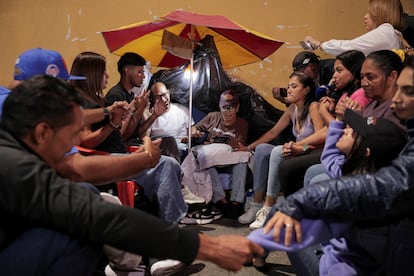
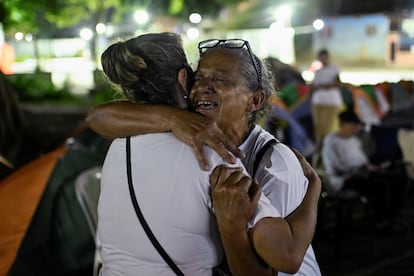
The negotiations took place while dozens of prisoners’ relatives maintained their protest vigils outside prisons across the country. Following the release of 444 people in the last month and a half, it is estimated that at least 600 political prisoners are still awaiting release.
The bill was expected to pass on Thursday of last week, but parliamentary debate stalled after the first six of the 16 articles were approved. The disagreement centered on the wording of Article 7, key to defining the spirit of the law: Chavismo maintains that those granted amnesty must first submit to the justice system — the same system that unjustly imprisoned them — a requirement that was not included in the initial version and raised concerns among NGOs.
The controversy highlighted the opposing views on the scope of the law: for Chavismo, it is about pardoning crimes, while defenders and relatives of political prisoners insist that the objective is to strip criminal status from acts that should never have been considered as such in the first place. They demand that the process include reparations for victims of arbitrary detentions, torture, and persecution, as well as guarantees of non-repetition, which are still pending.
“This law is not perfect, but our interest is for political persecution to cease,” said Nora Bracho, an opposition lawmaker and vice president of the committee designated to draft the bill.
Among the changes negotiated in recent weeks was the possibility that the beneficiaries of the amnesty could return to public life, as a way of restoring the political rights of a significant number of persecuted or exiled opposition members. It was also agreed to explicitly incorporate the legal principle of favoring the accused if any doubts arise regarding the application of the law. This is seen as a glimmer of hope, because it could potentially include all the cases that fell outside the specified timeframes.
The amnesty law was announced by Delcy Rodríguez on January 29. The matter quickly acquired an urgent character, although its approval has not been as swift as expected. The reason is that in this new era without Nicolás Maduro following his capture by U.S. forces in January, Chavismo has sought unanimous support for the initiative, despite not needing it thanks to its overwhelming parliamentary majority. Following the hydrocarbons law, which opened up the oil industry to the private sector, the amnesty is the second law passed with the support of a minority of moderate opposition members who coexist with Chavismo in the National Assembly, a body in which the leader with the greatest popular support, María Corina Machado, is not represented.
Sign up for our weekly newsletter to get more English-language news coverage from EL PAÍS USA Edition









































