
Relatives of political prisoners in Venezuela stage hunger strike in response to broken promises of their release
The protest has escalated in a Caracas prison after Jorge Rodríguez promised the freedom of all inmates 10 days ago


At midday on Monday, 10 women lay on mattresses propped against police barricades, numb from dehydration and having gone more than 50 hours without food. They had joined the hunger strike already started by the political prisoners whose freedom they are demanding. After more than a month of vigil, tents have multiplied around Zone 7, a command post of the Bolivarian National Police (PNB) in Caracas, and the protest has been growing. It is the only prison to have been visited by any government representative. There, 10 days ago, Jorge Rodríguez, president of the National Assembly, held an unusual meeting with relatives of political prisoners and assured them that all would be released no later than last Friday, with the amnesty law approved. That promise, however, has been put on hold.
“The releases have been a mockery. They didn’t keep their promises,” Evelyn Quero, one of the women still able to speak despite going without eating, told EL PAÍS. Quero held a glass of ice in her hand to wet her lips, while the others tried to sleep amid the pain that the lack of food was beginning to cause.
The delay in passing the law has further frustrated the families of prisoners. Vigils continue at prisons across the country, while inmate lists keep being updated. The latest report from the NGO Foro Penal indicates 444 releases since January 8, when the Chavista regime publicly announced the “gesture,” within the framework of a U.S.-backed transition following the military intervention in which Nicolás Maduro was captured. The NGO’s lists still show 634 people awaiting release, although this Monday the legal team was in Zone 7 documenting cases they had not previously recorded. Reports of new politically motivated arrests continue to surface.
Advocates have insisted that the release process must continue, regardless of the debate in parliament, which is scheduled to resume in plenary session this Thursday. The consensus broke down last week during the discussion of Article 7 of the proposed law, which stipulates that those granted amnesty must first face justice. The opposition and advocates argue that this contradicts the very principle behind such a law, as the provision presupposes that the thousands of political prisoners in Venezuela have committed crimes.
While the debate stalled, the first releases in Zone 7 occurred at midnight the following day. Seventeen people were released, but more than 50 remain detained. “If they had fulfilled their promise to release everyone here, we wouldn’t have started a hunger strike,” claims Quero, mother of Joel Bracho, a police officer accused of terrorism and conspiracy for allegedly participating in the placement of an explosive device in a Caracas plaza that failed to detonate at the end of last year. Her son served years in prison and was also included on the police promotion lists announced earlier this year. His family was only recently able to see him after more than two months of incommunicado detention.
After the first two days without food — only consuming water and electrolyte solution — three women have become ill. One of them had to be taken to a medical center due to a hypertensive crisis. Another was writhing in pain on Monday from stomach cramps. They were waiting for an ambulance, but the first woman ended up being transported in the vehicle of one of the lawyers present. “An ambulance has never been seen here. Police officer Edison Torres, who died here last month, was taken away in a patrol car,” one of the women reported. The president of the National Assembly has not been seen since his first visit either.
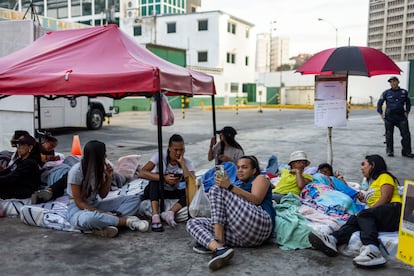
A volunteer doctor has come to check on the women’s health, and on Monday they insisted that he also be allowed inside the prison, where inmates have been on hunger strike since last Thursday as a form of protest. The situation of the prisoners is increasing the anxiety of those waiting outside.
Jenny Orozco, daughter of opposition leader Fernando Orozco, a member of the Popular Will party and a former congressman, has also joined the hunger strike. Her father’s case is not isolated: along with him are 40 other detainees who, though they don’t know each other, have been linked to an alleged conspiracy. The politician remains imprisoned with one of his sons, and until recently, his wife was also detained, although she was released due to delicate health. Orozco endured years of political persecution that forced him into exile, and he had returned to the country a couple of years ago. “They took everything from us. They seized the family’s transportation company and my grandmother’s house,” recounts his daughter, who managed to escape with other siblings before she too was arrested.
Cases involving military personnel also appear to be stalled. For this reason, NGOs maintain that the amnesty law is exclusionary and leaves out a group of detainees. This complaint was raised by the families themselves a week ago, during a meeting with a parliamentary committee and members of the Democratic Coexistence and Peace Program, created by acting president Delcy Rodríguez.
In addition to demanding the release of all prisoners, they denounced the mistreatment they have suffered and even the continued imprisonment of people who had already served their sentences. For them, these events demonstrate the collapse of the justice system, which for years — according to reports from organizations such as the Office of the High Commissioner for Human Rights — has functioned as yet another instrument of repression.
The government has been forced to make concessions amid the crisis facing Chavismo since January 3. One of these has been to allow contact again with some detainees whose whereabouts had been unknown for months. This is the case of the 32 individuals implicated in the so-called “Operation Gideon,” the failed military rebellion of 2020, who for six months were unaccounted for after being transferred from prison without their families being informed.
After meeting with members of the Democratic Coexistence and Peace Program, the families were allowed to enter Fort Guaicaipuro, one of the most feared prisons in the country, located in the Tuy Valley, on the outskirts of Caracas. The cells are underground; the heat is stifling, and the roof is a metal grate over which the guards walk. Several military personnel convicted for insurrections and failed uprisings are held there. The families were able to see them through a grate, watched over by hooded guards. They found them malnourished, yellow-skinned, and with vacant stares. “It wasn’t a joy to see them; it was torture to see how they are kept,” one of the mothers recounted.
This case is emblematic, and NGOs have demanded that it be included among those to be amnestied. The government has implicated them in an operation to overthrow Maduro, which allegedly had the support of former U.S. Green Berets who entered the country by boat. The foreigners have already been released as part of negotiations between Washington and Caracas, specifically during the exchange in which the now-disgraced Alex Saab left prison in Miami to join the Chavista cabinet. However, Interior Minister Diosdado Cabello himself has stated that none of them will be granted freedom under the amnesty.
Sign up for our weekly newsletter to get more English-language news coverage from EL PAÍS USA Edition









































