
Internal differences are delaying the amnesty promised by Delcy Rodríguez in Venezuela
On Thursday the National Assembly is scheduled to discuss the bill to release hundreds of political prisoners of the Chavista regime
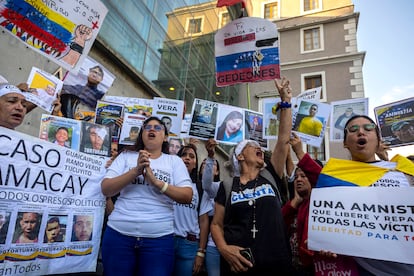

The amnesty law for political prisoners in Venezuela is delayed. The Chavista regime had hoped for a swift debate of the bill, but the suspension of Tuesday’s parliamentary session made it clear that it won’t be so simple. The issue is even at risk of not being included on the agenda of the National Assembly meeting scheduled for Thursday. These delays stem from conflicting views within Delcy Rodríguez’s government regarding the scope of ending years of political persecution in Venezuela.
The promise to approve it last Tuesday, made by Jorge Rodríguez, the head of the National Assembly, to soothe desperate relatives of the detainees, has crashed against the complexity that legislation like this entails in a country that is supposed to be taking its first steps towards a political transition.
Interior Minister Diosdado Cabello and the most radical Chavista figures argue that the law will have limitations because it grants pardons to people who have committed crimes, and they have also lashed out against the NGOs that have been supporting the families. Rodríguez, on the other hand, has promised that “everyone will be released.” The lawmaker Jorge Arreaza, who leads the parliamentary group that initiated the consultations, has met with these NGOs to hear their opinions.
The unions have also presented proposals. The journalists’ union, for example, is calling for a broad amnesty for people who were persecuted for exercising their freedom of speech, and says that there are still at least 59 reporters facing legal proceedings, four in prison, two under house arrest, at least 20 in exile due to persecution, and others with canceled passports.
Last weekend, in a session lasting over four hours, various organizations outlined the serious limitations of the bill in its first version, which was unanimously approved. The legislation proposes a review of the period from 1999 to 2026, but is limited to the months and years in which protests occurred. It excludes individuals who were unjustly imprisoned — some 500 people, according to estimates by the Committee for the Freedom of Political Prisoners, most of whom are military personnel. Furthermore, it does not propose reparations or guarantees against recurrence. On the contrary, it mandates the elimination of case files, which, NGOs have warned, could lead to impunity for those responsible for serious human rights violations.
Beyond the legal considerations, the very nature of the amnesty law, a common legal tool in transitional processes, is being called into question. This is not only due to its content but also to the actions of the government that is promoting it. The prisoner releases in recent weeks have come with restrictions on freedom. The re-arrest of opposition leader Juan Pablo Guanipa, punished for celebrating his release in public, has cast doubt on the reconciliation invoked by Chavismo since the capture of Nicolás Maduro by the United States.
“Amnesty is not an act of forgiveness or a moral concession. It is a legal tool for resolving conflicts. But even so, suggesting that the victim must ask for forgiveness is an aberration that revictimizes and distorts transitional justice,” wrote lawyer Joel García, one of the main defenders of political prisoners, on his social media.
The argument put forward by activists and legal experts is that a law of this kind cannot be considered a moral concession. This requires recognizing those who were imprisoned and persecuted for two decades as victims of the state, and acknowledging that responsibility for “political violence” is not equal among the sectors involved. The government has divided those who should benefit from the amnesty into detainees (without ever considering them political prisoners), and victims of “extremist political violence.”
This week, relatives of political prisoners protested in front of the National Assembly and were heard by a group of lawmakers in charge of drafting the law. Human rights defenders like Martha Tineo, from the NGO Justice, Encounter, and Forgiveness, stated that “the only legitimate path is the effective restoration of the rule of law” in Venezuela. “The situation of people detained for political reasons stems from the collapse and manipulation of the justice system to persecute and convict people without guarantees, in open violation of the Constitution and due process,” the activist said. She believes that a simple political decision could have freed all those detained.
Military prisoners
The families highlighted the cases of military personnel who have served their sentences but remain imprisoned years later. One of them is retired military officer William Paredes, accused of inciting rebellion. Three months ago, Paredes was transferred from Ramo Verde prison without his family knowing his whereabouts. “My husband was arrested in 2021 with me in Maracay. They took us to a house in Caracas, where I was detained for six days. They gave us both polygraph tests, which we passed, because neither my husband nor I are involved in anything, and they told us that he still couldn’t be released. He completed his sentence a year ago, and they still haven’t let him go,” says Thais Aparicio.
Another case is that of Alberto Bracho, sentenced to 30 years for allegedly participating in the drone attack that Nicolás Maduro suffered in 2018. “The prosecuting attorney is in jail for corruption, so is the judge, and we already know where the alleged victim is being tried,” said his mother, Bárbara Bracho, 50.
On Thursday, Youth Day in Venezuela, the student movement is scheduled to mobilize to demand the immediate release of all political prisoners. Chavismo will also bring its supporters into the streets to “defend” the oil industry while U.S. Energy Secretary Chris Wright tours production fields in the country. Meanwhile, the amnesty law remains a pending subject.
Sign up for our weekly newsletter to get more English-language news coverage from EL PAÍS USA Edition









































