
Opposition leader Andrés Velásquez, after 16 months in hiding: ‘We need to put a timeline on Marco Rubio’s plan in Venezuela’
Dissidents are beginning to slowly raise their voices again, and the longtime activist says he feels a ‘cautious optimism’
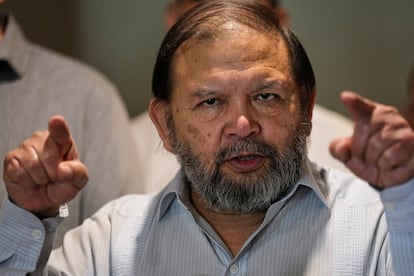
Andrés Velásquez, one of the best-known leaders of the Venezuelan opposition, spent 16 months in hiding. Having gone underground when the crackdown began after the July 2014 elections, in which Nicolás Maduro declared himself the winner, he faced extremely restrictive and harsh living conditions: during that entire time, he was unable to set foot outside or see his family. His face reflects the consequences of that hardship: dark circles under his eyes, a voice that betrays exhaustion, and an unusual beard. “Sometimes, a police officer would give me a tip-off to warn me that they might be looking for me, and I would move to a different location,” says the 72-year-old former governor of Bolívar state.
Velásquez ventured out of hiding with extreme caution. He did so last month, following the shifts in Venezuelan politics after Nicolás Maduro’s arrest. He says he frequently scans his surroundings to see if any police are following him. But he has observed that these days, officers don’t notice him. There doesn’t appear to be an order in place to arrest him on any pretext. Therefore, encouraged by information he receives from colleagues and associates, he has decided to return to public life.
Along with the release this Sunday of highly symbolic political leaders such as Jesús Armas, Roland Carreño, and Javier Tarazona, the return from hiding of Andrés Velásquez is one of the most evident expressions of the resurgence of protest and the return of the citizen agenda. A new atmosphere is beginning to emerge in Venezuela after the U.S. military intervention that led to the arrest of Nicolás Maduro. In addition to Velásquez, activist Delsa Solórzano also emerged from hiding. However, the re-arrest of opposition member Juan Pablo Guanipa just hours after Velásquez’s release has dampened expectations for this new phase.
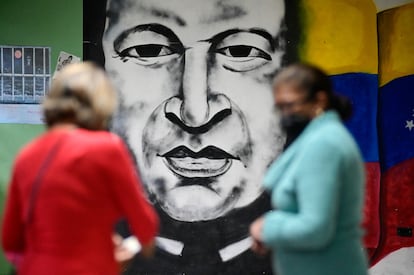
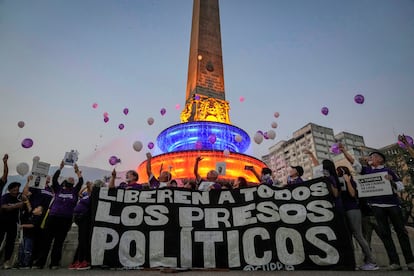
Prominent political prisoners recently released, such as Carlos Julio Rojas and Nicmer Evans, have taken to the streets to stand with the families of those still detained. Vigils continue at prisons throughout the country. Students from the Central University of Venezuela have organized several protests and, on one occasion, directly confronted Delcy Rodríguez, something unthinkable just over a month ago. Leaders like Alfredo Ramos and Andrea Tavares have also returned to the streets. Even the amnesty bill presented by the regime for political prisoners has been harshly criticized by the opposition for the Chavista regime’s failure to take responsibility.
Andrés Velásquez is encouraged by the recent surge in civic engagement. He hopes to soon organize a press conference with other members of the Venezuelan opposition who, until recently, were being persecuted. For him, opposition unity must be a priority at this time. He doesn’t have much faith in the amnesty bill. He notes that he has begun working on verifying the status of released political prisoners and those still awaiting release, providing support to their families. He wants to be part of the efforts to restore democracy in Venezuela. “I felt it was a good time to come forward and raise this challenge,” he tells EL PAÍS.
A classic figure in Venezuelan politics, Velásquez is an electrical technician by training and a union leader who emerged from the workers’ circles of the national steel industry, which became a benchmark in the country. He was a presidential candidate in 1993, has served as governor and deputy on several occasions, and has been an opponent of Chavismo since it came to power. He leads the Radical Cause, a reform-oriented left-wing party that is part of the Unitary Platform, and has always been distinguished by his combative style and Jacobin rhetoric against corruption.
The opposition leader doesn’t believe the country is on the verge of a democratic transition, although he does have expectations given the current political climate. “I feel like a huge portal has opened, but we are still very far from a transition. Those who are governing are the same people. Delcy Rodríguez doesn’t generate stability; on the contrary, she has been a jailer for the regime and bears direct responsibility for the repression of these past years,” he points out. Velásquez says he endorses the strategy outlined for Venezuela by U.S. Secretary of State Marco Rubio—stabilization, recovery, and transition—as a roadmap for achieving democracy. “We need to put a timeline on that plan,” he warns.
The process initiated after January 3 could lead to an electoral agreement negotiated with Chavismo. Faced with this possibility, the political leader is convinced: “If it enters the negotiating table as a serious formula for restoring democracy and popular sovereignty in the country, I would be willing to consider holding new elections. Without hesitation,” he affirms.
The statement may be controversial, but he explains it: “I am one of those who support the elections of July 28, 2024, and I have always been in favor of not turning the page. But, realistically, if we enter into a process in which even the U.S. administration gets involved to offer guarantees and ensure an honest election, I am not afraid to participate,” he reflects. His candidate would be María Corina Machado. “What we are experiencing has to end in a democracy. That is what we want in Venezuela: not a cosmetic change or to remain like this indefinitely,” he concludes.
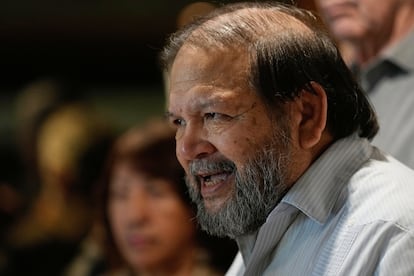
Velásquez is clear that one of the risks of the current situation is that Donald Trump’s agenda will weaken over time, allowing the Chavista leadership to navigate the situation. “It’s a risk we must take. We accept it clearly,” he says. He doesn’t have much faith in the political overtures being promoted by Delcy Rodríguez and the Chavista leadership. However, he acknowledges that the climate of persecution, which had become chronic, has eased. “I feel it firsthand: the pressure has lessened. Since I went out into the street, initially very wary, I could see that the atmosphere of political and police persecution has softened.”
He prefers not to dwell too much on collateral assessments of the U.S. military attack that made Maduro’s arrest possible and violated national defense lines. “It’s a capture, a specific operation to remove an illegitimate leader accused of international crimes from power. There was no alternative. It’s a consequence of the circumstances. The rest can be debated later.”
Sign up for our weekly newsletter to get more English-language news coverage from EL PAÍS USA Edition









































