
Rafael Quero Silva, an alleged Maduro regime torturer in Trump’s immigration detention centers
Five Venezuelans have accused the former military officer, who is currently in an ICE facility and could be deported to Venezuela, of torturing them during the 2013 protests
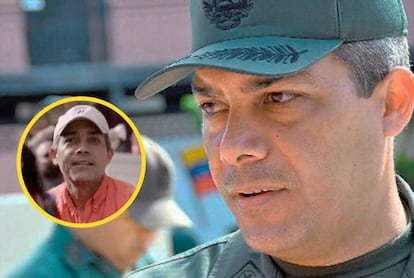

A former Venezuelan military officer accused in the United States of torturing protesters during the 2013 demonstrations against the government of Nicolás Maduro is being held at a migrant detention center in Miami. Former Lieutenant-Colonel Rafael Quero Silva is appealing in immigration court to remain in the U.S., while the legal proceedings against him for human rights violations continue amid the possibility that he could be deported to Venezuela before a decision on his case is reached.
The lawsuit against him was filed by five Venezuelans who were detained between 2013 and 2014 at the National Guard headquarters in Barquisimeto, in Lara State, where they claim to have been tortured on the defendant’s orders. According to the 31-page complaint, filed in December in the Southern District Court of Florida, Quero Silva was commander of Detachment 47 of the Bolivarian National Guard and directed repressive operations during the anti-government protests that erupted after the 2013 elections, which gave Maduro a narrow victory over opposition candidate Henrique Capriles.
The demonstrations, which flooded the streets in various cities, escalated into clashes that left dozens dead and wounded and hundreds detained. The five plaintiffs allege that they were subjected to severe beatings, electric shocks, gunshots, and death threats. They also claim to have been held for days without access to food, water, or medical attention, in cramped and unsanitary spaces, in forced positions, and subjected to invasive body searches. Some claim to have suffered serious injuries that required surgery and resulted in permanent disabilities.
The violations were part of a systematic pattern of repression against opponents, and Quero Silva was in charge of those who carried out the abuses, making him directly or indirectly responsible, the complaint alleges. The plaintiffs, who are being represented by Guernica 37, a Madrid-based international team of lawyers specializing in transitional justice and human rights violations, along with a Miami-based firm, are seeking compensatory and punitive damages.
One of them was arrested while participating in a protest near a National Electoral Council office in Barquisimeto, according to court documents. Guards beat him with a riot shield while holding him down with his arms behind his back, then took him and other detainees to the back of a truck where they threw in a tear gas canister and closed the door. He was then taken to Detachment 47, where the abuses continued. Another plaintiff was shot in the abdomen, sustaining serious injuries that required urgent medical attention and left him with lasting after-effects, according to the court record. A third was shot in the back and face with rubber bullets, sustaining serious injuries that required multiple surgeries.
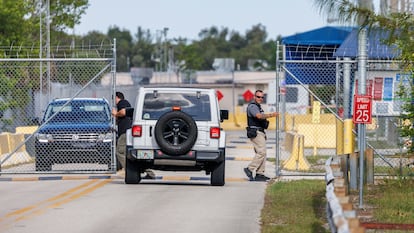
Quero Silva was detained by Immigration and Customs Enforcement (ICE) last year, accused of overstaying his visa, which he used to enter the United States in 2016. The Krome Detention Center, southwest of Miami, is listed as his official address in the lawsuit. An immigration judge rejected his asylum application last November, and he filed an appeal.
To the surprise of many Venezuelan exiles, Quero Silva appeared dressed as a police officer in 2018 as an extra in a soap opera titled Mi Familia Perfecta (My Perfect Family), and it was then revealed that he was living in South Florida. According to the plaintiffs, they gave testimony to the FBI in 2018 as part of an investigation into Quero Silva, but the authorities did not file any criminal charges. Then, through Human Rights Watch, they contacted Guernica 37, Almudena Bernabeu, director of the center in San Francisco who represents the plaintiffs along with the Miami law firm, told EL PAÍS.
To file the lawsuit, the five protesters invoked the Torture Victims Protection Act, passed in 1991, which allows individuals who have suffered torture or extrajudicial killings abroad to file civil suits in U.S. federal courts. For years, the International Criminal Court has been investigating the Venezuelan state for possible crimes against humanity committed against protesters. The plaintiffs warn that “there is no adequate alternative remedy in Venezuela” to seek justice, and that the ability to report abuses committed by the authorities is “limited and dangerous.”
Circumstances in Venezuela have changed since the lawsuit was filed in December. The United States captured Maduro and his wife, Cilia Flores, in an armed operation earlier this year following a massive military deployment off its coast, and has seized oil tankers and destroyed numerous vessels allegedly operated by drug traffickers.
Following Maduro’s capture, Washington and the interim government of Delcy Rodríguez have initiated diplomatic contacts that could have broader implications, including cooperation on migration. For years, Caracas refused regular deportation flights, amid a wave of migration that saw hundreds of thousands of Venezuelans arrive at the U.S. border. The flights resumed last year and have recently increased in frequency.
Possibility of deportation
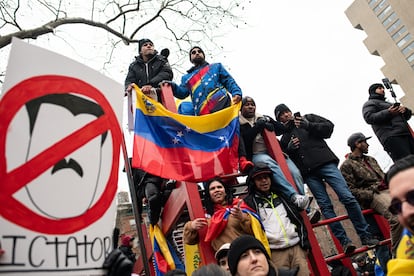
For the plaintiffs, the possibility that Quero Silva could be deported to Venezuela — a state linked to human rights violations and questioned by international bodies for its lack of independence — in the midst of the case, raises the question of whether the expulsion would, in practice, amount to leaving him beyond the reach of the law.
The former military officer is representing himself in the case and has asked the court to dismiss the lawsuit, claiming he is detained and destitute. The plaintiffs responded last week that, although the events occurred more than a decade ago, they were unaware of the defendant’s whereabouts for years, and there were no avenues for obtaining justice in Venezuela, where the government he served remains in power.
Quero Silva’s immigration appeal in his asylum case could take several months, and Guernica 37 warns that “legally, there is no obligation on the part of U.S. authorities to stop” the deportation. “I think that if the United States were to deport him, it would do so without looking back, without ensuring that there is any additional responsibility in Venezuela,” says Bernabeu, who believes that the possibility of him facing legal proceedings in his home country is uncertain. “Venezuela is at a very particular historical moment, so it’s difficult to predict. If he is ultimately deported, it’s unclear what would happen.”
The lawyer clarifies the difference between extradition of people accused of crimes in their countries of origin, and deportation. “When there is an open criminal case in the country of origin, extradition is usually requested, in which case the U.S. can choose to grant it or not. In this case, there isn’t one, because we all know the circumstances in Venezuela. Things would have to change drastically. The situation in Venezuela is moving very slowly, due to all the circumstances surrounding Maduro’s departure and all the interference from the United States, and this very strange government that has remained in place. In any case, it would be a deportation, I don’t know if it would be negotiated, because I don’t think there’s much appetite to prosecute someone like Quero Silva domestically,” she adds.
However, Bernabeu explains that, since it is a civil lawsuit, the process can continue even in the defendant’s absence. “If he is deported to Venezuela, he can also defend himself from abroad through a lawyer. His physical presence would be ideal for a jury trial, but his absence does not halt the civil action. The decision regarding liability and compensation for damages rests with the judge.”
Sign up for our weekly newsletter to get more English-language news coverage from EL PAÍS USA Edition









































