
The Venezuelan prisoners who found out about Maduro’s fall a week after the rest of the world
Those detained in solitary isolation received the news during their weekly family visits
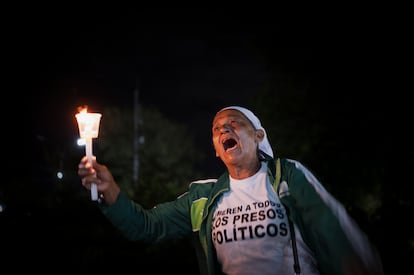

The entire world had already seen Nicolás Maduro being led in handcuffs into a New York courtroom in real time, but thousands of Venezuelans still believed that he and the first lady, Cilia Flores, remained in charge of the country. The world also knew that Maduro had declared himself a prisoner of war, that Delcy Rodríguez had assumed the role of interim president, and that Diosdado Cabello was patrolling the streets of Caracas to prevent unrest. But for the Venezuelans isolated in jails and prisons, the country remained the same.
These are political and common detainees held in prisons like El Rodeo, El Helicoide, and El Atillo. Without access to telephones, radios, televisions, or newspapers, they learned the news a week after the rest of the world. They believed everything was the same until family visiting days on Friday and Saturday, their loved ones bringing them the information about what had happened during the most turbulent week in Venezuela since Maduro assumed power in 2013.
A young woman, who prefers to remain anonymous to avoid reprisals, arrived, as she does every Saturday morning, at El Rodeo 1 prison with a food package under her arm and news for her brother. Despite the glass partition and the fact that he arrived in the visiting room hooded, she was able to tell him: “Maduro is gone, the Americans took him and they’re going to try him there. Delcy is the new president now.”
Her brother’s eyes — he is one of the 145 political prisoners at El Rodeo — widened in shock, she recalls. “That’s when he truly understood what had happened, although he already knew something, because the night before he’d heard shouts of joy coming from some nearby cells, from prisoners who had received visitors the day before.” However, until that moment, he only had a hunch that something serious had occurred the previous weekend. “They heard the planes, the explosions, more planes...” she says. Then came the silence, and later, the family visits.
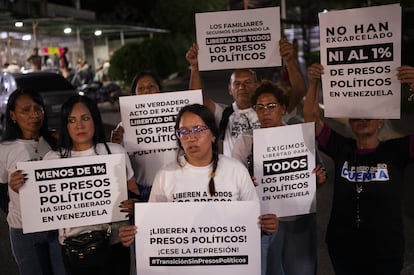
When she told him, two guards were closely monitoring the conversation. “He got excited and let out such a shout of joy that the officer immediately called him to order: ‘If you keep this up, the visit ends right now,’” she recalls.
“There is no contact between the prisoners, but after news like this they usually communicate by shouting from one cell to another, providing details,” the detainee’s sister explains over the phone.
Preventing any display of joy that could lead to protests or public celebrations has been one of the government’s main concerns, prompting it to issue a “state of emergency” decree. The decree authorizes the police to “immediately undertake the search and capture throughout the national territory of any person involved in promoting or supporting the armed attack by the United States against the territory of the Republic.” Since then, publicly celebrating the capture of Maduro and Flores has become practically a crime in Venezuela.
The decree authorizes authorities to restrict fundamental rights such as freedom of assembly, demonstration, and free movement for 90 days, with the possibility of an extension. So far, five arrests have been reported for “celebrating the kidnapping of President Maduro.” Two people were arrested for firing shots into the air, and three others were arrested for messages posted on social media. One young woman was even forced to issue a public apology, and the police released a video of her in handcuffs, accompanied by two officers. “Mr. President Nicolás, I am here to leave this message to apologize for a video I posted a few hours ago…” she says in the recording.
None of this was known to another prisoner accused of homicide, whose mother — who also prefers to remain anonymous — visited him in the cells of the Scientific, Criminal and Forensic Investigations Corps (CICPC) in Caracas. “He didn’t believe it. ‘Is this for real, Mom?’ he kept asking me. I told him about the invasion and that Maduro had been kidnapped, because he didn’t know anything,” the woman explains from Petare.
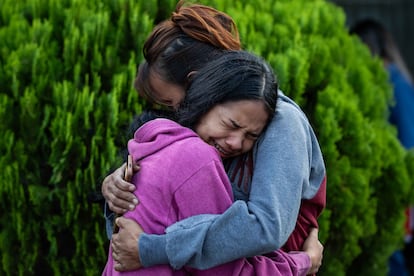
During the 15 minutes she has every two weeks to see her son, she recalls telling him that things were changing rapidly in the country. “But I didn’t see any happiness in him. I think he was worried, just like me. We’re a little scared.”
This mother gets emotional when she recalls the U.S. bombing of Caracas. “Those were hours of fear, hearing the planes. I don’t care about anything, but I kept thinking about the news reports I’d seen of similar bombings in Israel or Iraq,” she says about the two hours in which U.S. planes devastated the city’s landscape.
The more than 67,200 prisoners in the country, according to data from World Prison Brief and the Venezuelan Prison Observatory, were the last to find out about a heart-stopping week that, inside Venezuelan prisons, arrived in slow motion.
Sign up for our weekly newsletter to get more English-language news coverage from EL PAÍS USA Edition









































