
Meme Solís, the timeless pianoman
After 67 years in music, the Cuban singer, pianist, and composer still does not plan on ‘resting.’ He is currently promoting two new albums
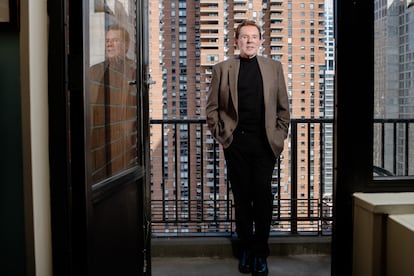

It’s not the Havana of the 1960s but today’s New York, yet the pianist has sometimes felt they are one and the same. He wakes up at noon in his 25th-floor Manhattan apartment, which has a view of buildings arranged like a scale model on the horizon, where everything human seems momentarily wiped out. The pianist had always wanted to live in New York, and here he is. He went to bed late the night before, as he’s used to being a nocturnal creature. “I worked in cabaret all my life,” he says. “The early morning hours have always inspired me.”
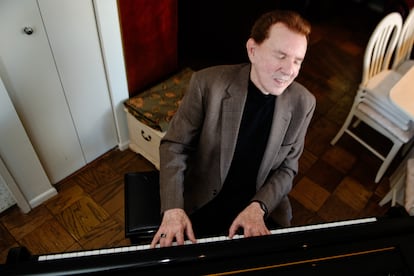
He makes himself a Cuban coffee, has breakfast, watches television or does some shopping, goes to the gym, spends time swimming, although he admits, “I’m not a good swimmer.” He sometimes does light exercise, nothing involving heavy weights or anything that might affect his fingering — the way he uses his fingers to draw music from the Yamaha piano sitting near the window, as if the skyscrapers, the lights, and the rooftops of New York were his great audience, witnesses to the eternal ballad of Meme Solís.
He wears a black turtleneck sweater, a striped jacket, matching trousers, and spotless shoes, all perfectly tailored to his 1.82-meter frame. Solís, 87, always seems ready to perform, ever at the ready, just as he was when he was not yet 15 and not yet one of Cuba’s most popular musicians, the accompanist to the country’s great female voices, or the creator of the quartet that took Cuba by storm.
He had been studying music since the age of six at the Rita Capú Conservatory in Santa Clara when he was approached to accompany Olga Guillot, the Queen of Bolero, on the piano. “I was terrified to accompany that giant. That woman was a goddess at that time. I accompanied her, and that marked the beginning of my career.” With Guillot, he began a path as an accompanist, forging close relationships with the most powerful voices of the Havana music scene in the mid-20th century.
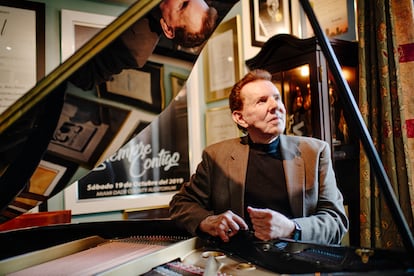
“He is a great accompanying pianist and one of the best vocal harmonizers Cuba has ever produced. In both cases, he is perhaps one of the last exponents of two schools to which he contributed the perspective and feeling of his generation,” says philologist and researcher Rosa Marquetti, who is currently working on the biography of the pianist, composer, and singer.
Early in his life, it was Guillot who told him he was going to be “a great artist.” “I didn’t believe her at all; I aspired to be a good pianist, but that stuck with me,” Solís says. He learned something from Guillot: “She told me, ‘The day you go on stage, never do it timidly; always go out thinking that you are the best.’”
Solís also cherishes everything he learned from the other women he accompanied on the piano. Playing with the singer Elena Burke was his first “great experience” when he decided to move from the center of the country to Havana, a capital city that left him speechless. “I’ve known and worked in several capital cities, but the impression I had upon arriving in Havana was the greatest I’ve ever had; it was unique, I don’t think there was another capital city that had that kind of nightlife at that time.”
Havana in the 1950s
Havana was the city of cabarets, nightclubs, and music on every corner. Havana in the 1950s, even in the early days of the Cuban Revolution — which triumphed when Solís was 18 — was the place “where everyone wanted to be.” “People say New York is the city that never sleeps, but that was Havana. There were shows until 6 a.m. There were countless cabarets, with shows, with dancers. There was the Tropicana, the Sans Souci, the Capri, the Havana Hilton, the Parisien, the Riviera…”
Amid so much grandeur and vitality, Solís stood out as the young man who began performing with Burke at Club 21. “Elena taught me a great deal about music. Accompanying her has been one of the most difficult tasks of my life. She was an extraordinary singer. She trained me for her. She loved me very much, helped me a lot in my beginnings, and showed me a whole new world.”
Later, other great figures of the country’s artistic scene came into his life, such as Rosita Fornés and Moraima Secada. “With Rosita, I did my first television program; with her, I learned to move beyond the piano,” he says. Moraima, for her part, was pure “dark humor,” the woman with the greatest “mental agility” he has ever known. “With a beautiful musicality. I fell in love with Moraima’s lovely way of singing. She sang mezzo-soprano; it was a unique voice, and she sang with such feeling; she was the one who captivated me the most. We became very close friends. She left me with her temperament, a precious friendship that lasted until the end of her days.”
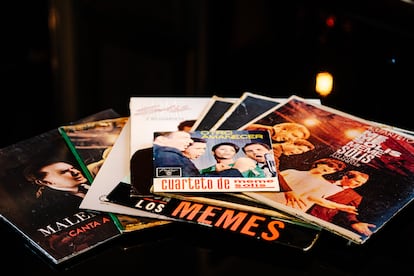
It was with Secada that he formed his first vocal group, El Cuarteto de Meme Solís, alongside Horacio Riquelme and Ernesto Martín. “The quartet was everything to me,” says Solís, who, in addition to playing piano, sang third voice in the group. Years later, model Farah María took over as the female vocalist for the quartet, which then became known as Los Memes. By the mid-1960s, they were among the public’s favorite artists. They performed all over the island. They were, as Solís says, “a boom,” which truly erupted when he released his song Otro amanecer (Another Dawn).
By that time, invitations to perform on stages around the world had already begun to arrive, but the Cuban government always resisted. “I wasn’t part of the Revolution, and it was very strange that an artist with the popularity I had at that time wasn’t part of it.” That’s how Solís first encountered censorship. Jorge “Papito” Serguera, then-president of the Cuban Institute of Radio and Television, told him: “Either you join, or doors will start closing on you.” That’s exactly what happened. “They started taking us off television first, then off theaters, off the most popular venues. They left us with the cabaret and the radio program.” Then not even that. Solís resigned from his job and requested to leave the country permanently.
It wasn’t that simple. The Cuban government wouldn’t let him go so easily. He was pushed into a shadow world of culture. “I made music for other artists clandestinely, while also studying.” It was during that period that he learned orchestral instrumentation. When the government enacted the Anti-Vagrancy Law in 1970, he was required to report to the Ministry of Labor and accept a job. “When the director there—who was a fan of mine — saw me, he felt so sorry,” the pianist recalls. He ended up working for several months in a cardboard factory. People could hardly believe it when they saw the artist doing those tasks. “It can’t be that you’re here,” they would say to him.
He had to wait a long 17 years. After talks with the government of then-Spanish prime minister Felipe González, Fidel Castro agreed to send two dozen prisoners to Spain. Solís, who wasn’t a prisoner, was among them. He left Cuba 38 years ago and hasn’t set foot on the island, his first stage, since then. When he arrived in Madrid, a large crowd was waiting for him at Barajas Airport. “I came to think that no one remembered me anymore, that my audience had forgotten Meme Solís. But that wasn’t the case.” Thus, Solis began his long international career that continues to this day: the pianist has no desire to stop working.
“I feel very bad when I’m not producing, I don’t want to rest, resting too much is bad for me,” he says.
Life outside of Cuba
After Spain, he spent three years in Miami, a city that welcomed him with packed theaters, where he found many of the same people who went to his shows in Havana’s cabarets. Later, he arrived in New York, staying at a friend’s house, who offered him a couch and food — “enough to get started.” Exile gave him the chance to continue being Meme Solís: he worked in clubs, took part in several Off‑Broadway musical productions, performed in countries around the world, appeared at festivals, and received honors such as the Great Musical Legends Medal from the University of Miami, as well as being named honorary president of the Bolero Association in Spain.
“Meme is a legend of Cuban music. One of the most important harmonic masters of all time,” says Félix Romeo, his representative. “What makes him unique is the quality of his art, which has transcended 67 years of his career. He has reinvented himself without losing his essence over time, while maintaining his core principles. What has happened with Meme is something that happens very rarely. He is about to turn 88 and remains relevant with his longtime fans and all those who have joined him over time. He endures because of his talent and the love and respect that the Cuban people hold for him.”
Some time ago, Cuban singer Malena Burke, Elena’s daughter, asked him to go to a recording studio. “Meme, why don’t we go into a studio and record?” she suggested. Solís agreed. “Malena has been an extension of Elena; we have something very special. We’ve worked more together than Elena and I ever did.” From this encounter came the album Malena Burke Sings to Meme Solís, produced by the singer’s daughter, Lena Burke. The album was nominated for Best Traditional Tropical Album at last year’s Latin Grammy Awards.
It is a record that feels like a return to the Havana nights of Solís’s early years. “I said: I don’t want Malena in a recording booth where I can’t see her, but rather in front of the piano, where we can see each other’s expressions, see each other’s breathing, and that’s how that live album was recorded. In two early mornings.” Another of his latest works is the album Juntos de Nuevo (Together Again), with singer Luis Alberto Fernández.
Life seems to have been kind to Solís. He is the composer of more than 300 works, spanning both popular and classical music; the author or collaborator on more than 25 albums; and has performed countless concerts before an audience. He is not a man who harbors resentment — not even toward his own country, which condemned him to ostracism for far too long. Even so, he has no intention of returning to Cuba, because the paradisiacal place of his youth no longer exists.
“I carry Cuba within me,” he says, “but perhaps I was beaten down so badly, and what I went through was so harsh, that I have no desire to go back. I may long for that Cuba, but not the Cuba I see today. It’s very sad. Sometimes I ask myself: how could there have been such a drastic change from the Cuba I knew to this one? That’s why I’m afraid to think that one day I might return and be disappointed.”
Sign up for our weekly newsletter to get more English-language news coverage from EL PAÍS USA Edition









































