
All democracies are perishable: Hitler’s rise to power as a warning about the present
‘Les Irresponsibles’, the new book by Nazism expert Johann Chapoutot, brilliantly recounts the end of the Weimar Republic, highlighting the parallels with the present day
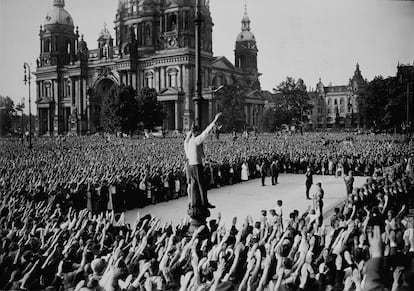

The appointment of Adolf Hitler as Chancellor of Germany in January 1933 is surely the 20th century event currently being most thoroughly examined by historians, though experts are not only looking to the past, but also to a present shaken by the rise of the far right in numerous countries and, above all, by the authoritarian drift of the United States under Donald Trump. How was it possible that one of the most advanced democracies in the world at the time, the Weimar Republic, ended up destroyed? Who was responsible for bringing Hitler to power, despite him never having hidden his racist and anti-democratic intentions? Why did they do it? A question that underlies all the others is the most important: could this happen again now?
Historical comparisons are always complicated: Weimar was shaken by the endemic violence of the Nazis, but also of the Communists. After the 1929 financial crisis, poverty was extreme, and the elites feared the contagion of the Soviet revolution. Defeat in the First World War and the humiliation of the conditions imposed by the victors fueled rampant and antisemitic nationalism. Very few parties believed in democracy in 1930s Germany, when an irreversible process began that would end with the Nazis in the chancellery. The world is different now, and yet too many threads link the past to our present. The French historian Johann Chapoutot attempts to reconstruct many of those hidden paths of history in Les Irresponsables: Qui a porté Hitler au pouvoir? (The Irresponsibles: Who Brought Hitler to Power?, 2025).
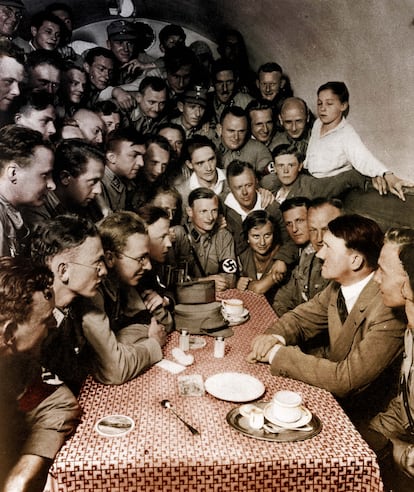
A professor at the Sorbonne and one of the leading experts on National Socialism, author of books such as The Law of Blood and The Nazi Cultural Revolution, Chapoutot makes no secret of his intentions in this new essay, which has caused quite a stir in France precisely because of the parallels it draws with the present. “The contemporary reader will undoubtedly have detected some reminiscences between the present day and Germany in 1932. There are so many that listing them would be almost tedious,” he writes in the epilogue of a brilliant book that, despite its enormous wealth of data and meticulous description of the complex processes that brought Hitler to power, never becomes remotely tedious.
Chapoutot’s story is full of fascinating characters like Alfred Hugenberg — the great press magnate in Germany in the 1920s and 1930s, who used all his media power to promote the far right, a precursor to millionaires like Rupert Murdoch — who made woefully wrong decisions, stupid and arrogant politicians and businessmen who believed that the Nazis were controllable once they came to power, and who despised the citizens who had brought them to power or made them rich.
Other important recent books — such as Fateful Hours: The Collapse of the Weimar Republic by Volker Ullrich, or The Death of Democracy: Hitler’s Rise to Power and the Downfall of the Weimar Republic by Benjamin Carter Hett — have dealt with the same period; but Les Irresponsables is especially valuable for Chapoutot’s perspective, always aware of the unsettling present from which he writes, yet without falling into anachronisms. Also of great interest is what he cannot reveal, because someone took it upon themselves to erase all possible documents: the extent of the involvement of German business in the rise of the Nazis.
There was nothing inevitable about Hitler’s rise to power; history could have taken other paths that would not have led to World War II, the deaths of millions, and the Holocaust. “It is difficult to imagine what such cataclysmic events as the Nazis’ rise to power owe to whispers, personal vendettas, and backroom intrigues, fostered by servile and self-serving individuals who played at high-level politics, mesmerized by the gold and mirrors in their offices, gambling with the fate of others,” the historian writes.
Hitler wasn’t elected by universal suffrage; he was elected by members of a powerful and irresponsible elite. His party lacked an absolute majority, was clearly declining in the polls, and, moreover, the president appointed the chancellor. It was a conscious decision by people with enormous power — political, media, and economic — who believed it was the best solution to combat a hypothetical Bolshevik revolution and who, moreover, didn’t believe in democracy, but rather in the power of elites and their own interests. “Weimar is such a vivid story that it awakens the dead and never ceases to raise questions in Germany, and indeed in all democracies facing their own mortality,” writes Chapoutot. “If the Great War made it clear that civilizations are mortal, the end of the Weimar Republic demonstrated that democracy, too, is perishable.” Nothing guarantees that the new irresponsible individuals who roam freely in the West won’t once again destroy our freedoms. That is why it is so important to focus on the years that led the world to catastrophe, on those individuals who took democracy away from their citizens.
Sign up for our weekly newsletter to get more English-language news coverage from EL PAÍS USA Edition









































