
Did Hitler have a micropenis? New documentary analyzes the Nazi dictator’s DNA
While the program firmly dismissed the claim that the dictator had Jewish ancestry, some of its conclusions have sparked ethical concerns
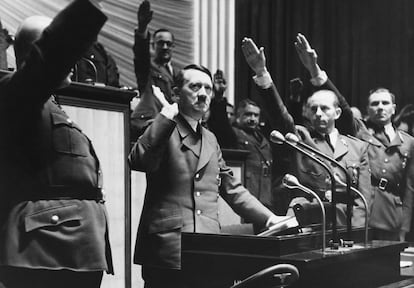

The documentary Hitler’s DNA: Blueprint of a Dictator, airing on the Channel 4 in the U.K., was bound to provoke controversy and sensational headlines, no matter how rigorously or carefully its creators approached the subject. While some of its conclusions definitively put an end to harmful myths and superstitions — such as the claim that the dictator had Jewish ancestry, which is completely false — others allow for a dose of sensationalism, like the idea that Adolf Hitler had a micropenis or was missing a testicle. Still other findings open important ethical debates, such as the researchers’ speculative suggestion that the man who has come to symbolize evil in human history may have had a predisposition to neurological syndromes such as autism, schizophrenia, bipolar disorder, or ADHD (attention deficit hyperactivity disorder).
The story of how the program, which consists of two episodes, came to be made is as fascinating as its conclusions. It involved credible scientists, such as British historian Alex Kay, currently at the University of Potsdam and a specialist in Nazi Germany, and geneticist Turi King, who among other major discoveries identified the remains of the legendary Richard III in an open-air parking lot in Leicester in 2012. “I really agonized over whether or not I wanted to be involved [in the documentary],” King admits in the opening minutes of the show. But she knew that the research would happen sooner or later, and she decided to join in to ensure the necessary caution and rigor.
Hitler’s DNA was obtained from bloodstains on the sofa in the bunker where the Nazi dictator shot himself in the head, shortly after Allied troops entered Berlin. U.S. Army Colonel Roswell P. Rosengren was able to access the shelter and had the presence of mind to cut out a piece of the upholstery, which has been on display for years at the Gettysburg History Museum.
None of Hitler’s living relatives agreed to have their genetic material compared with the blood samples to verify its authenticity. However, the researchers had access to a male sample collected by a Belgian journalist a decade ago while investigating rumors that the future dictator had an illegitimate child during World War I.
Comparison confirmed the Y chromosome perfectly — it was Hitler’s DNA. From there, deductions and findings about his ancestry, pathologies, biology, and mental health open a spectrum of a few solid conclusions alongside many hypotheses of varying scientific reliability.
Kallmann syndrome
The part of the documentary that many will view positively is the decisive debunking of the idea that Hitler had Jewish ancestry — a rumor propagated for decades by Holocaust deniers and historical revisionists, which has even been repeated in recent years. In 2022, Russian Foreign Minister Sergey Lavrov invoked the argument that Hitler “had Jewish blood” to justify his accusations of Nazism against Ukrainian President Volodymyr Zelenskiy, who is of Jewish descent.
The program’s most morbid finding, however, is the absence of a nucleotide in a gene called PROK2. From this absence, researchers concluded that Hitler suffered to some degree from a genetic disorder known as Kallmann syndrome, which affects puberty and the development of sexual organs. It can result in one testicle failing to descend into the scrotum or an unusually small penis.
During World War II, British soldiers popularized the song Hitler Has Only Got One Ball. The lyrics went: “Hitler, he only had one ball; the other one is in the Albert Hall [London’s concert hall], his mother, the dirty bugger, chopped it off when Hitler was small.”
The idea of Hitler’s small genitalia seemed consistent with medical records from Landsberg Prison, where he was incarcerated after the failed 1923 Munich coup, which were uncovered a decade ago by German researchers. The examining doctor noted that the prisoner had cryptorchidism in the right testicle, which had not fully descended. Nowhere did the records mention a micropenis, nor can such a condition be inferred from the DNA results. What Kallmann syndrome does produce is low libido and low testosterone production.
“It tells us a lot about his private life — or more accurately, that he didn’t have a private life,” explains historian Alex Kay in the documentary. This condition, according to the expert, would have predisposed Hitler to focus on politics rather than personal matters.
Many scientists, however, believe that the exercise conducted by the documentary suffers from reductionism and excessive simplification. For example, Denise Syndercombe Court, a forensic genetics professor at King’s College London, told the BBC that the program’s creators went “too far in their assumptions” and that “in terms of character or behavior,” the exercise was “pretty useless.”
Ethical issues
Beyond the myth of Hitler’s Jewish origins or the debate about his genitalia, the program raises serious ethical concerns. Using a polygenic test — which assesses a person’s likelihood of developing complex diseases by comparing their DNA with a large population sample — the documentary concludes that Hitler showed a predisposition to autism, schizophrenia, bipolar disorder, or ADHD.
Although the creators emphasize that this predisposition does not mean the dictator developed any of these conditions, linking him to them has scandalized organizations such as the U.K. National Autistic Society, which called the program a “cheap stunt.”
Both Channel 4 and the production company Blink Films have sought to downplay the controversy, pointing out that it includes the opinion of experts like Professor Simon Baron-Cohen of the Autism Research Center at the University of Cambridge, who explains that “how someone behaves is a product of many factors, not just their genetics but also, very importantly, their environment, everything from childhood and life experiences, how they were brought up, access to education and resources and the cultural factors around them.”
Sign up for our weekly newsletter to get more English-language news coverage from EL PAÍS USA Edition









































