
AfD, a key pawn for Trump in Europe, strengthens ties with Washington
The German far right, leading in several polls, is coming in from the cold with the support of Washington’s new strategic document
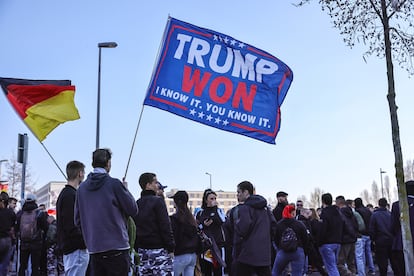

There was a party in Germany that everyone else considered an outcast. Its positions were marginal and, for many, anti-democratic, tainted by the totalitarian ideologies of the 20th century. The story is German, but it happens in other European countries as well.
Now this party, Alternative for Germany (AfD), is leading in many of the polls. It has just received the endorsement of the United States, the country that taught West Germans what democracy was after the defeat of Hitler. It believes it can count on President Donald Trump to break the cordon sanitaire that isolates it in the U.S. and fight the constitutional bodies that could lead to its ban.
The new National Security Strategy, the document in which U.S. administrations present their worldview and priorities, warns of the risk of the “erasure” of what it calls European civilization. It accuses EU leaders of “subverting the democratic process.” It promises to “cultivate, within European nations, resistance to Europe’s current trajectory.”
For the United States, this “resistance” is made up of parties such as Vox in Spain and the National Rally (RN) in France, or AfD in Germany.
The German far right is a unique case. It enjoyed the support of Trump-aligned magnate Elon Musk and Vice President J.D. Vance in the campaign for the general election last February and became the second-largest group in parliament. It is a more radical party than the National Rally, to the point that German intelligence services have labeled the AfD an “extremist” party with principles contrary to the democratic order.
In Germany, the natural party of Atlanticism — the one that anchored the Federal Republic in the West after World War II — was the Christian Democratic Union (CDU). Not anymore.
The AfD’s cultivation of ties with the MAGA movement may seem perplexing. Within the German far right, pro-Russian and anti-American currents coexisted, making this close alliance with Washington difficult to imagine.
But today, Washington’s rival is not Moscow. It’s Brussels, the Western “elites.” Just as communist leaders made pilgrimages to Moscow during the Cold War, AfD members now visit Washington and New York, where they cultivate relationships with the new American political elite.
“Until now, the AfD was considered an extremist party, outside the democratic spectrum,” explains political scientist Paula Diehl. “From the moment the U.S. supports it, it automatically becomes socially acceptable.” Diehl, a professor at the Christian Albrecht University of Kiel, uses a very expressive German word, salonfähig, which literally means that its presence is accepted in the halls of society.
Normality through radicalism
Others, like the French National Rally, have emerged from marginality by softening their positions. The AfD is becoming more mainstream by radicalizing.
Not in a meeting room, but in her Bundestag office, Beatriz von Storch, vice-chair of the AfD parliamentary group and a well-informed observer of the U.S., receives this newspaper. In the late 1990s, Von Storch did an internship in Washington with a Democratic congressman. Last January, she attended Trump’s second inauguration. She is one of the German contacts within the Trump camp. On the walls of her office are framed quotes from John Paul II and Ronald Reagan. A picture of Claus Schenk von Stauffenberg, the German military officer who led a plot to assassinate Hitler in July 1944, hangs nearby.
“We see the National Security Strategy as an opportunity for transatlantic cooperation on issues of freedom of expression and migration,” says Von Storch. A common thread between the MAGA movement and its European partners is the denunciation of the alleged limitations on freedom of expression, or the stoking of fears about a Muslim-majority Europe. “It is not surprising that, with their security strategy, and the AfD with its political strategy, we arrive at similar conclusions,” the MP adds, “and that, therefore, we maintain a dialogue.”
The problem for the AfD is that it ends up being seen not only as an appendage of Moscow, but also of Washington: doubly stigmatized as the “party of foreigners.” Last week, AfD members of parliament traveled to the U.S. to participate in meetings in Washington and then at a Republican gala in New York. According to other parties, the trip was financed with public funds. “It is more than worrying that a parliamentary group is taking advantage of the opportunity to travel abroad to stir up trouble against Germany,” Alexander Hoffmann, of Chancellor Friedrich Merz’s conservative group, told the weekly magazine Der Spiegel.
What’s significant is that, until recently, accusations against the German far right centered on its ties to Russia. The existence of a pro-Russian faction and a more pro-American one caused internal tensions. “From the moment the U.S. no longer sees Russia as a rival,” observes political scientist Diehl, “the contradictions are resolved.”
“We are at a point where the West is divided into two camps, and sooner or later each party will have to choose one,” says Von Storch, alluding, without naming them, to Merz’s CDU, who are imposing a cordon sanitaire on the far right. “We stand with those who want to maintain the sovereignty of national democracies. We stand for the Christian West, for our culture and identity.”
Another AfD deputy, Maximilian Krah, proposed a disconcerting historical analogy on social media. According to him, for Merz or the president of the European Commission, Ursula von der Leyen, the National Security Strategy is the equivalent of what Mikhail Gorbachev’s perestroika was in 1989 for Erich Honecker, the orthodox leader of communist East Germany. As then, according to this analogy, the tutelary power — then the USSR, now the U.S. — is abandoning its satellites and their leaders, overwhelmed by history. “The end!” Krah exclaimed. Back then the Soviet bloc fell; today the liberal bloc is supposedly falling.
But the Washington document doesn’t necessarily mean a break in the transatlantic relationship, according to several experts — both Atlanticists and those concerned about its drift — who agreed a few days ago at a colloquium hosted by the DGAP (German Society for Foreign Relations) think tank. What they foresee is that the nature of this relationship will be transformed.
“The question is whether it will be an alliance united by democratic and liberal values, or an alliance united by illiberal values,” said Amanda Sloat, a professor at IE University in Madrid and a veteran of the Biden administration. “They are waiting [in Washington] for the National Rally and other parties like the AfD to come to power, and they have strategies to help make that happen,” said Thomas Kleine-Brockhoff of the DGAP. “That’s what they’re doing.”
Sign up for our weekly newsletter to get more English-language news coverage from EL PAÍS USA Edition









































