
Trump’s worldview clashes with a Europe trying to defend itself
A classified version of Washington’s controversial National Security Strategy proposes creating a new forum of powers that would exclude the Old Continent
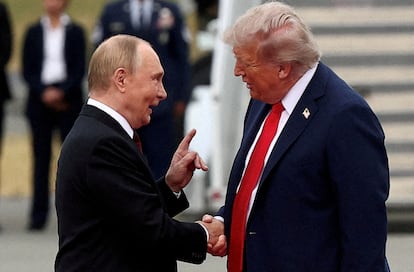

A U.S. government that defends the free expression of the far right. That is obsequious to Russia and appeases China. A government for whom the villains are the “soft” liberal democracies of Europe, and an invaded country, Ukraine, is as guilty of its occupation as the aggressor, Moscow. This is not a dystopia created by George Orwell in 1984 or Philip K. Dick in The Man in the High Castle. Nor is it the product of the worst nightmares of former presidents like Franklin D. Roosevelt or Ronald Reagan. It is the administration of President Donald Trump and his vision of foreign policy. A vision in which wealthy countries — or those from which one can profit — are what matter. The rest, in the president’s own words, are “garbage,” like Somalia.
But not everyone in the United States accepts this view, which became clear on December 4 with the publication of the National Security Strategy signed by Trump himself. Some measures of resistance are already being outlined in his country. EU leaders, the target of the Republican’s criticism, will try to find a joint response at the crucial summit to be held this Thursday and Friday in Brussels to the military, economic, and geostrategic attacks coming from both Washington and Moscow.
Trump has confirmed that the National Security Strategy — in which Europe appears as the enemy to be defeated and Latin America is portrayed partly as the origin of some of the major U.S. problems, and partly as a basin of resources — truly describes his concept of foreign policy.
In an interview given on December 8 to the online newspaper Politico, the president insulted European leaders, whom he called “weak,” and reiterated his conviction that the continent is on the path to “civilizational erasure” for being too tolerant of immigration.
On the same day, he gave the green light for China to acquire Nvidia’s H200 series artificial intelligence semiconductors, among the most advanced currently available: a step that would have been unthinkable during his first term, when he unleashed a technological war between the two giants. Earlier, Trump’s envoys, Steve Witkoff and his son-in-law, Jared Kushner, had returned from their trip to Russia to negotiate with Vladimir Putin.
According to Trump’s foreign policy, the great powers — rather than competing as Washington had proclaimed until now — tolerate each other. They allow each other to dominate their respective geographic spheres of influence and set aside ideologies to do business. It is a worldview in which the word “corruption” does not exist and where contradictions abound: the president proclaims himself a peacemaker, yet prepares for a possible war in Venezuela and promises enormous defense spending.
“It’s a triumph of the economy and trade relations over anything else,” says Michael Froman, former economic advisor to Barack Obama and current director of the Council on Foreign Relations (CFR). “The mirror through which China, Europe, or the Western Hemisphere are viewed seems to be primarily that of economic opportunities for the United States,” he notes.
Two versions of the document
The publicly released version of the National Security Strategy has sparked dismay among European partners. But there is another, more extensive version that remains classified, according to the online publication Defense One, which claims to have obtained a copy. This version is even more ominous for Europe and for supporters of democracies and human rights — those whom the Trump administration and its supporters in the MAGA movement label as “globalists.”
According to this version, the Trump administration intends to convince four countries (Italy, Hungary, Austria, and Poland) to leave the European Union, as the United Kingdom did, and thereby “Make Europe Great Again.” It also intends, according to the online publication, to “support parties, movements, and intellectual and cultural figures who seek sovereignty and preservation/restoration of traditional European ways of life… while remaining pro-American.”
The classified version also suggests the creation of a new forum of major powers, the “Core Five” or C-5. This group would bring together the United States, China, India, Japan, and Russia, and would completely exclude Europe. It would also sideline other associations of key players in the current global architecture, such as the G-7 of the most developed democratic nations, or even the G-20, the group of the world’s leading economies.
This C-5 would meet regularly at summits with specific themes. Among them, one on security in the Middle East, which would aim to normalize relations between Israel and Saudi Arabia.
The published document proclaims that “the days of the United States propping up the entire world order like Atlas are over.” The classified version, according to Defense One, states, instead, that the goal of achieving global hegemony was “the wrong thing to want and it wasn’t achievable.”
The White House has denied the existence of any version of the National Security Strategy other than the one already published. Spokesperson Anna Kelly emphasized: “No alternative, private, or classified version exists. President Trump is transparent and put his signature on one NSS that clearly instructs the U.S. government to execute on his defined principles and priorities.”
In the past, Trump has flirted with the idea of integrating China and Russia into the G-7 — the group of the most developed democratic economies plus the European Union — and has declared Moscow’s expulsion from that forum after Russia’s invasion of the Ukrainian peninsula of Crimea in 2014 a “mistake.” After his meeting with Chinese President Xi Jinping in South Korea in October, Pentagon chief Pete Hegseth even spoke of a G-2, a concept that Beijing had been proposing and that Washington had systematically rejected until now: a relationship in which both giants recognize and treat each other as equals.
To what extent Trump’s strategy will materialize is questionable. Some of his attempts at exerting pressure in Latin America have been a complete failure: after trying to force Brazil to pardon former president Jair Bolsonaro, the United States lifted sanctions on the judge who convicted him, Alexandre de Moraes, last Friday. Ukraine refuses to cede the territories Trump is proposing to Russia. Moscow and Beijing already have a stronger relationship with each other than the ties that are emerging between either of them and Washington.
Within the United States, the outlook is also uncertain. Next year’s midterm elections could give Democrats control of at least one house of Congress and upend the political landscape. The National Security Strategy has generated criticism and surprise and not only among the opposition, which, like the ranking Democrat on the Senate Foreign Relations Committee, Jeanne Shaheen, believes “the president’s harsh attacks, in word and deed, towards our closest allies are nonsensical when compared to his kind words and sweetheart deals for autocrats like Xi Jinping and Vladimir Putin.”
The House of Representatives gave an initial indication that Trump will not find it easy to impose his vision: this week it passed a $900 billion defense budget bill, a measure the president had long desired. But it included a key provision requiring the Pentagon to maintain at least 76,000 troops in Europe: a way to protect the U.S. military presence against the administration’s desire to cut it. And to tell the president that he can’t have it all.
Sign up for our weekly newsletter to get more English-language news coverage from EL PAÍS USA Edition









































