
EU’s prestige at stake with proposal to fund Ukrainian war effort with Russian assets
European leaders must decide this week whether to mobilize €193 billion in sovereign funds held by a Belgian clearinghouse. Failure would ‘seriously damage the EU’s capacity for action for years,’ warns German chancellor Merz
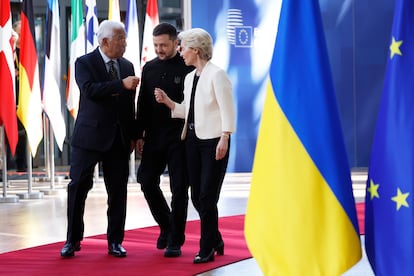
Just steps from the shopping boulevards and bustling city center of Brussels, in an unassuming skyscraper, sits the financial institution that holds the key to a treasure chest that could unlock one of the most consequential decisions the European Union has made in a long time. Euroclear, a little-known Belgian financial clearing house, is now under scrutiny. This organization holds €193 billion in Russian funds, mostly belonging to the Central Bank of Russia, frozen since 2022 due to sanctions imposed on the Kremlin following the invasion of Ukraine. The EU is now debating whether to release more than €92 billion from these Russian sovereign wealth funds to Ukraine as a “reparations loan” to help the country stay afloat.
The decision, encouraged by the European Commission — the EU executive — and countries like Germany, will be the focus of the European summit on Thursday and Friday in Brussels. If approved, it would represent a qualitative leap in the EU’s sanctions policy against Russia. With this initiative, Europe’s prestige is at stake. “Let’s not fool ourselves. If we don’t succeed, the EU’s capacity for action will be seriously damaged for years, or even longer,” declared German Chancellor Friedrich Merz on Monday in Berlin.
But both Euroclear — a company that manages the pipelines of the stock market, through which shares, sales and cross-border transactions circulate, ensuring that everything works smoothly— and Belgium, the country where that entity settled decades ago, oppose the proposal.
Meanwhile, Kyiv’s European partners are clinging to the idea. Against a backdrop of very tight budgets, they maintain that this is the only viable and quickest way to throw Ukraine a financial lifeline at this crucial moment. The EU is now debating complex legal mechanisms to try to unblock the proposal and win over Belgium and a few other members, such as Italy, who are not entirely convinced. Bulgaria and Malta are also not satisfied. Their preferred option? Joint debt, which faces outright rejection from Germany and the Netherlands.
The roadmap remains on track. Last week, a majority of EU member states approved an unprecedented emergency mechanism, designed for crises or natural disasters, that allows these funds to be frozen indefinitely (instead of having to renew the sanctions that freeze them every six months) and, moreover, the move was approved by majority vote instead of unanimity. This was a highly significant first step toward accessing these funds and avoiding a veto from Kremlin-friendly members states such as Hungary.
The Thursday and Friday summit in Brussels promises to be a truly heated one. The Belgian government argues that this financial lifeline for Kyiv could be extremely damaging not only to Belgium, but to the entire European market and its reputation. They also contend that the decision could create a rift and set a precedent for similar decisions against other global players whose funds are held in custody by Euroclear or other financial institutions. Countries like China, India, and others with large reserves in Europe are closely watching how events unfold.
Russia’s demands
Russia, which has already filed lawsuits against Euroclear over its inability to access its own funds, has warned that if Russian funds sitting in this company and in private banks in countries like France are used for Ukraine, it will consider it a “cause of war.”
Euroclear, which manages €42.5 trillion in deposits, remains almost silent. Its chief executive, Valérie Urbain, stated in an interview with Le Monde a month ago (one of the very few times she has spoken publicly) that she does not rule out suing the EU if the legal framework chosen for the frozen Russian assets results in their confiscation.
From that conversation, it’s clear that Urbain, who, like her entire family, has bodyguards due to threats, fears for the future of her institution. “We are a crucial link that must remain unbroken for the stability of the financial markets,” she told the French newspaper.
Pressure is mounting on Belgium. Representatives of the member states are analyzing the European Commission’s latest legal proposal, which seeks to guarantee the Belgian government that the risk will be shared regardless of the circumstances.
Until now, the use of these Russian sovereign assets had been different. Last year, the EU approved using the returns they generate to issue a significant loan to Ukraine. Now, the proposal is unprecedented. The European Commission’s idea is to use the cash balances of the Russian assets to issue a zero-interest loan to Ukraine, which would only have to be repaid if Russia, once the war ends, pays for the damages caused. In return, the member states would provide a guarantee.
Furthermore, a three-point network is being offered to Belgium: the country could access funding equivalent to the full package if it were to face legal demands or reprisals from Moscow; it could count on that funding, regardless of the total financial guarantees offered by each EU country; and the money will not be transferred until the guarantees are in place, according to diplomatic sources.
The 27 member states are also debating, as part of the proposal, that all countries that still have bilateral investment treaties with Russia (such as Spain, for example) terminate them simultaneously. However, this does not entirely prevent possible reprisals from the Kremlin, since these agreements contain temporary clauses that maintain protection mechanisms.
From a political standpoint, most already have their hands in the till. The idea is not just to throw Ukraine a financial lifeline, but to elevate the symbolic component: that Russia should foot the bill for the damage. However, not all economists and experts are convinced by this approach.
Ursula García, founding partner of finReg 360, a law firm specializing in financial regulation, warns that taking the step of appropriating assets requires a “solid legal foundation.” This element is key for her. Failing to do so properly could open the door to litigation in international courts for many years, with uncertainty about the outcome for a key institution in the financial markets.
For Judith Arnal, a researcher at the Elcano Royal Institute, there are “very significant” legal doubts on two fronts. “From the perspective of public international law, there is the principle of sovereign immunity that protects the assets of states, even in the context of sanctions. While the EU has legally frozen these assets through sanctions, taking the step of mobilizing the principal, not just the returns, enters legally more uncertain territory and could be subject to challenges before international courts,” she points out.
“From Belgium’s perspective, the problem is even more concrete: Euroclear, as an entity domiciled in Belgian territory, maintains a contractual legal obligation to return the assets to their legal owner, which remains the Central Bank of Russia. If the EU borrows these balances and disburses them to Ukraine, Belgium becomes the jurisdiction where a repayment obligation of €185 billion would materialize if the sanctions are lifted, further exposing it to potential Russian reprisals of a cyber, energy, or other nature,” Arnal adds.
The researcher, who also works at the Centre for European Policy Studies, has just developed a proposal together with the director of this think tank that relies solely on the use of returns from fixed assets, creating an extraordinary financial tool that “avoids touching the main assets, drastically reduces Belgium’s legal and geopolitical exposure, and relies on conventional financial instruments that the markets understand perfectly.”
Arnal —and other analysts such as Wolfgang Münchau— point out that taking the step proposed by the Commission without further ado could set a “precedent that erodes the confidence of other central banks [not just the Russian one] to maintain significant euro reserves in European infrastructures, weakening the attractiveness of the euro as an international currency.”
Sign up for our weekly newsletter to get more English-language news coverage from EL PAÍS USA Edition









































