
Trump confronts the EU with its greatest fear: Political interference from its biggest ally
The United States has launched a cultural and ideological war against liberal Europe
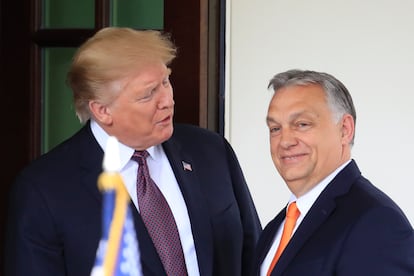
The era of harmony in transatlantic relations is over. For Donald Trump’s United States, Europe — with its project of values and defense of the rules-based multilateral order — is an adversary. One that must be steered back onto the illiberal and reactionary path dictated by Trumpism and followed by its European allies: the ultra-right-wing, national-populist, and Eurosceptic Trojan Horses who seek to undermine the European Union from within. Washington, which refers to these groups as “patriotic” political parties and formations, aims to promote them in its new national security strategy. This promise of interference, of meddling in European sovereignty, might sound more like something autocracies like Russia or China would do (though they would most likely keep their intentions quiet) than the historic ally that is no longer one.
The document, made public in the early hours of Friday morning, outlines the Republican administration’s strategy for addressing geopolitical challenges facing the U.S. and the world. It comes at a time when U.S.-European relations are at a low point, marked by the trade war and Washington’s decision to sideline Europe in negotiations to end Russia’s war in Ukraine. The document makes its playbook abundantly clear. “Our objective should be to help Europe correct its current trajectory,” it states. And that implies “cultivating resilience,” it continues.
This is something that Washington has historically done, as during the Cold War. “The difference is that back then it was done in the name of democratic values,” notes Ian Lesser, a distinguished fellow at the German Marshall Fund think tank, who also points out that the strategy reflects Trump’s preference for dealing and negotiating with specific individuals, parties, or governments, rather than with organizations and entities like the EU.
The age-old divide-and-conquer strategy aims to weaken the bloc of 27 countries and 450 million inhabitants. It seeks to undermine the EU, as Russia has already attempted — a tactic echoed in the U.S. administration’s document, which appears to have more affinity for the Kremlin than for Brussels.
Now, Trump is leveraging his power and social media reach to boost parties aligned with MAGA ideology. These include far-right groups like Alternative for Germany, which the U.S. president endorsed in last year’s elections. His tech magnates are also working hard to shape a Europe that suits their interests or benefits their businesses, with less regulation and weaker consumer and data protections. And they are using blackmail to achieve this, suggesting they could recalibrate their tariff policies if Europe weakens its technology regulations, a senior EU source notes.
The national security strategy is a veritable written declaration of cultural warfare. It aligns perfectly with what U.S. Vice President J.D. Vance declared at the Munich Security Conference last February. His speech — in which he asserted that freedom of expression “is under attack in Europe” — shocked those who still considered themselves his allies, and who must have realized then that things have changed.
There are still those who hold out hope, however. At least publicly. “The U.S. is still our biggest ally,” said High Representative for Foreign Affairs and Security Policy Kaja Kallas on Saturday at the Doha Forum in Qatar. “I think we haven’t always seen eye to eye on different topics, but I think the overall principle is still there. We are the biggest allies and we should stick together,” the EU’s top diplomat affirmed.
“Dear American friends, Europe is your closest ally, not your problem,” Polish Prime Minister Donald Tusk emphasized. “And we have common enemies. At least that’s how it has been in the last 80 years. We need to stick to this, this is the only reasonable strategy of our common security. Unless something has changed,” he added on Elon Musk’s social network, X, which the tech magnate uses daily to launch tirades against European democracies and their regulations.
For Mujtaba Rahman, coordinator of the EU unit at the political risk analysis consultancy Eurasia, the U.S. administration’s document confirms the deepest fears of many European capitals. Of course, they were aware of the shift in support for Ukraine, the rethinking of NATO, and the trade war, but above all, they feared the ideological clash, this analyst points out: “This strategy makes that policy explicit — MAGA’s desire to work with allies in member states, to support far-right parties to help overthrow the government in power,” he explains by phone.
“This is a major strategic problem, because there is no good answer to how Europeans can address the administration’s political leanings. It plays on the biggest fear that member states have had about the U.S. administration,” he insists.
For Rahman, managing this type of interference in domestic politics, especially when it comes from a supposed ally, and even more so if it’s the United States, is much more difficult than interference from hostile countries. “Electoral interference by Russia has become the norm. It’s predictable and, of course, undesirable, but when it comes from an ally, from a country that is supposed to be the guarantor of European security, it’s a completely different and much more problematic situation.”
“This strategy is definitive confirmation, if we needed it, that the United States considers liberal democracy and European integration to be adversaries,” asserts Nathalie Tocci, director of the Institute for International Affairs and a professor at Johns Hopkins University, in a telephone interview. To be able to act, Europe must finally accept the reality of this divorce, which some are finding difficult to acknowledge, she maintains. “Trump is not unpredictable, inconsistent, or incoherent. In fact, he is extremely coherent, consistent, and predictable when it comes to Europe: he wants to destroy us,” Tocci states.
“We must be extremely cautious in how we have addressed our weaknesses, for example, in defense, by increasing our dependence on the U.S. If they consider us adversaries, that’s not the wisest thing to do right now,” says the expert, who believes it is very difficult to reduce these vulnerabilities and dependencies in the short term, but that they must be addressed definitively. “Sometimes, as Europeans, we should take a step back and reflect: if there are countries much smaller, much weaker, much poorer than us, and with much greater capacity for action than Europe, perhaps our main problem is psychological rather than one of capabilities. And that is the level at which we should be working,” Tocci concludes.
“The U.S. National Security Strategy is clear evidence and provides ample arguments for why Europe needs to rapidly build its own defense independence and its own geopolitical independence,” the European Commissioner for Defense, Andrius Kubilius, said on social media this Saturday. “We have the defense readiness strategy, a roadmap for our defense independence. We need the same for our geopolitical independence,” he added.
In Brussels, more than one person on Friday — after reading the document and recovering from the shock of seeing in black and white what they already knew about the U.S. administration — was confident that this would be a wake-up call, leading those who still harbored hopes of a more manageable (or less hostile) White House to abandon them. And from there, those who make the decisions should move to action. Hans Kribbe, senior researcher and founder of the Geopolitical Institute in Brussels, summarized it this way: “This document should focus Europeans on the geopolitical question that really matters: do we want to be vassal states or a free continent pursuing its own interests?”
Sign up for our weekly newsletter to get more English-language news coverage from EL PAÍS USA Edition









































