
Oleksandra Matviichuk, Ukrainian lawyer: ‘Putin doesn’t want peace. He wants to forcefully restore the Russian Empire’
The activist who heads the Ukrainian organization Center for Civil Liberties, which won the 2022 Nobel Peace Prize, warns that ending the invasion will only be possible if the Kremlin feels that ‘the price of continuing the war is higher than the price of stopping it’
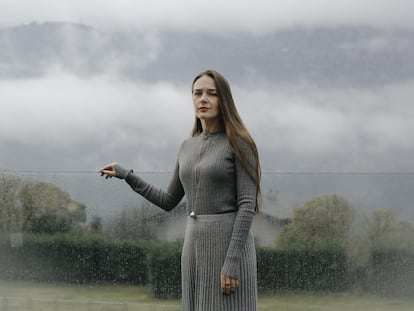

When Oleksandra Matviichuk, 42, accepted the 2022 Nobel Peace Prize as president of the award-winning Center for Civil Liberties, she said something very significant in her acceptance speech: faced with brutal aggression and the absence of justice, many human rights and peace activists were forced to defend their ideals with weapons in hand. Through her life, her work, and her words, as well as the award for the organization she leads, she sheds light on the defense of peace and human rights in a time of unbridled imperialism and growing impunity
Matviichuk gave this interview on Thursday in the Italian town of Saint-Vincent, on the sidelines of the Grand Continent Summit, a conference organized by the magazine of the same name to reflect on the future of Europe. During the conversation, the Ukrainian lawyer expressed her conviction that “Putin doesn’t want peace. He wants to achieve his goal. […] He wants to forcefully restore the Russian Empire.”
After the interview, she was preparing to travel to Syria, another country where Russia’s actions, through its support for Bashar al-Assad’s dictatorship, should be subject to judicial scrutiny.
Question. We are seeing intense diplomatic negotiations to stop the conflict in Ukraine. What do you think is necessary to achieve peace?
Answer. I work directly with people affected by this war. So let me assure you that people in Ukraine dream of peace. Because war is horrible. Unfortunately, Putin doesn’t want peace. Putin wants to achieve his goal. And when we look at the current situation, we see how Putin is trying to imitate peace negotiations to, first, gain time, and second, to decrease the level of support of Ukraine, to make his goal to occupy the whole country easier. And the main question in all these peace talks is whether we can make Putin stop. I don’t mean just an operational pause, withdrawing and resuming the act of aggression, but to getting a lasting peace.
Q. And how can that be achieved?
A. It means that we must begin discussing, first, real security guarantees for Ukraine, to make Putin understand that it is impossible for him to achieve his goal of occupying the entire country and advancing further, attacking the next one. And second, that the United States and the European Union must take decisive action to make the price for Putin of continuing the war higher than the price of stopping it.
Q. What is Putin’s ultimate goal in deciding to attack Ukraine? Is it just about Ukraine, or is it something more?
A. It’s not just about Ukraine. Russia is an empire. An empire has a center, but it has no borders. An empire is always trying to expand. These aren’t my words. They are Vladimir Putin’s, who claimed that the borders of the Russian Federation “never end.” And I’ve seen it even in my human rights work. When I interviewed people who survived Russian captivity, they told me that Russians see their future like this: first we will occupy Ukraine, and then, together with you, we will go on to conquer other countries. Putin sees Ukraine as a bridge to attack the next European country. His logic is historical. He dreams about his legacy. He wants to forcibly restore the Russian Empire because the collapse of the Soviet Union was, to quote him, “the biggest geopolitical catastrophe of the past century.” So he wants revenge. And this means that people in the European Union are safe only because the Ukrainians are still resisting and not allowing the Russian army to advance and attack the next country.
Q. The organization you lead was awarded the Nobel Peace Prize. President Donald Trump is very keen to win one, but he doesn’t seem to care much about human rights and democracy. And the 28-point plan we saw recently completely ignored the justice aspect of the future of this conflict. What do you think about Trump’s initiatives?
A. I think it’s a good attempt to stop the war. President Trump said he wants to end this war because he cares about the people who are dying. But that also means he needs to care about the people who are dying in Russian prisons. And the human dimension needs to be included in the peace plan. And in those 28 points, there isn’t a word about the millions of people living under Russian occupation. This is not right. We’re talking about millions of Ukrainians living in terror without the tools to protect their rights, their freedom, their property, their lives, their children, their loved ones. Russian occupation isn’t just changing from one government to another. Russian occupation means enforced disappearances, torture, rape, denial of your identity, forced adoption of your own children, infiltration camps, and mass graves. We need to talk about what will happen to the more than 20,000 Ukrainian children who were illegally deported and separated from their families. There are many urgent humanitarian issues, and I think it’s wrong for politicians to only talk about geopolitical interests and not about the people.
Q. What do you think of the Europeans? They have been supporting Ukraine financially, militarily, diplomatically. Is it enough?
A. I recently heard a top Swedish government official report on how much money they’ve allocated to support Ukraine [shows an image of a presentation on her phone]. It’s €170 billion [$197 billion]. And how much money they’ve spent buying products from Russia. And you can see it’s €311 billion [$362 billion], much more. This is the answer. We’ve heard a lot of decisive words from the European Union. Very correct words. We need correct actions. There are words, there are actions, and there’s a gap. And the European Union leadership is behaving as if they have time. As if they have several years before Russia starts attacking. But Putin isn’t stupid. Why do they think he’ll give them several years to prepare and not attack now?
Q. What should Europe do?
A. I think that to regain the initiative, the European Union must take decisive action. Such as creating a special tribunal on aggression, using frozen Russian assets for self-defense and the reconstruction of Ukraine. And also helping Ukraine close its airspace. I literally don’t understand what the problem is with shooting down a piece of metal that costs €1,000 [$1,160]. I’m referring to a Russian drone. It’s not an airplane with a pilot, just a piece of metal. Russia sends hundreds and hundreds of drones every day to destroy Ukrainian civilian infrastructure. And they succeed, because now we have lost the vast majority of the energy infrastructure in Ukraine, which poses a real threat to millions of people who could face winter without heating, without water, without energy, without electricity. It’s a vital problem because you can’t even warm milk for a newborn.

Q. In Ukraine, an anti-corruption investigation has forced the resignation of the president’s chief of staff. This is a sign that Ukrainian democratic institutions are working, but at the same time, it is a major blow to a government in wartime. What is your opinion on this matter?
A. I’ll start with my emotion. I was furious. Furious, like millions of people in Ukraine, for an obvious reason: we all donate a lot. We donate to the Ukrainian army, to the wounded, to people who lost everything in this war, to the victims of Russian war crimes. Ukrainian pensioners give the last of their pensions as donations.
But when we look at the situation from a pragmatic point of view, first, this corruption scandal has happened not because of a journalistic investigation, but because of an official investigation by state anti-corruption agencies, which shows that these official anti-corruption agencies are working effectively. Just 12 years ago, this was unthinkable, because before the Revolution of Dignity [also known as Euromaidan], these people were untouchable. It’s a sign that we’re on the right track and making progress.
And secondly, and this is very important: this official investigation by the anti-corruption agencies was possible because this summer a huge number of people took to the streets in Kyiv and other cities to peacefully protest against an attempt by the Ukrainian Parliament to limit the independence of the anti-corruption agencies. And we succeeded. We preserved that independence. And this is not a sign of weakness. It is a sign of the strength of Ukrainian society. Because, once again, we are very different from Russia. Our source of survival is not top-down resilience. It is not a centralized hierarchy. It lies in local democracy, in freedom of speech, in the agency of ordinary people, in grassroots initiatives, in self-organization, and in people’s belief that their efforts matter. So yes, we are not perfect. We have a lot of problems that we take seriously. It is our responsibility. But we are still a democracy. A democracy in transition, and we are on the right track.
Sign up for our weekly newsletter to get more English-language news coverage from EL PAÍS USA Edition









































