
The Kremlin clings to Trump’s concessions and calls European plan ‘unconstructive’
Vladimir Putin says the White House’s original proposal ‘can be used as the basis for a final peaceful settlement’ in Ukraine
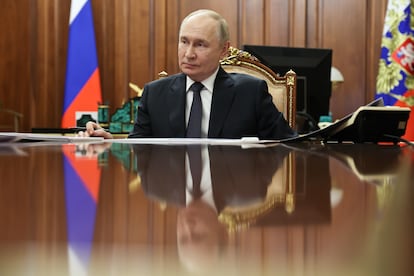

The Kremlin rejects the European peace plan and the progress agreed upon between the United States and Ukraine, and insists that negotiations should begin with Washington’s original proposal, which left Kyiv on the verge of surrender. Moscow took this position on Monday following intense negotiations held last weekend in Europe, emphasizing that no agreement has yet been reached.
“The Kremlin is aware of the European peace plan. Its provisions are unconstructive and unsuitable for Russia,” said Yuri Ushakov, Vladimir Putin’s foreign policy advisor. Earlier, the Russian leader had reiterated in a call with Turkish leader Recep Tayyip Erdogan that Donald Trump’s original proposal “can be used as the basis for a final peaceful settlement.”
The original initiative launched by Washington consisted of 28 points, including the transfer of the entire Donetsk and Luhansk regions to Russia, a freeze on the conflict in Kherson and Zaporizhzhia, and a firm rejection of Ukraine’s entry into NATO. Following a meeting Sunday between delegations from Kyiv and Washington in Geneva, the new peace plan had been reduced to 19 points and included some of Ukraine’s main demands, according to the Financial Times. The newspaper RBC Ukraine added that the provisions regarding territories and Kyiv’s non-adherence to NATO have been postponed for further debate at the presidential level.
“We have received a draft. And, naturally, it will be subject to review and modification on our part, and, most likely, by Ukraine and the American and European sides,” Ushakov explained. “Russia is aware of one of the options in the American peace plan, but no concrete negotiations have taken place,” the diplomat added.
Putin’s advisor denounced the alternative proposed by the European Union, whose plan envisions security guarantees for Ukraine similar to NATO’s Article 5 [protection through military intervention in the event of a renewed invasion] by European partners and the United States. However, Ushakov has shown some appreciation for the Trump administration’s initial proposal.
“Many — I wouldn’t say all, but many — of the provisions in this plan seem entirely acceptable to us. Others, and there are many — 28 points in total — require discussion and detailed consideration between the parties,” Ushakov said.
Peace negotiations had cooled after the meeting between Putin and Trump in Alaska in August. Faced with American attempts to end the war quickly, the Kremlin responded in recent months that peace must address “the root causes of the conflict.” That is, it must satisfy all Russian objectives, disarm Kyiv, and bring Ukraine back under its sphere of influence.
The new peace plan has revived these talks, albeit in a confusing manner. In fact, the origin of the original U.S. draft is uncertain. Some media outlets speculate that it may have been a document sent by Moscow to Washington. Several Republican senators said over the weekend that U.S. Secretary of State Marco Rubio had told them the original plan was a Russian “wish list.” Rubio later refuted this accusation.
In any case, the Kremlin does not want to accelerate negotiations. Putin stated last Friday that the 28-point plan must be reviewed “thoroughly” and expressed his satisfaction with the progress of his invasion, which is on track to surpass, in less than two months, the duration of the Soviet Great Patriotic War against the Third Reich.
Putin has shown interest in the original American draft, and reiterated Monday that the plan could form the blueprint for an eventual peace deal.
“Vladimir Putin told [Erdogan] that these proposals, in the form in which they were formulated when the Russian side reviewed them, are in line with what was discussed during the Russia-United States summit in Alaska,” the Kremlin statement said regarding the conversation with the Turkish leader.
However, the American proposal has not sparked any euphoria in Russian political circles. High-ranking officials have remained silent, even the most outspoken, such as former president Dmitry Medvedev, and only one Duma deputy has voiced what many are thinking. “It is a provocation [...] The conflict can only be fully resolved if we achieve a clear victory on the front and Ukraine capitulates. Any other outcome will simply postpone the war,” declared Alexei Zhuravlev, first vice-chairman of the State Duma Defense Committee, this past weekend.
The Kremlin is trying to rewind negotiations to the sweet spot it reached with Trump during the presidential summit in Alaska, when it managed to avoid the first sanctions imposed by the new U.S. administration. However, the White House eventually lost patience with its convoluted negotiations and sanctioned Russia’s two largest oil companies, Lukoil and Rosneft, in October.
According to Abbas Galiamov, a former speechwriter for Putin, writing in the independent media outlet Mozhem Obiasnit, Trump’s rushed peace plan “could simply be a show” to try to curry favor with the Russian president after “literally, illegally seizing” the overseas assets of his oil companies. “For Putin, this represents a major blow, not only financially, but also reputationally in the eyes of his elite,” he adds.
So far, U.S. sanctions have caused Russia’s oil export revenue to fall by 35% in November compared to the same month last year, according to estimates by Reuters. This represents a significant blow to an economy heavily reliant on hydrocarbon exports.
Sign up for our weekly newsletter to get more English-language news coverage from EL PAÍS USA Edition









































