
US and Ukraine move closer to agreement on peace plan
Kyiv and Washington claim to have created an ‘updated and refined peace framework’ based on the Russian-American one that Trump and Zelenskiy must now approve
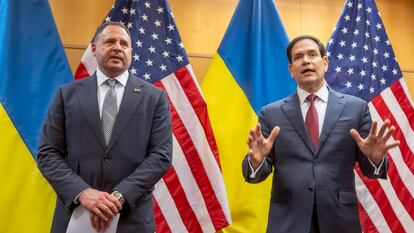
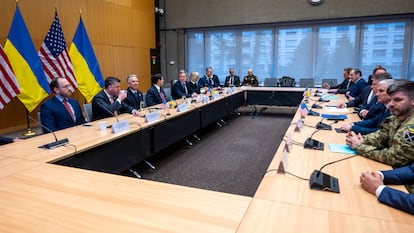
Kyiv is heading into a critical moment. The United States and Ukraine made progress on Sunday night toward a preliminary agreement on a peace plan aimed at ending the imperialist war launched by Russia in February 2022. The project — drafted after an intense meeting in Geneva, in which the Ukrainian government was supported by European representatives, and based on the controversial U.S.-Russian proposal — still requires technical work and the “final decisions” of U.S. president Donald Trump and Ukrainian president Volodymyr Zelenskiy, according to a joint statement issued by Washington and Kyiv. “As a result of the discussions, the parties drafted an updated and refined peace framework,” says the statement released in the early hours, which opens a path of hope for the invaded country by stating that “any future agreement must fully uphold Ukraine’s sovereignty.”
The statement does not provide any details about this new framework, leaving many questions unanswered. In addition, in a separate declaration, the White House said that the new version of the plan included strengthened security guarantees and that the Ukrainian delegation considered that the framework “reflects their national interests,” something not included in the joint statement.
The announcement of progress in the negotiations comes after Trump increased pressure on Kyiv. The U.S. president on Sunday said that Zelenskiy had “zero gratitude” for U.S. efforts to achieve peace, and criticized Europeans for continuing to buy oil from Russia while trying to support Ukraine.
Neither Ukraine nor the United States has revealed the content of the new framework agreement, which amends the 28-point plan outlined by Russia and the U.S. that required Kyiv to cede territory to the Kremlin, limit its army, and give up its ambitions to join NATO. However, the foundation — the core of this preliminary agreement — remains that roadmap drafted without the participation of Ukraine or Europe, which Kyiv and European partners have tried to modify as much as possible to limit the extent of the damage.
The Ukrainian and European idea, according to sources familiar with the negotiations, is to shield Ukraine with solid security guarantees that would allow them to defend the country in the event of new aggression (something that would serve as a deterrent to the Kremlin), as well as ensure that Kyiv is not forced to limit its military size and weaponry as severely as the 28-point plan suggests. On the table is the idea of a force of 800,000 troops in peacetime, instead of the mere 600,000 marked by the U.S.–Russian roadmap. They also seek to reformulate and minimize as much as possible the clauses under which the invaded country would be required to cede territory.
Reuters reported having seen the document containing the European counterproposal, built upon the 28-point plan. This new text proposes, among other things, that the security guarantee offered by the U.S. should be similar to NATO’s Article 5 (which guarantees mutual defense in case of attack); that Ukraine hold elections as soon as possible after the agreement — rather than within a fixed 100-day period; that Ukraine’s integration into NATO depends on the consensus of all members, a consensus that does not exist — rather than obliging Kyiv to include in its constitution a renunciation of accession; and that NATO agrees not to deploy troops in Ukraine in peacetime — rather than not at all.
As for the territorial issue, instead of accepting Russia’s de facto annexation, the text merely states that Ukraine commits not to seek to recover its sovereign territories by force.
European leaders, who have spent weeks debating a European Commission proposal to transfer to Kyiv €180 billion ($207 billion) in frozen Russian sovereign assets located within EU territory (mainly in Belgium) due to sanctions, are also demanding that these funds be handed over to Kyiv as compensation and used for reconstruction.
Meanwhile, the U.S.–Russian plan states that around €100 billion ($115 billion) of the Russian assets would be invested in reconstruction and in projects in Ukraine, but through a U.S.-led format in which the United States would receive 50% of the profits. Europe would also add, according to that plan drafted without the Europeans, another €100 billion for reconstruction.
U.S. Secretary of State Marco Rubio, and Head of the Office of the President of Ukraine Andriy Yermak described the Geneva talks as enormously significant. “We’ve had probably the most productive and meaningful meetings so far in this entire process,” Rubio said on Sunday. What remains now is both to clarify the details of the new framework and to gauge the Kremlin’s reaction — and whether it will once again block efforts to end the war.
European mobilization
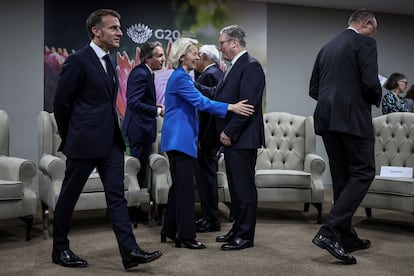
Europe and Kyiv’s Western allies have mobilized to support the invaded country in its negotiations with the United States. “Any credible and sustainable peace plan should first and foremost stop the killing and end the war, while not sowing the seeds for a future conflict,” Ursula von der Leyen said this Sunday in a video statement. The president of the European Commission reiterated the position of Kyiv’s Western allies that “borders cannot be changed by force” and that Ukraine should not be forced to reduce its army. “The centrality of the European Union in securing peace for Ukraine must be fully reflected,” insisted the head of the EU’s executive branch, who took part in the G-20 summit in South Africa this past weekend.
At a press conference held in Johannesburg after the conclusion of the G-20, Italian Prime Minister Giorgia Meloni said she had had a phone conversation with Trump and that he was “willing” to modify the 28-point plan for Ukraine. Meloni expressed support for a negotiating strategy that uses the 28-point plan as a starting point and focuses the dialogue on the elements that Europeans find problematic, instead of drafting a full counterproposal.
“It makes more sense to work on the existing proposal and focus on the truly crucial issues,” said Meloni. “The Russians also need to give some concrete signal that they actually want to achieve peace,” she added.
German chancellor Friedrich Merz also addressed the negotiations over the plan for Ukraine in Johannesburg. The German leader said he believed the deadline set by the White House to settle the issue was too soon. “President Trump’s plan is to reach an agreement on Thursday. We are still very far from that. That doesn’t mean it’s completely impossible to reach... But I’m skeptical whether such an outcome is possible given the current differences,” the chancellor said on the sidelines of the G-20 summit.
Germany is, after the United States, the country that has provided Ukraine with the highest value of assistance: around €38 billion ($43 billion) from the invasion up to this past August, according to calculations by the Kiel Institute.
Turkish President Recep Tayyip Erdoğan also commented on the Ukraine issue. The leader said he has a call scheduled with Putin for Monday, and that his intention was to discuss with him the possibility of reactivating the agreement allowing grain shipments to pass freely through the Black Sea. “I think it would be very beneficial if we can start this process,” he said.
Questions over who authored the plan
Meanwhile, the U.S.–Russian plan continues to face criticism. On Saturday night, a group of U.S. senators (both Democrats and Republicans) claimed that Rubio had told them the roadmap was designed by Russia. After the controversy, before leaving for Geneva, the U.S. Secretary of State insisted that the 28-point plan was “authored by the U.S.” and that it had been based on “input” from both Russia and Ukraine.
On Saturday, Ukraine’s allies attending the G-20 summit in South Africa issued a statement saying that the 28-point plan required “additional work” and that, as it stands, it would “leave Ukraine vulnerable to future attack.”
“Together with the leaders of Europe, Canada and Japan, we have declared our readiness to work on the 28-point plan despite some reservations,” posted Polish Prime Minister Donald Tusk on X. “However, before we start our work, it would be good to know for sure who is the author of the plan and where was it created.”
Sign up for our weekly newsletter to get more English-language news coverage from EL PAÍS USA Edition









































