
Viktor Yushchenko, former president of Ukraine: ‘Dialogue with Putin is a waste of time’
The veteran Ukrainian politician is pessimistic about Trump’s strategy and believes the only way to end the war is by arming the country and pressuring China
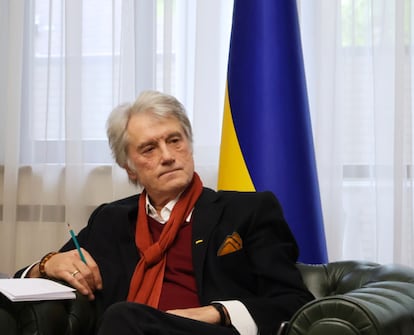

The world remembers Viktor Yushchenko, 71, for the turbulent year of 2004. The scars from the poisoning he suffered during that year’s presidential elections are still visible on his face. In 2004, for the first time, hundreds of thousands of people took to Maidan Square in Kyiv during the Orange Revolution to protest against the rigged election that had declared pro-Russian Viktor Yanukovych the winner. The elections were rerun, and Yushchenko was elected as the first Ukrainian president to openly advocate breaking with Russia.
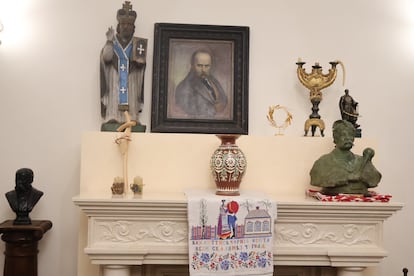
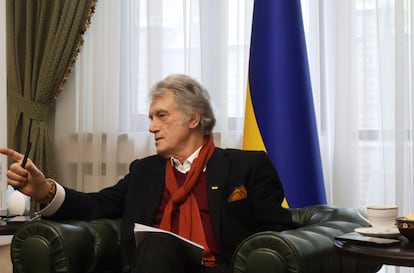
Today, Yushchenko maintains a low public profile, avoiding media attention after having grown exhausted by political battles during his years on the front lines, as he admitted during a meeting with international journalists organized on October 17 by the communications group Your City Media Hub. The interview took place in Yushchenko’s Kyiv villa, which serves as his office, in a meeting room adorned with objects reflecting his Christian faith and portraits of historical figures central to Ukrainian identity.
The former president asserts that, despite Russia’s war in Ukraine, his country has made progress in terms of democratic values and national unity. However, he admits to feeling “pessimistic” about U.S. President Donald Trump’s diplomatic strategy to negotiate with Russian President Vladimir Putin to secure an end to the conflict.
“It’s a dead end,” the former Ukrainian head of state said in reference to the summit that Putin and Trump were expected to hold in Hungary in the coming weeks, before it was canceled.
“He’s a criminal; he should rot like an animal behind bars. No one should shake hands with a murderer,” Yushchenko said about Putin. “Dialogue with him is a waste of time; peace is his defeat; it would mean his political, and perhaps even biological, death.”
With respect to the Russian president’s strategy, Yushchenko said: “Putin gains time with various empty initiatives. He wants to show that he has an answer. He does not have an answer. I repeat: what he is most afraid of is peace. Peace is his defeat.”
“The appeasement of Putin is a mistaken path,” continued Yushchenko, who did not hesitate to compare the current situation to the prelude to World War II.
Anyone who signs an agreement with the Russian autocrat could be repeating the ill-fated role played in 1938 by Neville Chamberlain, Yushchenko says of the British prime minister who believed he had secured peace with Adolf Hitler in exchange for accepting the German annexation of the Sudetenland in Czechoslovakia: “It seems to me that today we are frighteningly close to that same tragic historical scenario.”
Yushchenko grounds his fears in recent history — specifically, in the blind eye the European powers turned when the Kremlin invaded part of Georgia in 2008, and again in 2014 when it illegally annexed Crimea and backed the armed uprising in eastern Ukraine.
To end Russia’s invasion, there is no alternative but to arm Ukraine’s military with more international support, said Yushchenko — a position defended by Ukrainian President Volodymyr Zelenskiy.
Above all, he says, pressure must be put on China: “A single word from President Xi [Jinping] can produce major shifts in this war,” he said, referring to the Chinese leader and Russia’s main diplomatic and economic ally.
For Yushchenko, the man who led Ukraine between 2005 and 2010, Europe has enough political and commercial leverage to increase the pressure on China. “We must be wise in choosing the keys that encourage changes in the military-technical cooperation and political relations” between Beijing and Moscow, he says.
The former leader also supports applying, without hesitation, so-called secondary sanctions — economic penalties on countries that buy Russian oil and gas and thereby enable the Kremlin to evade market restrictions.
Leading polling firms in Ukraine indicate that most of the population wants an agreement that ends the war as soon as possible, a view that partly contradicts the former president’s stance. But that same majority also believes that stable peace is unlikely with Russia as its neighbor.
“As hard as it may be to accept, we will never be safe as long as Russia exists,” said the well-known Ukrainian jurist and politician Oksana Syroyid, currently serving in the military, at a conference in Kyiv on Thursday.
Breaking up the Russian Federation
Yushchenko’s view is not very different. For the former president, an essential condition for achieving peace in Europe is the disappearance of “Putin’s regime” and the democratization of the country. But he warns that one should not count on this happening, because, in his view, Russian society is not ready for this change: “I believe that Russia’s problem is not only Putin himself. The problem is that over the course of the Soviet regimes and tsarist regimes, a serf mentality was created — a worldview that does not love freedom, does not strive for it.”
That is why, Yushchenko ventures at the end of the interview, the only viable option is for the Russian Federation to cease to exist, and the way to achieve that is by encouraging uprisings among its national minorities: “I believe that today may be one of the best opportunities to formulate the correct emphases in the national-liberation movements of the dozens of Indigenous peoples of Russia who long for this.”
“I do not believe Russia has a viable state future as it is,” said Yushchenko. “I say that Russia should break up into 25 uluses — administrative units from Mongol times."
Sign up for our weekly newsletter to get more English-language news coverage from EL PAÍS USA Edition









































