
Trump faces the challenge of offering security guarantees to Ukraine in his push for peace
Moscow insists it must be part of negotiations on the mechanisms to ensure Kyiv’s future security
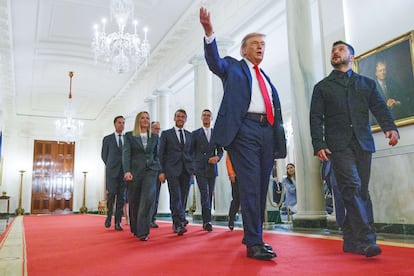

After months of resistance, U.S. President Donald Trump has declared his willingness to participate in security guarantees for Ukraine, one of the key points in discussions about a peace agreement with Russia. He even specified that Washington could participate in some way with its air force. But it is still unclear what form these guarantees will take to ensure that the country is not attacked again in the future. Nor is it known what Trump will ultimately decide — the president’s base opposes any U.S. involvement in a conflict they see as very distant. Even less clear is whether the decision will be accepted by Russia.
Ukrainian President Volodymyr Zelenskiy and his European allies highlighted Trump’s offer as one of the major breakthroughs following Trump’s meeting in Alaska with his Russian counterpart, Vladimir Putin, and on Monday at the White House with Zelenskiy and the European leaders. Zelenskiy emphasized that these guarantees to prevent Russia from repeating its aggression in the future are “a starting point towards ending the war.”
“The security concerns at play are far too important both for Moscow and Ukraine not to be spelled out and explicitly agreed, lest they become a diplomatic poison pill,” warned George Beebe, Anatol Lieven, and Mark Episkopos from the Quincy Institute for Responsible Statecraft think tank in an analysis.
So far, the U.S. president’s promises remain vague. For the moment, he has ruled out deploying U.S. troops to Ukraine as part of a hypothetical stabilization force. He has, however, indicated that Washington could provide air support for that force: “We’re willing to help them with things, especially, probably, if you talk about by air because nobody has stuff we have.,” he said on Tuesday in a phone interview with Fox News.
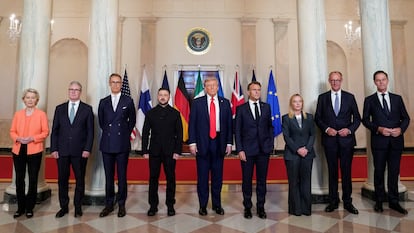
Trump also said that European countries would be the “first line of defense” to ensure Ukraine’s security. These nations “are going to take a lot of the burden. We’re going to help them and we’re going to make [Ukraine] very secure.”
Proposals such as the one Zelenskiy has conveyed — Ukrainian arms purchases worth $90 billion, funded by Europe — are entirely to the liking of the Republican, who since taking office has refused to renew the free military aid that his predecessor Joe Biden had provided.
European troops for a contingent
Several European countries have proposed contributing troops to a contingent that would be reinforced by sea and air. French President Emmanuel Macron and Zelenskiy himself have also insisted on the need for a very robust Ukrainian Armed Forces, without any limitations, such as restrictions on troop numbers. But Moscow is radically opposed to a Euro-Atlantic interposition force on Ukrainian territory and is demanding an end or a drastic reduction in the supply of Western weapons to Kyiv’s forces.
Trump is eager to achieve — and announce — results that would allow him to end a war he promised to conclude within 24 hours of his inauguration. According to his Fox News interview, during the summit at the White House, one European leader proposed to meet again “in another month or two.” “I said, a month or two? You’re going to have another 40,000 people dead in a month or two — you have to do it tonight."
Already on Tuesday, U.S. Chief of Staff General Dan Caine organized a meeting of allied defense officials. On Wednesday, U.S. and other NATO military officials held a videoconference meeting to discuss the topics discussed at Monday’s summit in Washington.
The White House has also announced that its National Security Council, temporarily led by Secretary of State Marco Rubio, is responsible for coordinating with allies, Ukraine, and Russia to advance proposals for a peace agreement and to organize a bilateral meeting between Zelenskiy and Putin — a face-to-face meeting proposed by Trump — which could then be followed by a summit involving the two adversaries and himself.
But Russia remains skeptical. Although White House spokesperson Karoline Leavitt stated at her Tuesday press briefing that Moscow had approved the summits, the Kremlin has not confirmed it will participate. On Wednesday, Foreign Minister Sergey Lavrov responded that Russia will only approve security guarantees if it participates in the negotiations — and if it obtains a veto right over them. Otherwise, he warned, discussions on security in Ukraine will be “a road to nowhere.”
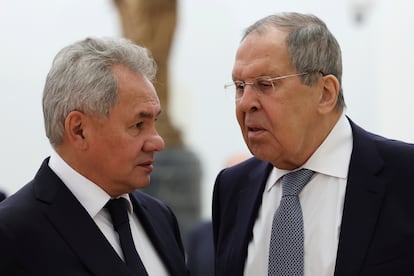
“We cannot agree with the fact that now it is proposed to resolve questions of security, collective security, without the Russian Federation. This will not work,” Lavrov said after a meeting with his Jordanian counterpart in Moscow.
Moscow would be more receptive to a solution similar to the one discussed in Istanbul in 2022, when it was agreed that a coalition of states would guarantee Ukraine’s security. Russia was part of that coalition, which ultimately included a clause stipulating that decisions be made unanimously — giving Russia veto power. As a result, it was rejected by Ukraine’s negotiators.
The differences in position are stark. “It is hard to imagine there being any deal today that is acceptable and that respects the red lines of the Ukrainians and Europe as well as the red lines of the Russians,” noted Matthias Matthijs, from the Council on Foreign Relations, after the White House summit. “Security guarantees were clearly discussed in Alaska, but it seems like what the Russians have in mind is very far from any NATO troops on the ground.”
Trump is convinced that if anyone can get it done, it’s him. During the White House summit, when he thought he was speaking discreetly aside to Britain’s Keir Starmer, Trump was caught on a hot mic saying: “I think [Putin] wants to make a deal for me. Do you understand? As crazy as it sounds.”
A senior White House official told Politico: “He alone could sell [a peace agreement] to Putin. I don’t think Putin would pay any attention to the others, and I’m not sure the others would do it without him.”
When presenting his proposals, Trump will also have to consider his domestic political landscape. His most extreme supporters, the Make America Great Again (MAGA) movement, oppose any U.S. military involvement abroad.
“This is a European problem; we have all the leverage here," Steve Bannon, a former Trump political advisor and informal spokesperson for the MAGA movement, told Politico. “If we don’t fund this, it stops happening. The only way this goes forward — the only way this continues every day — is American money and American arms. The Europeans don’t have enough either military hardware and/or financial wherewithal."
Sign up for our weekly newsletter to get more English-language news coverage from EL PAÍS USA Edition









































