
Trump says meeting with Putin and Zelenskiy possible ‘if everything works out well today’
The US president promised the Ukrainian leader ‘very good protection’ in a White House meeting, in a warmer tone than in February
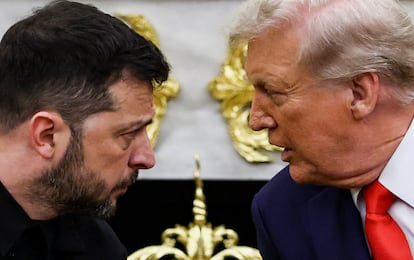

The meeting between U.S. President Donald Trump and Ukrainian President Volodymyr Zelenskiy at the White House to discuss the future of the war in Ukraine unfolded on Monday in a very different manner from that of last February 28, when the Ukrainian leader was unceremoniously shown the door after a public humiliation by his counterpart.
This time, the two exchanged jokes and smiles in an apparently relaxed atmosphere. Despite this supposed easing of tensions, Zelenskiy and the European leaders accompanying him on this trip are well aware that the meetings taking place these days will determine the future of the country invaded by Russia.
If Monday’s talks are successful, the U.S. president hopes that a summit will be held as soon as possible between Zelenskiy and Russian President Vladimir Putin — in which he himself could also participate as a mediator. “I think if everything works out well today we’ll have a trilat, and I think there will be a reasonable chance of ending the war when we do that,” Trump told the press before the start of the meeting.
The president specified that once Monday’s meetings concluded, he would call Putin, whom he met with on Friday in Alaska. According to Trump, he had already been in indirect contact with the Russian leader ahead of his meeting with Zelenskiy. For his part, Zelenskiy repeatedly expressed gratitude to Trump for his efforts to achieve peace.
Trump, who just hours earlier had declared that peace depended on Zelenskiy, noted that Monday’s talks are “not the end of the road” and promised “very good protection” for Ukraine after the war. Significantly, he did not rule out the possibility of U.S. troops being deployed on the ground.
No demand for a ceasefire
As he had already foreshadowed after the Anchorage meeting, Trump confirmed that he has ruled out demanding a ceasefire as a precondition for negotiations. He also pointed to the possibility of an announcement later on Monday, after a meeting with European allies accompanying Zelenskiy on his trip to Washington, regarding the security guarantees Kyiv is seeking in a peace deal.
“We’ll let you know that maybe later today,” Trump told reporters. “We’re meeting with seven great leaders of great countries also. And we’ll be talking about that. They’ll all be involved. There’ll be a lot of help, when it comes to security [...] It’s going to be good. They are a first line of defense because they’re there, they’re Europe. But we’re going to help them out also. We’ll be involved.”
Trump’s warmth in this meeting contrasted sharply with his remarks only a few hours earlier. Three days after meeting with the Kremlin chief in Anchorage, Trump publicly put Zelenskiy on the spot, demanding via social media that he accept a peace deal. The Ukrainian leader also resorted to social media to make clear that he would not accept any territorial concessions, despite Russia’s demands.
The meeting between Trump and Zelenskiy began around 1:15 p.m. Washington time with a greeting at the entrance to the West Wing of the White House. On this occasion, Zelenskiy wore a black suit: in his last Oval Office appearance on February 28, his choice to forgo a formal jacket — wearing instead his customary military attire since Russia’s full-scale invasion of February 2022 — earned him his first rebukes, culminating in a spectacular, televised dressing-down by Trump and Vice President J.D. Vance. This time, however, the president smiled and gestured toward the jacket as he greeted him, signaling his approval of the change in attire.
Tensions had been high after the Alaska summit. Trump appeared to have embraced Putin’s arguments. Having arrived in Anchorage seeking a ceasefire and threatening Russia with “severe consequences” if one was not secured, the U.S. president emerged from the meeting announcing that he would drop the ceasefire demand and move directly into peace talks, just as the Kremlin wanted. He also relayed to Zelenskiy and the European Union Moscow’s proposal to end hostilities: Russia would keep the entirety of Ukraine’s Donbas region (the provinces of Luhansk and Donetsk), including areas still under Kyiv’s control, in exchange for stabilizing the front line.
If, after that meeting, Trump had declared that peace depended on Zelenskiy — and not on the aggressor country — in the run-up to Monday’s encounter he ratcheted up the pressure even further on the Ukrainian leader. In a social media post, he insisted the responsibility for a deal lay with Kyiv: Zelenskiy, he wrote, “can end the war with Russia almost immediately, if he wants to, or he can continue to fight.” He added that Ukraine would have to resign itself to never regaining the Crimean Peninsula, occupied by Moscow since 2014, and to seeing its path toward NATO membership permanently blocked.
Security guarantees
Zelenskiy, for his part, arrived in Washington determined to stress to Trump that Ukraine requires credible security guarantees in any negotiated settlement that may be reached. According to White House negotiator Steve Witkoff, the United States may now be willing to assume such commitments, after months in which Trump had rejected them.
The Ukrainian president did not come to Washington alone. He was flanked by a substantial European delegation, including the bloc’s most powerful leaders and those with the best rapport with the U.S. president: European Commission chief Ursula von der Leyen; French President Emmanuel Macron; Finland’s President Alexander Stubb, an occasional golfing partner of Trump; German Chancellor Friedrich Merz; U.K. Prime Minister Keir Starmer; Italy’s Prime Minister Giorgia Meloni; and NATO Secretary General Mark Rutte, who has in recent months showered Trump with praise.
The European delegation’s goal was to show support for Zelenskiy at a crucial summit and avoid a repeat of the unpleasant scene six months ago. Above all, they sought to underscore the united front between Ukraine and Europe, and to make their position clear to the White House: Kyiv must have a voice and a vote in negotiations to end the conflict, and the solution cannot be cooked up solely between Washington and Moscow, forcing Ukraine to accept terms it considers unacceptable. As Macron put it on Sunday: the idea is that “there can be no discussions about Ukrainian territory without the Ukrainians, just as there can be no discussions about European security without them.”
“We’ve got to get this right” insisted Britain’s Starmer during remarks aboard his official plane en route to Washington. “We’ve got to make sure there is peace, that it is lasting peace, and that it is fair and that it is just,” he said.
For most European leaders, the stakes could not be clearer: the continent’s stability and security hinge on Ukraine’s future — whether the occupied nation preserves its independence, democracy, and prosperity, or instead becomes a weakened state under constant threat. “We are going there tomorrow, not simply to support President Zelenskiy. We are going to defend the interests of Europeans. Europe does not want to be at the negotiating table as a topic of discussion. Europe must be at the table to discuss itself and its future,” Macron stressed on Sunday.
Sign up for our weekly newsletter to get more English-language news coverage from EL PAÍS USA Edition









































