
Zelenskiy travels to Washington under threat of Trump demanding he give in to Putin
The Ukrainian president and several European leaders will meet with the US president Monday to discuss peace negotiations with Russia
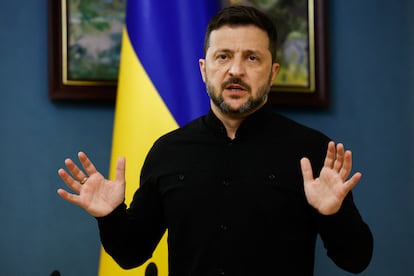

The sword of Damocles once again hangs over Volodymyr Zelenskiy. The Ukrainian president is scheduled to meet with Donald Trump Monday in Washington, facing the threat that his American counterpart will place unacceptable demands on the table to force a peace agreement with Russia. The obstacles to ending the war are enormous, especially after Vladimir Putin made his conditions known to Trump on Friday in Alaska. One of these is that the Ukrainian army withdraw from the Donbas region and hand it over to the occupiers on a silver platter.
The signals that emerged from the Alaska summit between Trump and Putin are not encouraging for Kyiv. The Ukrainian president’s office was confident that the Republican would fulfill his objective, which he himself had expressed just two days before the meeting with the Russian autocrat: if Putin did not agree to an immediate ceasefire, he would impose severe sanctions on Russia and would not meet with him again. But the opposite occurred: Trump accepted the Kremlin’s position that a truce is not necessary, postponed the threat of sanctions, and announced that another conference must take place, this time a trilateral one with Zelenskiy, in addition to a possible visit to Moscow.
The incident caused enormous confusion in Bankova, the Ukrainian presidential headquarters. The weekend’s agenda was thrown into disarray, especially because Trump urgently summoned Zelenskiy to Washington. The Republican leader stated that all his partners, including the Ukrainian president, had accepted that the ceasefire was no longer necessary to negotiate peace.
But Zelenskiy reiterated twice on Saturday via social media that Moscow’s refusal to temporarily cease hostilities demonstrates that “it will be even more difficult for Russia to accept peace.” “Stopping the killing is a key step toward ending the war,” he added.
Fear of a new fight
Disagreements over the ceasefire and the outcome of the summit in Alaska are adding tension to Monday’s meeting at the White House. The last time Zelenskiy visited Trump in Washington, last February, one of the most unprecedented scenes in recent diplomatic history unfolded. The press conference in the Oval Office ended in a heated exchange between the Ukrainian president, Trump, and his vice president, J. D. Vance.
Relations between Kyiv and Washington were severely damaged, but diplomatic efforts by Ukraine, the United Kingdom, France, and Germany helped rectify the situation. To avoid another schism, Zelenskiy will return to the White House accompanied by several European leaders: German Chancellor Friedrich Merz; French President Emmanuel Macron; European Commission President Ursula von der Leyen; Italian Prime Minister Giorgia Meloni; British Prime Minister Keir Starmer; and NATO Secretary General Mark Rutte, among others.
Zelenskiy informed Trump by phone Saturday that it’s impossible for him to agree to withdraw his troops from Donbas. Kyiv is willing to freeze the conflict on the current front line while peace negotiations are underway, but abandoning what they still control in Donetsk province would be political suicide for the president.
Putin conveyed other demands to Trump, many of which had already been raised by his envoys in the three meetings the two governments held between May and July in Istanbul, Turkey. One of these is the recognition of the Crimean Peninsula, illegally annexed in 2014, as part of Russia. The Russian delegation in Turkey reiterated that the provinces of Kherson and Zaporizhzhia, partially occupied by the invader, are also under Russian sovereignty. Putin only suggested to Trump in Alaska that the front in these two provinces would be frozen. The Russian leader offered to return to Ukrainian control the small areas that his army has captured in the provinces of Sumy and Kharkiv, according to Reuters.
Beyond territory
Territory is the thorniest issue in the peace process, but the obstacles go beyond this. The Kremlin wants, above all, the lifting of the sanctions that are punishing its economy and blocking the movement of thousands of people linked to the invasion. Ukraine has demands in this area that directly conflict with Russian interests. Specifically, the establishment this summer of a special European tribunal for Russian war crimes and Ukraine’s demand that Russia pay for the reconstruction of what it has destroyed.
Last July, German Chancellor Merz estimated the damage caused by Russian weapons at “at least €500 billion.” Also key in this area of the negotiations will be the more than €250 billion in Russian assets that Ukraine’s Western allies have frozen in their countries.
Particularly sensitive are the legal proceedings opened in 2023 by the International Criminal Court against Putin himself, for whom an international arrest warrant is pending. This concerns the thousands of minors from the occupied Ukrainian territories who have been forcibly displaced to Russia. For Kyiv, the return of these children to Ukraine is a crucial issue.
A Russian red line, which the U.S. has already stated will be respected, is that Ukraine should not join NATO. Atlantic Alliance countries are willing, in return, to provide extraordinary “security guarantees” for Kyiv, ranging from a special defense agreement to the deployment of troops to train the Ukrainian army or to confirm the end of hostilities.
The Russian delegation in Istanbul proposed as an essential condition for ending the war that Ukraine stop receiving weapons from its international partners, something that would mean the de facto surrender of the invaded country.
Putin also wants Russian to be an official language of Ukraine alongside Ukrainian. Zelenskiy’s predecessor, former president Petro Poroshenko, pushed through laws that progressively reduced the status of Russian as a language in public administration, the media, and schools.
The Venice Commission, a Council of Europe body, does not require Russian to be officially recognized in its reports on Ukraine’s democratic developments, but it does insist that protection of the rights of national minorities must be improved. This includes the millions of people who speak Russian as their mother tongue and whose origins are in regions of the Russian Federation. Putin also demands the restoration of the Orthodox Church loyal to the Moscow Patriarchate, which was outlawed in Ukraine in 2024 for being considered an institution loyal to the invader.
Sign up for our weekly newsletter to get more English-language news coverage from EL PAÍS USA Edition









































