
Trump gives Putin ‘10 or 12 days’ to resolve the war in Ukraine or face sanctions
The US president also calls on Netanyahu to make changes in Gaza and acknowledges that children in the Strip ‘look very hungry’
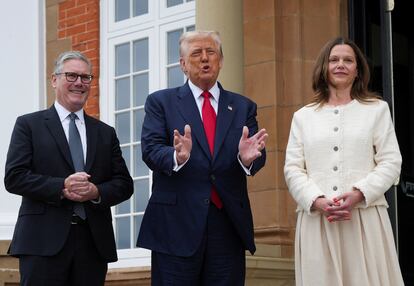
The escalating humanitarian crisis in Gaza has begun to shift the dial on the rhetoric of U.S. President Donald Trump, who has publicly warned Israel that it will have to approach the conflict “differently.” Days after the United States and Israel walked away from the negotiating table over a potential ceasefire in Gaza, Trump on Monday said he disagreed with with Israeli Prime Minister Benjamin Netanyahu’s assessment, who denies that there is a large-scale famine unfolding among the Palestinian population: “Based on television, I would say not particularly, because those children look very hungry,” Trump said.
Regarding Ukraine, the other major conflict that captured the attention of the U.S. president’s meeting with British Prime Minister Keir Starmer Monday in Scotland, the Republican leader maintained the tough line he has displayed in recent weeks with Russian President Vladimir Putin, setting a new deadline — “of 10 or 12 days” — to end the war.
Trump said he was “very disappointed” in Putin, after several rounds of talks to reach an agreement, “then President Putin goes out and starts launching rockets into some city like Kyiv and kills a lot of people in a nursing home or whatever. You have bodies lying all over the street. And I say that’s not the way to do it,” he said. As a result, Trump threatened to cut short a 50-day deadline he had given the Russian leader two weeks ago to end the conflict. Otherwise, the Kremlin would face severe sanctions in the form of a tariff offensive.
In addition to Gaza and Ukraine, Starmer was determined to address the trade relationship between the two countries, which remains fraught with uncertainty despite the bilateral agreement announced in May. The British Prime Minister is seeking improvements in areas eligible for tariff reductions, such as steel and aluminum, whose British exports are currently subject to 25% tariffs, half of those imposed on the EU. Given the humanitarian crisis in Gaza, the goal is to urge the U.S. leader to take a tougher line on Israel, with the aim of resuming ceasefire talks.
Speaking to the media after hosting Starmer at one of his golf resorts in Scotland, the U.S. president considered that “a ceasefire is possible,” but clarified that “possibly the fight will have to be a little bit different,” a less forceful position than that of his guest, who openly declared that there is “a humanitarian crisis” in Gaza.
“It’s an absolute catastrophe,” the British prime minister said. Starmer’s hard line is understandable, given the increasing international and domestic pressure in the face of the deteriorating situation, which has led hundreds of British MPs and leading members of his government to demand that the United Kingdom follow France’s lead and formally declare recognition of the Palestinian state.
Gaza, in fact, is one of the key issues in the British prime minister’s briefcase for his informal meeting with Trump, ahead of his state visit to the United Kingdom in mid-September. Trade relations and Ukraine are the other two components of the triptych for a meeting convened to take advantage of the U.S. president’s four-day stay in his mother’s homeland. Like the president of the European Commission, Ursula von der Leyen, he had traveled to Scotland over the weekend to finalize the trade agreement between the European Union and the United States. This time, it was the Labour leader’s turn, who attended the meeting with Trump with his wife, Victoria.
In addition to his message to Netanyahu’s administration, the U.S. president also had words for Hamas, accusing it of being “unwilling to talk” and using the remaining hostages as a safeguard. “I always said when you get down to the final 20, you won’t release them, because that’s like their shield,” he later declared at the start of the meeting with Starmer, about which both agreed that Gaza was “one of the main reasons” they had come together.
In Donald Trump’s diplomatic handbook, it is the U.S. president who acts as host to the British prime minister, despite being on British soil and on what the White House has described as a “private visit.” Starmer’s plane arrived Monday morning at Prestwick Airport in Glasgow for the prime minister’s day with Trump, first at his golf resort in Turnberry, a town of just 200 people in southwest Scotland, and then at Trump’s resort on the east coast of Scotland, in Aberdeenshire.
Starmer has a clear rapport with Trump, who again lavishly praised him during their meeting. Despite belonging to different political ideologies, the two have displayed remarkable understanding in their successive meetings. Proof of this was the prime minister’s significant presence in Trump’s private agenda Monday, not only sharing a coast-to-coast trip in Scotland, but also a private dinner.
The result of this unexpected personal connection has its practical effect, as the United Kingdom is one of the few powers to which the 10% tariff threshold imposed by the Trump administration applies. This threshold is also favored by the fact that, unlike the EU, there has historically been no deficit in the trade relationship that benefits the British. Even so, London is seeking an even larger reduction, especially in the automotive and pharmaceutical industries, despite resistance from Washington.
Sign up for our weekly newsletter to get more English-language news coverage from EL PAÍS USA Edition









































