
Trump sows confusion (and some indifference) with his tariff swings
Washington’s latest offensive in the trade war leaves its partners at the mercy of the US president’s mood. His threats are being greeted with disbelief by the markets
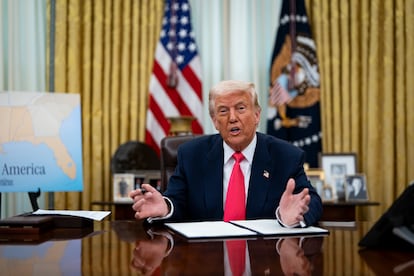

In Donald Trump’s Washington, it’s easy to forget how things used to be...a week ago. This week, tariffs have returned to the forefront of political and economic discussions, but not, as expected, because the July 9 deadline he himself set (for the implementation of the tariffs he threatened dozens of countries with in April) was about to expire. Rather, it was because the U.S. president has now decided—unilaterally, once again—to set a brand new date for their entry into force: August 1.
That’s the new date when the tariffs will presumably materialize — those Trump has already communicated by letter to some of his partners, 25 as of this Saturday, the day that kicked off in Washington with the 30% tariff bombs launched at the European Union and Mexico—and those yet to reach their recipients.
Or maybe not. Confusion is the only certainty in this administration’s trade policy. Also certain is its president’s confidence in the power of import tariffs to restore manufacturing jobs to the United States—and, incidentally, its greatness. Other factors are uncertain: Will the threats be real this time? Will countries have time to reach deals with Washington to soften these penalties? Will the impact be felt by those who haven’t agreed to a universal “15% or 20%” tariff by then, as Trump promised in a television interview on Thursday?
“I don’t have answers to those questions,” Maurice Obstfeld, a former chief economist at the International Monetary Fund (IMF) and a fellow at the Washington-based Peterson Institute, replied in an email on Friday. “We live in a state of shared ignorance about what the president is really thinking.” At least, Obstfeld seemed convinced of one thing: the three weeks remaining until the new deadline expires “are not enough time to close serious trade deals, but they are enough time for [Trump] to, under face-saving excuses, extend the negotiation deadline once again.”
The list of countries to have already received a letter is a heterogeneous one, from Moldova to South Korea, and from Sri Lanka to Japan. There are notable exceptions in that group, such as Brazil, which has seen its tariffs quintupled for non-trade reasons (Trump’s desire to free his friend Jair Bolsonaro from jail in his coup trial). Or Canada, which was unexpectedly slapped with a 35% tariff on certain products with a somewhat laughable excuse: its alleged inaction to stop fentanyl trafficking. But in general, the numbers contained in those letters from Trump—again, with the exceptions of the EU and Mexico—are very similar to those seen already on the XL poster board on April 2, when the president threatened to unleash a global trade war in a widely followed appearance at the White House.
Then the markets collapsed, and the panic nearly spread to public debt—which would have been a serious blow—so the president backtracked and decided to grant the countries a 90-day reprieve to sit down to negotiate with the United States. Washington also fantasized about a well-rounded slogan (“90 trade deals in 90 days”), but has had to settle for two tentative deals —with the United Kingdom and with Vietnam, an agreement of which, a week later, there is still no documentary evidence from either side—as well as a truce with China.
This time things were different: rather than shouting, the stock markets responded with a prolonged yawn. “They clearly rule out the possibility of draconian tariffs coming into force,” Obstfeld continues. Or, to put it less flatteringly for the U.S. president, it seems investors are once again seeing him in his TACO version, an acronym invented by a Financial Times analyst. It stands for “Trump Always Chickens Out” and its protagonist finds it disgusting.
“He relies on his negotiating talent, and his strategy is to go all out before lowering the stakes, taking things to the extreme, and, yes, retreating,” opines Carolyn Kissane, a professor at the Center for Global Affairs at New York University, in a telephone interview. She clarifies that all his bravado serves at least to “send a message to his supporters.” What they see is a strongman defending the United States after years of being—in Trump’s words—a looted, pillaged, raped, and plundered country. And he does so grandiloquently. “He grabs headlines, and then makes concessions a couple of weeks later, when people are already looking elsewhere.”
The Tale of Peter and the Wolf
Kissane is confident that U.S. negotiators will back down “with the larger countries” and with copper, a material on whose imports the world’s leading power will impose a 50% tariff, also starting August 1st if nothing changes. The expert also believes that Trump’s behavior this week is partly due to the fact that “he is emboldened because the economic indicators are relatively stable.” “Companies have rushed to fill their warehouses, and that has increased activity, so the repercussions of the tariffs will come later.” To explain the markets’ reaction and the countries’ attitude of resignation, the expert resorts to the tale of Peter and the Wolf. When the tariffs finally do arrive, perhaps no one will believe Trump.
The Nobel Prize-winning economist Paul Krugman warned this week on his Substack channel about the danger of trusting that Trump won’t follow through on his threats. “My bet is that the TACO people will be wrong this time. I’d love to be wrong, but right now it looks to me like deeply destructive tariffs are coming,” Krugman wrote. “The tone of those letters” and “Trump’s obvious obsession with tariffs” lead the illustrious economist to believe that the U.S. president won’t withdraw them this time.
If left as they are now (that is, a mix of those launched in April and those contained in this past week’s letters, plus the sudden changes they’ve experienced along the way), businesses and consumers will face, according to a report from the Yale Budget Analysis Laboratory, the highest tariffs since 1934, at the height of the golden age of American isolationism brought about by the Smoot-Hawley Act. With that law, which had unintended repercussions, President Herbert Hoover sought to protect an agricultural sector in crisis. The Yale report also estimates that Trump’s tariffs will cost American families an additional $2,300 per year.
Bank of America global economists Claudio Irigoyen and Antonio Gabriel warned in an analysis this week that the fact that the stock market has ignored Trump’s new [tariff] shock, coupled with the low likelihood that consumer confidence will be affected, could encourage Trump to “escalate” his bet, given that the marginal cost he faces is very low. Irigoyen and Gabriel also do not rule out the risk of stagflation [a phenomenon resulting from higher inflation and lower growth] as uncertainty increases.
The factor that contributes most to this uncertainty is Trump’s volatile personality, whom a critical editorialist in The Wall Street Journal, described this Saturday as Tariff Man. If there is one thing that unites those who sit down at the table with the United States in these months, it is the certainty that he will always have the last word, and that a declaration from the president or a message in Truth is enough to derail a negotiation that seems to be going well.
In the first round of tariffs in April, the U.S. administration at least bothered to share a mathematical formula, even if it was dismantled in just a few hours. This past Thursday, asked by a reporter about the criteria for calculating the tariffs in the letters, Trump abandoned all pretense at mathematics: “The formula was based on common sense, economic deficits, historical treatment, and raw numbers.”
That same afternoon, Canadians learned that nothing can be taken for granted with Trump. Ottawa, which saw Washington break off negotiations two weeks earlier in protest over a digital tax Canada had to withdraw, was surprised by Trump’s announcement of an unexpected 35% tariff, which fell like a bomb 11 days before the deadline the two countries had set.
Countries that haven’t yet received their letter will surely be taking careful note of everything that could go wrong. There are still almost three weeks until the deadline, whether definitive or not, imposed by Tariff Man. And three weeks, in Trump’s Washington, is a whole other era.
Sign up for our weekly newsletter to get more English-language news coverage from EL PAÍS USA Edition









































