
Trump escalates pressure on Canada with 35% tariff threat
The US president adds uncertainty to trade discussions by notifying Prime Minister Carney by letter of an unexpected levy that will take effect on August 1

Donald Trump’s tariff puppet show continued Thursday night with an unexpected plot twist: a bombshell announcement that the U.S. president had sent yet another letter, this time to Canada — its preferred trading partner — threatening to impose a 35% tariff on certain products. The letter also stated that the measure would take effect on August 1.
Such an announcement was not expected, so the publication on Truth Social — Trump’s social media platform — of the letter addressed to Canadian Prime Minister Mark Carney once again sowed chaos and confusion in the bilateral relationship. On Thursday, that relationship entered a new phase of the trade Trump reignited after returning to the White House for a second term. It has now been almost six months of an aggressive, erratic, and unpredictable economic policy.
The letter — clearly intended as a pressure tactic during ongoing negotiations for a new trade agreement between the two countries, now at risk — does not specify whether the 35% tariff will affect products protected under the United States-Mexico-Canada Agreement (USMCA), which Trump himself signed during his first administration and has repeatedly threatened to tear up since returning to power. A White House official confirmed to The Wall Street Journal that the new tariff would apply only to goods not covered by the agreement, which are currently subject to a 25% tariff — but also added that things could change as quickly as Trump changes his mind.
In the letter, the U.S. president revives an old and dubious justification: the so-called “national fentanyl crisis.” Washington blames its northern neighbor for not doing enough to stop the trafficking of the potent opioid, which has caused hundreds of thousands of overdose deaths in the United States in recent years.
Trump does clarify in the letter that the new tariff is separate from the “sectoral” tariffs. That is, the existing duties on automobiles (25%) and on steel, aluminum, and copper (50%) will remain in place — sectors particularly sensitive for Ottawa. The letter also warns that if Carney retaliates with reciprocal tariffs, those actions will be met with additional duties of another 35% on Canadian exports to the U.S.
“If Canada works with me to stop the flow of Fentanyl, we will, perhaps, consider an adjustment to this letter. These Tariffs will be modified, upward or downward, depending on our relationship with your Country. You will never be disappointed with the United States of America,” the letter concludes.
The casus belli chosen by Trump is somewhat laughable: in 2024, border authorities seized just 18 kilograms of fentanyl at the Canadian border, compared to one ton found attempting to enter from Mexico. Nevertheless, in February, Ottawa announced a $1 billion investment to reinforce its border and the appointment of a “fentanyl czar.”
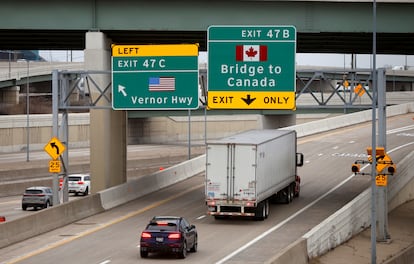
The news was received with concern in Mexico. If fentanyl becomes the reason for new tariffs, the southern neighbor has far more reasons than Canada to worry. And if the new tariffs effectively mean a de facto breakup of the USMCA, the future of the trade relationship with Washington will need to be closely watched.
Main trading partner
The United States is Canada’s main trading partner, having imported goods worth $349 billion and exported $413 billion southward in 2024, according to data from the U.S. Department of Commerce. Since returning to the White House, Trump threatened Canada with 25% tariffs and adopted aggressive rhetoric, including the fanciful idea of annexing the country to make it the 51st state. That discourse awakened a nationalist sentiment that had long been dormant.
Canadians launched a boycott of American products and revived the slogan “Elbows out,” borrowed from hockey national hero Gordie Howe, to illustrate their determination not to be intimidated. Trump’s influence on Canadian politics translated into the victory of Mark Carney, who succeeded prime minister Justin Trudeau as leader of the Liberal Party in elections that, before Trump’s arrival on the scene, seemed destined for the Conservatives.
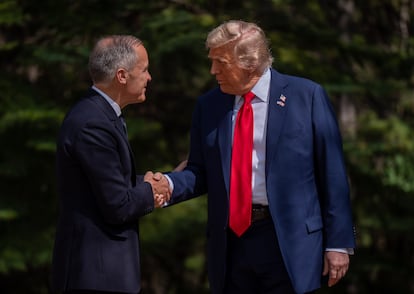
The Republican leader’s disdain for Trudeau was evident, and he appears (or appeared to) have more respect for Carney, the former governor of the Bank of England and the Bank of Canada. Carney visited Trump at the White House and emerged successfully, making clear that his country “is not for sale.” He later hosted Trump at the G-7 summit held in mid-June in Kananaskis, Alberta, a border province.
Carney has been firm in responding with reciprocal tariffs to those imposed by the U.S., which are especially worrying in industries such as automotive manufacturing and in provinces like Ontario. Canadian tourism in the United States has declined in recent months, although Ottawa breathed a sigh of relief when Trump announced unilateral tariffs on dozens of countries on April 2, with Canada, like Mexico, excluded from the list.
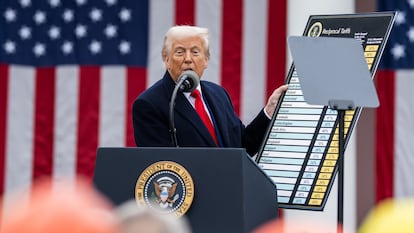
Then came the 90-day pause on tariffs that the U.S. president granted himself and his partners — a period during which Canadian negotiators tried to finalize a favorable trade deal, though they could never quite avoid Trump’s bullying tendencies. He showed another sign of this instinct two weeks ago, when he abruptly announced — again on Truth Social — that he was breaking off talks with the northern neighbor due to Canada’s impending implementation of a digital tax that would hurt Silicon Valley giants. That same weekend, Ottawa reversed course and withdrew its plan to impose a 3% tax on profits earned in Canada by companies like Amazon, Apple, and Google.
More than 20 letters
The letter sent to Canada on Thursday adds to the 22 letters dispatched between Monday and Wednesday to other countries: a list that includes major trading partners like South Korea and Japan, as well as a group of far less consequential countries, from Moldova to Algeria, and from Iraq to Kazakhstan. To all, he threatens tariffs ranging from 20% to 40%, while telling them there is still room to negotiate a deal to soften those tariffs — provided it happens before August 1, the new deadline chosen by the U.S. president, who has changed the date multiple times. Nothing indicates that he won’t do so again.
Brazil deserves special mention. Trump has hit the South American country — which has no trade deficit with the U.S. — with a 50% tariff and a justification unlike the others: the hefty tax responds to the treatment former president Jair Bolsonaro is receiving in court. Bolsonaro faces charges for allegedly plotting the January 2023 coup, just months after losing the election. He faces 43 years in prison, and his friend, the U.S. president, considers him a victim of a “witch hunt.”
In another sign that there is no guarantee of economic stability — neither in the U.S. nor globally — while Trump is at the helm, the president declared to NBC on Thursday afternoon that his strategy of intervening in global trade through letters was about to enter a new phase. His idea, he explained, was to set a baseline tariff of 15% or 20%, which would apply to the dozens of countries still waiting to receive their letters, including the European Union.
Less than two hours later, Trump turned everything upside down again by announcing a 35% tariff on Canada. With this, not only the trade war but also two centuries of mutual trust between the two old allies entered a new and unpredictable phase.
Sign up for our weekly newsletter to get more English-language news coverage from EL PAÍS USA Edition









































