
Weariness and pessimism in Bucha, the scene of Russia’s worst war crimes in Ukraine
The residents of this town north of Kyiv believe that the only peace plan Vladimir Putin will accept is Ukraine’s surrender
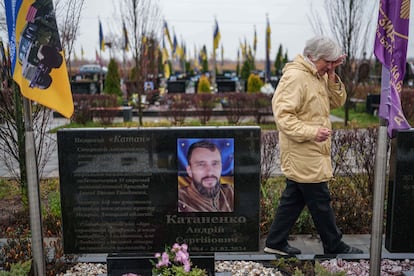

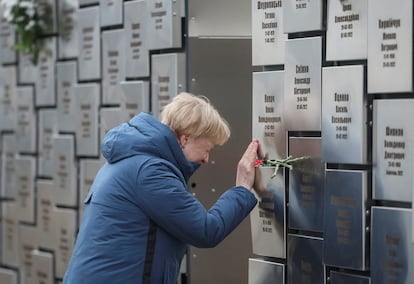
On Yablonska Street in Bucha, nothing remains to remind us that the Russian army committed its worst crimes during the war in Ukraine here. In March 2022, at the start of the invasion, more than 450 civilians were killed in this municipality north of Kyiv. Yablonska was one of the places where the largest number of bodies were recovered. The only building on the street that provides evidence the war continues today is the local military recruitment office. And in the lines outside, pessimism is contagious.
A dozen men wait to be seen. Some are soldiers applying for leave. Mikhail, 34, was wounded a month ago in a missile attack on the Dnipropetrovsk front. He walks on crutches and still shows signs of the concussion caused by the blast. He is from Bucha and says: “If people know what happened here (in Yablonska), the Russians cannot be forgiven for their actions.”
Mikhail is referring to one of the points included in the so-called “peace plan” officially proposed on January 20 by U.S. President Donald Trump to Volodymyr Zelenskiy. The Ukrainian president and his European partners launched an emergency diplomatic campaign to reformulate Trump’s proposal. As a result, 22 of the original 28 points remain. The remaining ones will have to be discussed directly between the two leaders. One of the points that could remain in effect is that which obliges Ukraine to relinquish its right to prosecute war crimes committed by Russia.
Mikhail says he agrees with 50% of the plan and finds the other 50% debatable. What his country cannot accept, he insists, is an amnesty for an invader which, according to United Nations figures, has killed some 14,600 civilians. Another point in Trump’s plan that he considers unacceptable is a suspended clause stipulating that the Ukrainian army should withdraw from the 25% of Donetsk province still under its control. “However these negotiations end, we in Ukraine know that it is extremely difficult for Vladimir Putin to agree to end the war without us giving in to his demands.”
Also in line at the enlistment office is 25-year-old Dmytro Kudlai. He has received a draft notice, but he works in a factory that, according to the law, is strategic for the country’s functioning and should exempt him from combat. “I don’t want to go into the army. Family and friends who are serving advise me against it, saying the situation is extremely difficult,” Kudlai admits. “I also don’t trust how the army operates; there’s a lot of corruption, no doubt about it. We don’t have the same motivation we had in the first year of the invasion.”
Reluctance to enlist
Kudlai finds Trump’s initial peace plan unacceptable, but on the other hand, he concedes that he doesn’t believe Ukraine has the strength to defend itself for another two years, a possibility Zelenskiy raised in October. The main reason, according to this young man, is that nobody wants to enlist anymore.
The Russians are advancing faster and faster, Kudlai laments. He is the perfect example of the dilemma many Ukrainians face: on the one hand, they don’t want to see Moscow victorious, but on the other, they don’t want to fight anymore. “Perhaps the most important thing in a peace agreement, what would convince us, would be the security guarantees our allies would give us, guarantees that would make it impossible for Russia to attack us again,” he concludes.
This is precisely one of the most important aspects of the peace proposal that Kyiv is negotiating with Washington, as Andriy Yermak, Zelenskiy’s right-hand man, admitted in statements to Axios on Tuesday. Ukraine is willing to renounce its NATO membership, as Moscow demands, but in return must receive the maximum possible military support from its members.
Disunity
At the Hotel Roma in Bucha, work is still underway to repair the damage caused by the months of fighting in 2022. Despite this, its restaurant, specializing in traditional Ukrainian cuisine, is one of the busiest in the municipality. Svitlana Biuhova, who runs the establishment, says she is “very, very tired of the war.” Two things contribute to her pessimism: the men in her family and circle who have died on the front lines and the disunity she perceives in the country. “At the beginning, we had so much strength, a national unity we had never felt before, but society today is not united with our leaders. And that makes it difficult to go on.”
Biuhova is referring to the growing doubts surrounding the Commander-in-Chief of the Armed Forces, Oleksandr Syrskyi, and the corruption plaguing Zelenskiy’s inner circle. “I don’t want to give Russia the victory, to let them keep what isn’t theirs,” the businesswoman reflects. “The 28-point plan is so negative because it would mean that many of our people lost their lives for nothing. But I want peace; I want people to stop dying, Ukrainians and Russians, because I imagine there are civilized people among their families too.”
Distrust of the country’s leaders is a recurring criticism among those interviewed by EL PAÍS. Volodymyr Krivanush is 39 years old and comes from the neighboring city of Gostomel. He is overseeing the renovations to a new flower shop across from the Hotel Roma, in a building that was refurbished after the fighting. The worst part, according to him, is that the U.S. wants to forget about Ukraine: “They want to get rid of our problem at all costs.” Beyond this, he says, amnesty for war crimes would be a mistake, but not only because of what the Russians are doing: “Those in Ukraine and Europe who allowed the Russians to get here should also be prosecuted.”
One of the criticisms leveled against Zelenskiy during the war — from the opposition, but also from former army chief Valerii Zaluzhnyi — is that the president ignored warnings until the very last moment that the invasion was inevitable.
“In 2022, we gave away so much territory to the Russians… I think our president, government, and parliament are so incompetent that it seems they work for the Kremlin. Otherwise, I can’t explain it,” says Vitali Opaliuk, a 49-year-old taxi driver, one of those waiting at the Bucha enlistment office. He was a captain in the army before the war. In 2022, he volunteered three times to rejoin and fight, according to his testimony. There were so many volunteers at the time that he was rejected because of health problems. Now, he wants to obtain the paperwork to be exempted from conscription due to his respiratory illness.
Opaliuk’s detached house in the Bucha region was destroyed during the fighting, and he now lives with his wife and in-laws in a small apartment in another city in Kyiv province. He, like hundreds of thousands of others, fled the occupied zone in 2022.
Of all those interviewed, Yaroslav Holiven is the one who can best bear witness to those weeks under the Russian yoke north of Kyiv. He is 27 years old and at the time aspired to be a professional boxer. A grenade left him crippled in March 2022, when he had left the underground shelter where dozens of civilians were living. “What I remember most from those weeks is that no one came to my aid. I’m alive by a miracle.”
There was fear among the population; the occupying forces instilled terror. Holiven says he can neither forgive, nor accept a peace plan that benefits Russia. “In any case, the Russians wouldn’t accept it either,” he says. “Their logic is to conquer us. This war won’t end until the Russian Federation disintegrates. Until that happens, peace is impossible.”
Sign up for our weekly newsletter to get more English-language news coverage from EL PAÍS USA Edition









































