
Bosnia and Herzegovina relives the trauma of Srebrenica 30 years after the genocide
Victims of the worst civilian massacre in Europe since World War II recall the inaction of the international community and lament that, now that war has returned to the continent, the world has failed to learn from the tragedy
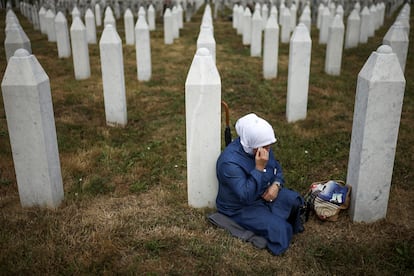

Almasa Salihovic was in the place where the worst massacre in Europe since World War II was carried out — Srebrenica — where 8,372 people were killed in just five days. She was eight years old, there with her mother and her 15-year-old brother. Bosnia and Herzegovina had declared its independence from Yugoslavia in 1992 and had been at war for three years with the Serbian army. The military had entered Srebrenica, a small town about a three-hour drive from Sarajevo, the Bosnian capital, and only eight miles from the Serbian border. No foreign power, no international organization, managed to prevent what ultimately happened around July 11, 1995. The country marks the 30th anniversary of the genocide this Friday.
That week, each family grabbed only what was essential from their homes and ran toward the U.N. peacekeepers’ compound in the neighborhood of Potocari, seeking protection. That very site now houses the Srebrenica Memorial and Cemetery, where Salihovic, the center’s spokesperson, tells her own story.
There were only 400 U.N. peacekeepers in the compound — young Dutch soldiers — who were overwhelmed by the 4,000 troops under Serbian General Ratko Mladic. “We were left helpless. The U.N. handed us over to the Serbs,” says Salihovic.
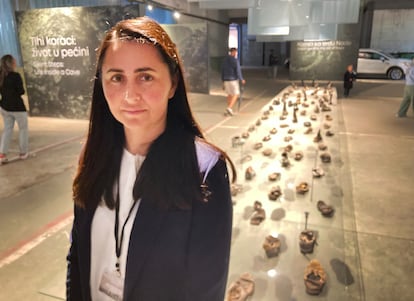
“Inside here,” she recalls, “about 4,000 or 5,000 Bosnians had managed to get in. And outside, there were around 20,000 of us, trying to get in too. But the U.N. peacekeepers were overwhelmed and no longer letting anyone in. We had no bread, no salt, barely any water, no sugar. My 19-year-old sister had made it inside, but we didn’t know that. We also didn’t know where my 18-year-old brother was. My father had died before the war.”
Salihovic remembers that the Serbs offered to let the women leave on buses. “We knew the men would be killed.” Her mother hid her 15-year-old brother under the seat in front of her.
Salihovic will never forget how a Serbian soldier boarded the bus, took off his shirt, pulled out a knife, and shouted for everyone to hand over anything of value: rings, watches, jewelry… “I stood up and told him I only had my doll, but that I would give it to him.”
Everyone carries the wounds of that war in their own way. Some prefer not to speak. Many emigrated. Others chose to return and live in Srebrenica years later, even though their homes had been taken over by Serbs.
The commemoration of the 30th anniversary comes at a time when Europe is reliving some of its darkest nightmares. War as a means of gaining territory has returned in all its brutality.
Sead Turcalo, 47, dean of the Faculty of Political Science in Sarajevo, believes that if the international community had acted in time in Bosnia, what is happening now in Ukraine might have been avoided. He also thinks that one of the keys to preventing such tragedies is teaching history properly — without fear of naming the criminals.
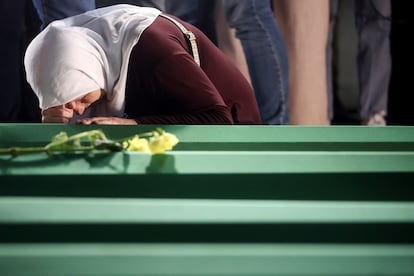
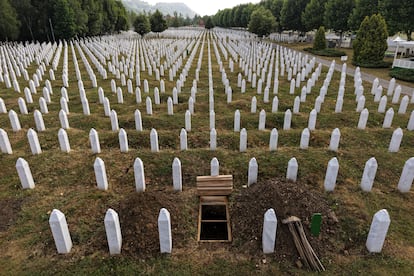
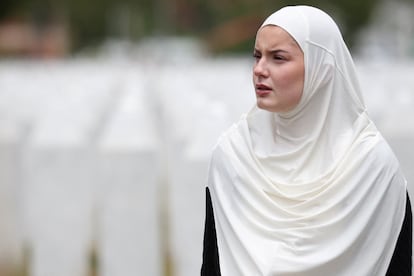
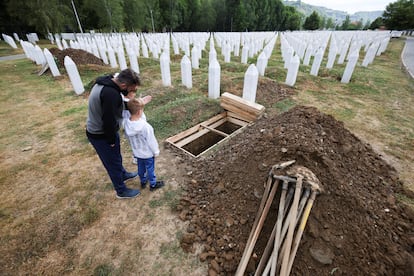
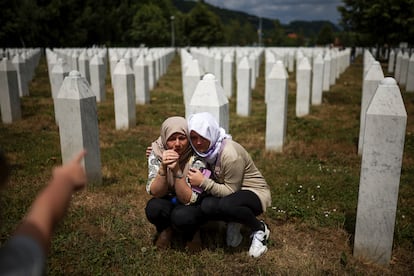
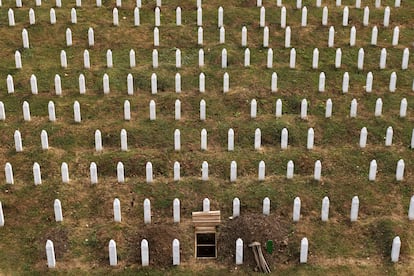
The Srebrenica massacre, however, bears no comparison with what the country invaded by Russia has experienced. In Bosnia, more than 8,000 people were killed in just three days. In Ukraine, after more than three years of invasion, around 13,500 civilians have died. The worst massacres of civilians carried out by the Russian army, such as the one in Bucha, left more than 400 dead, according to the Ukrainian government.
The iconic image that has come to symbolize the Srebrenica massacre — recognized as genocide by the International Criminal Tribunal for the former Yugoslavia (ICTY) — is a portrait of an elderly woman with her eyes closed in anguish. It was painted by Safet Zec, one of Bosnia’s most renowned artists, after seeing a photo taken by famed Bosnian photographer Almin Zrno of Suhra Malic, the elderly woman, during the burial of one of her two sons who had been killed.
Malic, now 90, lives in a care home in Srebrenica that was opened in 2023 to accommodate elderly survivors of the genocide, funded by the International Solidarity Fund. Malic proudly says she was the first Bosniak woman to return to her home after the genocide. Many homes had been taken over by Serbs — hers included. She returned in 2001, six years after the war.
“My husband and I arrived to find some Serbs who claimed they had fought for that land and that house,” she says. “We slept out in the open for four days, at the doorstep of what had once been my home. Someone from an international organization saw us, and in the end, with their help, we managed to get it back.”
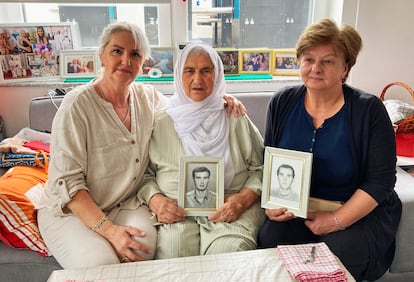
It’s a week of reunions in Srebrenica. Suada Selimovic, 56, is the daughter of Suhra Malic and now lives in Sweden. “I had a 40-day-old baby when I fled through the forest,” she recalls. “I kept a diary during the war. And I’ve never read it.”
When asked why, she replies: “So I wouldn’t have to relive it all.” Selimovic says she moved to Sweden because she didn’t want her children to grow up on the land where she had suffered so much. She says she will give the diary to her grandchildren someday.
People bring pastries to Suhra Malic’s room. They embrace, laugh, and cry. Tahira Osmanovic, 67, who has lived in Colorado, United States, since 2001, arrives with her daughter Sahza, 32. As soon as she mentions the 16-year-old son she lost that July 30 years ago, her eyes well with tears. “I also lost my brother. And we still haven’t found his remains.” She says the world has learned nothing from the massacre.
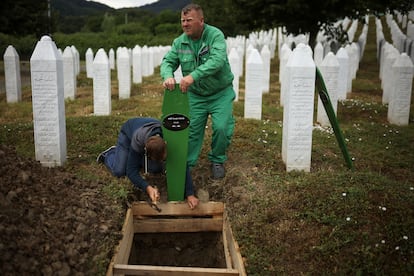
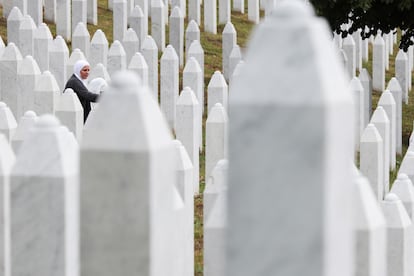
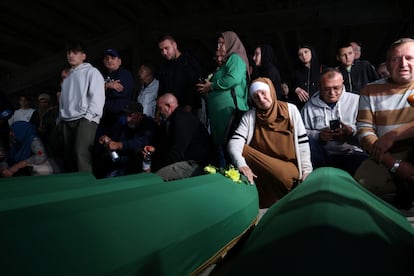
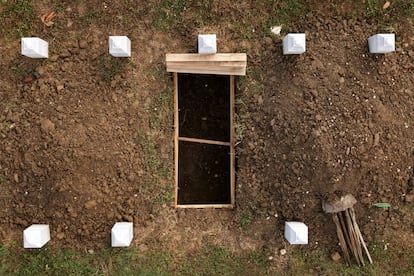
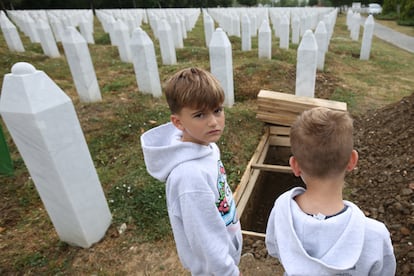
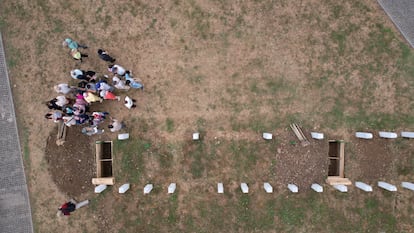
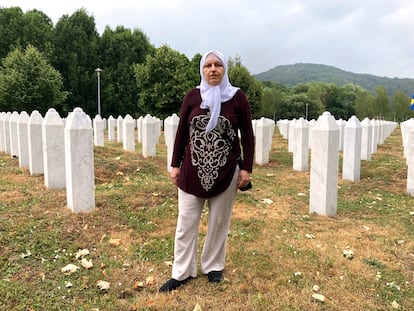
On Wednesday, two days before the anniversary, rain falls on the Srebrenica cemetery. The solitary figure of Mirzeta Karic, 50, can barely be seen praying among the graves. “There are about 50 members of my family buried here,” she says. “But the one I miss most is my father. I left on a humanitarian bus, and so did he. He was 48. But the Serbs pulled him off. My father had never held a rifle, never hated anyone, never argued with anyone in town. And now, 30 years later, I’m going to bury him with just a single bone.”
Karic also lives in Sweden, where she raised two children, who are now 27 and 28. She explains that her brother’s body, who died at 22, was found shortly after the war. But for her father, only the jawbone was discovered in 2022. “I waited to see if more would be found. But my mother is very old now, and we’re going to bury him.” Karic pounds her chest and says she wishes she could cry, but she can’t. She insists her Serbian neighbors were all good people — until they weren’t. “If a war broke out right now,” she says, “I’d be the first to join.”
At the cemetery is David de Galli, a 43-year-old music teacher based in Milan, who hired a guide to bring him from Sarajevo. “We’ve learned nothing from this tragedy,” he says. “In Italy, there’s a lot of far-right nationalism, and we live as if these things could never happen again. But this happened in Europe. Sarajevo is only a 55-minute flight from Milan,” he warns.
The Dayton Accords (signed in Dayton, Ohio) ended the war in 1995. Today, Bosnia and Herzegovina is made up of two entities: a Federation — home to the Bosniak and Croat majority — and the Republika Srpska, with a Serb majority, where Srebrenica is located. The country, with just 3.5 million people, also has three presidents: one Bosniak, one Croat, and one Serb.
Almasa Salihovic, the spokesperson for the Srebrenica Memorial, managed to escape with her mother, unharmed by the soldier who had threatened them with a knife. “The bus driver, also a Serb, convinced him to leave us alone,” she recalls. But her 18-year-old brother was killed. His remains were found in 2008. And now, the children of Serbs and Bosniaks in Srebrenica attend school together.
“We live together, it’s true, we work together in institutions. But we’re a long way from real reconciliation. Children aren’t taught history at school. So we make sure they learn it at home,” says Salihovic.
Sign up for our weekly newsletter to get more English-language news coverage from EL PAÍS USA Edition









































