
Merz warns against possible US interference in German elections
The chancellor was asked about a program announced by the US State Department to fund civil society organizations in Europe, from which groups close to the AfD could benefit
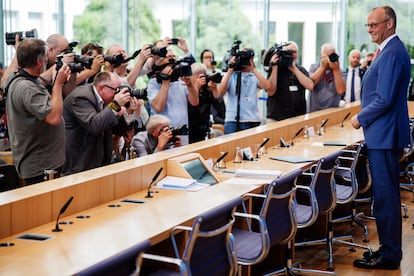
German Chancellor Friedrich Merz on Wednesday pushed back on any potential interference from the United States, or from any other country, in the regional elections to be held in the fall in the federated states of Saxony-Anhalt and Mecklenburg-Western Pomerania, where the far-right Alternative for Germany (AfD) tops the polls.
During the traditional summer press meeting with accredited reporters in the German capital, the politician was asked about a grants program announced by the U.S. State Department to fund civil society organizations in Europe, from which groups close to the AfD could potentially benefit.
“In Germany it is illegal to finance political parties from abroad. It is illegal. That said, I assume that our friends around the world also respect these legal rules that we have imposed in Germany,” the chancellor said forcefully.
The German politician stressed that just as Germany does not interfere in U.S. electoral affairs, he would expect “neither the U.S. government nor institutions close to it to interfere in German elections.”
The program, called Developing Civilizational Bonds, Democratic Resilience, and Rule of Law in Europe, is promoted by the State Department through the Office of Democracy, Human Rights, and Labor with the aim of funding organizations and groups in Europe that work to “preserve the heritage and resilience of Western civilization.”
During the press meeting, Merz was repeatedly questioned about the political advance of the far right in the country, the possible results for the AfD in the upcoming regional elections in September, and the work he and his government have done to prevent its rise.
The chancellor said he felt calm, that he had traveled repeatedly through the states where elections will be held, and that he had persuaded people his government is doing the right job.
“I am and remain convinced that we will, in the three federated states—especially in Saxony-Anhalt and Mecklenburg-Western Pomerania—prevent the AfD from obtaining a majority of seats in the respective regional parliaments, and I will keep this optimism until 6.00 pm on election night,” he said.
The situation in Saxony-Anhalt is, however, especially delicate, as the far-right party could reach an absolute majority. To date it stands at 41% of voter preferences, followed by CDU candidate Sven Schulze with 23%.
If the AfD does not achieve an absolute majority, the situation would remain equally complicated, because Merz’s party, the Christian Democratic Union, would have serious problems forming a coalition, as its percentage points would not be enough even if it allied with the Social Democrats (SPD) and Die Linke (The Left).
Regarding a possible coalition with the AfD in that scenario he was unequivocal: “I will do everything in my power to prevent it,” Merz said, while recalling that there is a party congress resolution that rules out any cooperation with the far-right party.
During the 90-minute press meeting, the German chancellor spoke about other domestic issues dominating the political agenda in Germany, such as his government’s package of reforms, the economy, security policy, and the environment.
In an initial intervention Merz took the opportunity to praise what has been achieved so far, saying his government has found its rhythm and has delivered, and noting good cooperation with its partners, the Social Democrats. He also defended that his administration has restored a more active role for Germany in Europe. And although the boasts were many, he also acknowledged that significant challenges remain.
Sign up for our weekly newsletter to get more English-language news coverage from EL PAÍS USA Edition









































