
Three of the four Afghans who left the country to play the Chess Olympiad are detained in Kabul and face uncertain fate
The players are under house arrest and face corporal punishment because the game has been banned by the Taliban government for religious reasons
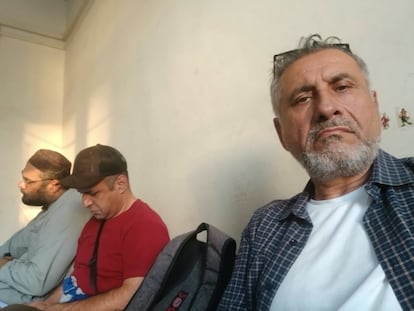

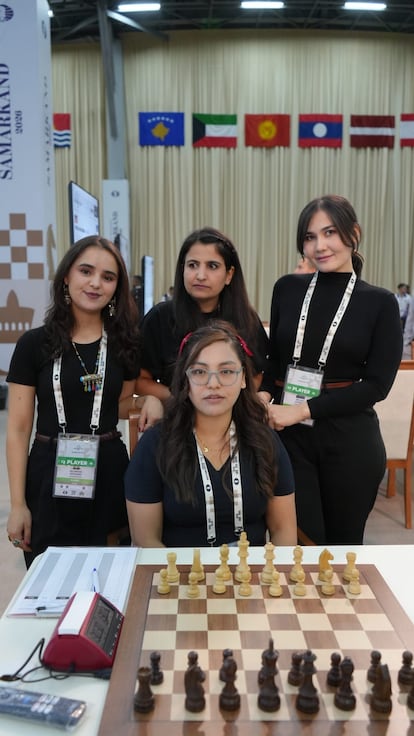
Three of the four Afghans who left their country to compete last week in the Chess Olympiad in Samarkand, Uzbekistan, were detained at the border on Monday when they returned to Afghanistan, where chess is banned by the Taliban government. The players are under house arrest in Kabul and face penalties that could include corporal punishment. The fourth player has been able to return home without reprisals.
Inside the European Parliament, the Progressive Alliance of Socialists and Democrats is trying to have the matter debated at the request of Spanish MEP Ignacio Sánchez Amor. And the International Chess Federation (FIDE) has announced diplomatic measures of support.
Khaibar Farazi —who besides being a chess player is a very popular television comedian in Afghanistan— and Habibullah Guldoost, captain of the Women’s Team (which includes four women living abroad) at the Olympiad, contacted this newspaper from the border as soon as they were detained on Monday night: “They confiscated our passports and separated the three of us into different rooms,” they told this newspaper, which was shown the official Taliban arrest orders. Hours later they were returned to Kabul, where they remain under house arrest. The third detainee is Habibullah Amini, a member of the Absolute Team, like Farazi.
The fourth returnee (the other eight members of Afghanistan’s Olympiad delegation live abroad) is Mirzaad Sayed Wahabuddin, who crossed the Hairatan border without any problems. Hairatan is the only border crossing open between Uzbekistan and Afghanistan.
Afghanistan’s FIDE delegate, Adzhmal Mangal, whose personal situation is ambiguous (he enters and leaves the country with some frequency while almost all other members of the Afghan federation live abroad) sought to play down the issue and asked that publication of the events be delayed: “”Please, do not worry yet, since the information is uncertain. They are doing well and are at home. Within the next two or three days, everything should become clear. I will inform you as soon as I have news,” he wrote, still from Samarkand.
By contrast, the Absolute Team captain, Zaheer Asefi, who lives in the Netherlands, sounded much more worried and recalled how it all began: “The four left Afghanistan legally two weeks ago, but at midnight, when border checks are more lax.” Although chess is banned (“suspended,” the government says), with clubs closed and at minimum fines for anyone caught playing or simply holding a board, the four believed that any punishment on their return from the Olympiad would be mild.
What they did not know was that, just one hour after their departure, all border posts, both air and land, received a strict order from the government, accompanied by numerous attached documents, to detain them. That was followed by another order concerning their return once the government confirmed they were participating in the Olympiad under Afghanistan’s name and flag, and at a venue where men and women (more than 3,000 people in total, from around 200 countries) were in close physical proximity each day for two weeks; moreover, the fact that the four women on the women’s team live abroad —and play with uncovered heads and ordinary clothing in free countries— may particularly anger the Taliban, according to consulted sources.
Asefi insists that it is impossible to predict what punishments they could face: “The most radical interpretations [such as the Taliban’s] of the sharía [the moral code that guides Muslims’ public and private lives] do not specifically list chess among punishable acts, but they associate it with gambling and games of chance, even though that link existed only in the Middle Ages [and not in all countries]. Since gambling is explicitly prohibited, there is a possibility that punishments could be severe.” In the most extreme cases, those punishments include amputation of the hands or other corporal mistreatment.
Those radical interpretations are not limited to the Taliban. Ten years ago, the Saudi mufti Abdulaziz Al-Sheikh said chess should be banned, justifying it this way: “It makes the rich poor, and the poor rich. It creates hostility and wastes time.” Both the Taliban and that mufti implicitly scorn the later correction of Iranian ayatollah Khomeini, who, after banning chess following the 1979 Revolution —“It is a satanic game that disturbs the mind of those who play it,” he said— reversed his position and promoted the game shortly before his death in 1989. That disdain is linked to animosity between the two main branches of Islam, Shiism and Sunnism. In both Afghanistan and Saudi Arabia the tendencies are radical, but much closer to Sunnism than to Shiism.
Good relations between the Afghan government and Russia (which is very influential in FIDE) raise some hope that the new leaders of world chess can help resolve the humanitarian problem. “We will work on it,” the Kazakh (born in Russia) Timur Turlov, the newly elected president, told EL PAÍS. At least two other senior officials confirmed that diplomatic actions are under way. As for the European Parliament, the Progressive Alliance of Socialists and Democrats is trying to add the matter to the agenda of the next plenary session under urgent procedure.
Sign up for our weekly newsletter to get more English-language news coverage from EL PAÍS USA Edition









































