
Evan Gershkovich, WSJ reporter jailed by Putin: ‘They didn’t break me as a human being’
‘It would be ridiculous for me, after being arrested, to say that I hate Russians; that would be self-hating,’ says the former correspondent, who has written about his experiences in a new memoir, ‘This Cursed Beautiful Land’
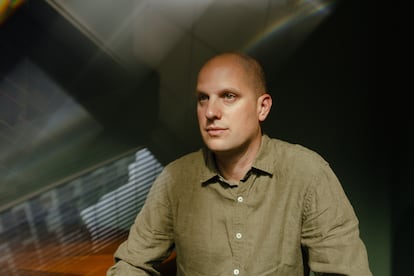

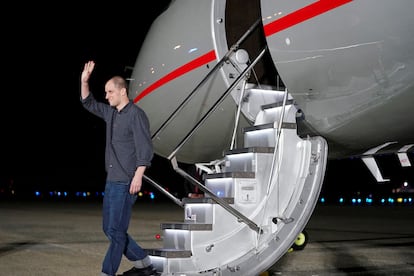
Evan Gershkovich does not conceal the fact that he would rather be on the other side of the table. “Your job as an interviewer is much more fun than mine,” admits the journalist who has had to get used to being the center of the story. His ordeal began on March 29, 2023. The then–Moscow correspondent for The Wall Street Journal was detained that day on charges of espionage. He spent 16 months in prison before being freed in the largest prisoner swap between Russia and the West since the Cold War. The exchange, in which the governments of the United States and Germany were heavily involved, had the makings of a spy movie.
Since then he has had time to recover and to write This Cursed Beautiful Land, the book in which he recounts his ordeal. Gershkovich, the son of Russian immigrants, was raised in New Jersey but traveled to Russia in 2017 in search of his roots and an exciting career in journalism. He made friends there and enjoyed his investigative work until Vladimir Putin’s slide into authoritarianism made reporting increasingly difficult and forced many people in his circle to leave the country. “The party’s over,” is the chapter’s title. The next major twist came with a set-up by a source that led to his arrest in Yekaterinburg, deep in the Urals.
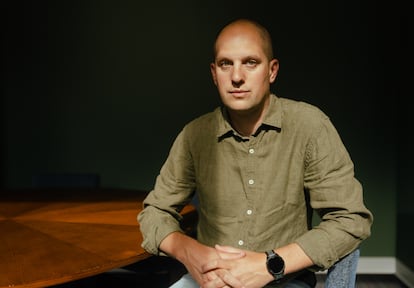
Gershkovich, 34, met EL PAÍS at the New York offices of Penguin Random House, the publisher of the book. Prison did not make him renounce his work. “Life feels heightened when you’re chasing a story. In those moments there’s an excitement that makes everything else seem boring.” It also did not worsen his view of the country that jailed him. He bristles when told that the tone of the book is surprisingly upbeat. “I’m not going to make up that they strung me up with a rope by my feet and look how miserable it was,” he replies, somewhat irritated.
In recent years, Gershkovich says he has found a balance between his two selves: Evan, the kid who grew up in New Jersey, and Vanya—the name he answered to in prison—who was so immersed in the Russian language that when the U.S. ambassador visited him he struggled to find words in English.
Question. It is an obvious question, but in your case unavoidable. How are you?
Answer. Very well. It took me about the same time I was in [prison] to get back to life. The beginning was quite difficult. I saw a psychiatrist who specializes in post-traumatic stress disorder. I had certain symptoms. I had difficulty sleeping. Certain things might trigger me. Short temper, a fuse, that kind of thing. But with time, it’s getting better. Writing the book also helped—it’s therapy in a way too: you’re looking at an event, staring at it straight on, processing it. At first the hardest part is realizing you’ve forgotten what normal felt like. You don’t feel well and it’s really hard to remember what normal is because it’s not like in normal life you always feel good. You’re searching for what normal is and that takes a long time. But I’m doing really well.
Q. In the book you provide many details about what happened to you, but you don’t explain how it affected you. How have those 491 days in prison changed your relationship with Russia and your work as a journalist?
A. Actually, nothing’s really changed. I feel like the same exact person. I think my relationship to journalism hasn’t changed whatsoever, and my relationship to Russia hasn’t changed at all. The last time they’d taken a foreign correspondent hostage on fabricated espionage charges was 40 years before that under the Soviet Union. We didn’t think something like this would happen. But that hasn’t changed my view of the country. The Russian state was already on a certain path.
Q. It’s striking how you describe your time in prison in quite a positive way. You talk about the camaraderie you found there and recount genuinely funny moments, like when you cook and say it reminds you of the film Goodfellas. Have you considered whether you experienced something like Stockholm syndrome?
A. No, definitely not. The thing that I tried to describe is how I was treated compared to others. It’s something that recurs in Russia’s history: they are very careful about who they torture and mangle and murder. Ukrainian journalist Victoria Roshchina was captured in occupied territory, taken to Russia and murdered. She was sent back to her family without any teeth in a body bag. So that’s just the reality of it. I tried to describe the experience as accurately as possible. It is not pleasant to be in a tiny room with another person and not be able to leave. The conditions were good compared with other prisoners, but the Russian prison system is very harsh. I describe the panic attacks I suffered. But you get used to things. Humans are incredibly adaptable.
Q. Aside from the conditions, your account of the experience seems fairly optimistic. At one point you say it helped you deepen your understanding of Russia.
A. What I tried to convey in the book is that they didn’t break me as a human being; they didn’t torture me or make my life miserable. If those things had happened, the book would be different. As for my relationship with Russia, the book describes a big bad Russian state that is torturing and maiming Ukrainians, that started imperialistic wars that it shouldn’t have started. But at the same time, I am Russian. I’m not gonna go write off an entire people and say, look at this horrible group of people. I belong to them as well. It would be ridiculous for me, after being arrested, to say that I hate Russians; that would be self-hating. When you read a Gulag memoir, it can be the most miserable experience in human existence and then at the same time be decent: people bake birthday cakes, write poetry, fall in love and form families in the Gulags. Compared with that, my experience was like a five-star resort.
Q. Why do you think you coped well with the experience?
A. For several reasons. First, I’m from a Russian background, so I speak the language; I knew I could communicate with inmates, guards and FSB investigators [the Russian intelligence agency]. Also, I’m blessed with a sense of humor. That’s really lucky and important because if you take everything really seriously all the time, you’re not going to handle it well. Finally, I had worked as a reporter in Russia for five and a half years before, so I knew the system. When I went to court, I wasn’t shocked that the judge wasn’t listening to rational arguments—something that, for example, wouldn’t happen to a tourist who is set up and framed with drugs. From the start I had no expectation of receiving a fair trial.
Q. You say you were treated better because they knew you would one day be released and write this book.
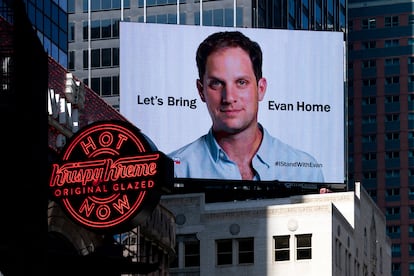
A. Yes, because I would be writing about it. I assume that’s why they weren’t stringing me up by my feet and electrocuting me. But also because they knew that detaining a foreign correspondent from The Wall Street Journal would provoke a huge worldwide uproar, something they needed to pressure for a prisoner swap.
Q. What degree of responsibility do you see in Russian society, which remains inert in the face of the war in Ukraine?
A. It’s really hard to do polling in Russia. We can try as best we can but it seems to me it’s sort of like 15 percent are really for the war, 15 percent are really against the war, and then 70 percent are just sort of ‘please leave me alone.’ It’s a society that never catches a break: it’s the Tsarist period, it’s the Soviet period, and we have a little blip in the 90s, and now Putin’s here, and he’s been here for 26 years. From the outside, it’s easy to say they are complicit or that they’re not rising up and stopping what’s happening. But they face the risk of ending up in prison. Like a historian I know, sentenced to eight years for writing about war crimes in Bucha. The logical reaction, if you want to preserve something like a normal life, is to keep your head down.
Q. Opposition leader Alexei Navalny was expected to be part of the prisoner swap that freed you, but six months earlier he was killed in a Siberian prison. Do you think Putin never intended to free him?
A. There was a lot of debate—people saying the swap should have been carried out more quickly so perhaps he would still be alive. It’s impossible to know for sure, but I think they would have killed him anyway. I think his death sentence was basically written.
Q. For posing a danger to the regime.
A. I don’t know if he truly was a danger, but I think they clearly saw it that way. Why would they kill him otherwise?
Q. How did you experience the moral debate surrounding the swap?
A. I fully understand the debate. Each country approaches this issue differently. The United States has considered since the time of Thomas Jefferson, in the early 19th century, that every U.S. citizen is as important as every other U.S. citizen, and we will do everything in our power to get them back.
Q. But by becoming a bargaining chip, it creates incentives to capture more people to be used in future swaps.
A. That’s true. And the Russians are smart. The swap happened the way they wanted it to. They got their guy [Vadim Krasikov] back from Germany who killed a person on a state-assigned mission. And they got away with it in the sense that there was no sanctions imposed on them. You feel guilty that the person is free because of you. But I see two aspects. First, I’m glad we have that policy because thanks to it I’m free. And second, I agree with the idea behind it. It’s positive that journalists, opponents and human rights activists are free. It’s a statement of principles in a world where we’re shifting away from liberal and free values, and where an autocratic axis is emerging. It’s something to be proud of.
Q. In the book you say that when you returned to Washington and wanted to meet some officials, they were afraid of being seen with you amid the cuts led by Elon Musk. You suggest that reminded you of things you experienced in Russia. Do you see a parallel with the administration of Donald Trump?
A. I think there are more similarities with Viktor Orbán’s Hungary than with Russia. I was frightened when Trump called the FBI directly to investigate alleged voter fraud in Georgia in 2020. Calling a national intelligence agency and ordering it to do something is dangerous. You see some parallelisms, but I think it’s too simplistic and crude to say, ‘oh, it’s like Russia.’ You need to analyze how certain countries become more authoritarian. We should not look at just big bad Russia, but also what lessons we can learn for ourselves about how institutions function.
Q. You have followed him for years—what do you think is Putin’s true driving force?
A. I think what’s moved him at different points has been very different, but I think it’s more interesting to think about what moves him now. What drives him now, at 73 and after 26 years in power, is his desire to see himself in the pantheon of Russian leaders and in history. He thinks in terms of empire and trying to expand the empire. He didn’t use to be this way in the first four or eight years. He would talk about Russia’s security and Russia’s interests. One of my favorite quotes was spoken by Foreign Minister Sergey Lavrov. When asked how Putin could have planned the war without much of the Russian establishment knowing, he replied: ‘He has three advisors: Ivan the Terrible, Peter the Great and Catherine the Great.’
Sign up for our weekly newsletter to get more English-language news coverage from EL PAÍS USA Edition









































