
Russian influencers break their silence on Putin: ‘Vladimir Vladimirovich, people are afraid of you’
Celebrities with millions of followers criticize the authorities for not informing the president about the country’s problems, although they avoid attacking him directly
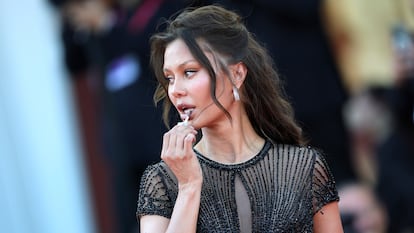

She doesn’t wear a uniform or have access to the Kremlin’s corridors of power, but she has 13 million followers on Instagram, a social network banned in Russia. “Vladimir Vladimirovich, people are afraid of you,” begins Viktoria Bonya in one of her recent posts, in a surprising direct appeal to Putin. “Between us — ordinary people — and you there is an insurmountable wall, and I want to tear it down. No governor will tell you this because they are afraid of you,” she continues, addressing the president. The former Dom-2 (the Russian version of Big Brother) contestant and epitome of extreme luxury, who now lives abroad, is a symbol of the lifestyle that millions of citizens in Russia desire and only the elite enjoy.
She’s not the only one appealing to Putin: other Russian influencers — and companies like Vkusno i Tochka, the chain that acquired McDonald’s restaurants — have broken the silence in recent days, offering criticisms or suggestions to the country’s president. The internet blackout, not the invasion of Ukraine, was the final straw. And the opposition suspects that the phenomenon is more a response to a power struggle between different factions.
Aiza, a presenter and singer, has joined the chorus of criticism. “Can you think about the people who are suffering, who are on the brink of disaster? Please, how much can this cost? How much money do the [State Duma] deputies have to steal to have enough?” she says in another reel directed at Putin. “I sincerely hope that our president is truly unaware of this.”
In an old Russian tradition, celebrities are exonerating Putin with a phrase repeated in Slavic literature for centuries: “If only the Tsar knew!” This whitewashing of the Russian leader comes precisely as his popularity is plummeting due to the economic crisis and the internet blackout. According to the Kremlin’s polling center, VTSIOM, Putin’s approval rating among citizens has fallen to its lowest level since the start of the war: he maintains a comfortable 67.8%, but for the first time it has dropped below 70%.
Neither the constant bombing of Ukrainian cities, nor the hardships suffered by Russian border cities like Belgorod, nor the detention of opposition figures, many of them ill, nor the massive spending on the war while much of the population struggles to make ends meet — none of this is addressed in the videos. The protests have erupted because of the government’s intrusion into the last bubble for Russians: social media.
The criticism, in any case, has gone viral, representing one of the few open confrontations with the Kremlin from apolitical sectors of Russian society since the harsh repression of anti-war protests. That was in 2022. Since then, civil society has remained virtually silent, with the courageous exception of the wives of military personnel who have stood up to the Kremlin by demanding that their husbands return home.
On the ultranationalist flank, hardly anyone has raised their voice since the death of the powerful Wagner Group leader, Yevgeny Prigozhin, in 2023. And those who have spoken out have paid for it: earlier this year, military blogger Ilia Remeslo was committed to a mental institution for criticizing the conduct of the war.
Bonya, Aiza, and other celebrities like Ida Galich and Ekaterina Gordon use a very measured tone to blame the authorities for not properly informing Putin. They also don’t mention the invasion of Ukraine among the problems Russians face, even though Bonya, a model, presenter, and actress, previously described the sanctions against Russia for the war waged against the neighboring country as a “genocide.”
The internet blackout imposed by Russian security services is one of the five problems Bonya cites. The others are the mass slaughter of livestock in the Novosibirsk region (due to alleged outbreaks of pasteurellosis and rabies that the authorities have not substantiated), flooding, and other environmental problems such as the ongoing spills from two old oil tankers sunk in the Black Sea in 2024 (which recently left some 200 dead birds on the beaches of Anapa), and the new regulations that allow the hunting of endangered animals. “There won’t be a swimming season this year. They’re lying to us,” the model criticizes.
Fracture in the elite
The Russian opposition is debating whether these criticisms are sincere or simply being promoted by a faction within the Kremlin — the political wing, led by Sergey Kiriyenko, one of the heads of the presidential administration — to try to curb the other, the Federal Security Service (FSB), in its attempt to seize control of all state mechanisms. For Kiriyenko, whose mission is to show Putin that the people adore him, Telegram is an essential tool; and therefore, restricting access to it — something imposed by the FSB — is a mistake.
“The same points: Putin is unaware of what’s happening, he needs information from the people, officials are hiding the truth from the leader… This can only mean one thing: they received orders (and the manual) from the Kremlin, from Kiriyenko’s department,” political scientist Ivan Preobrazhensky stated on the social network X. He warned the public: “Whatever the goals of Kiriyenko’s department may be, you must remember one thing: the well-being of you, the ordinary people, is NOT among them.”
Ivan Zhdanov, former director of the Anti-Corruption Foundation of Alexei Navalny, the dissident who died in a Russian prison in February 2024, echoed this opinion.
Others see it a different way: “I completely disagree that Bonya and Aiza were given a task by the Kremlin. Both are spirited and active, and besides, they live outside the country,” counters Lyubov Sobol, an opposition politician and former member of Navalny’s foundation. “I don’t know if they really think Putin isn’t aware of this or if they understand that speaking out like this is the only relatively safe form of protest, but the fact that they mention Putin’s name in connection with these issues is already a step forward. Thank you, girls,” she adds.
In her video, Bonya emphasizes that the authorities “are squeezing people like a spring.” “And one day that spring will snap,” she warns. “People,” she adds, “are Googling how to leave Russia.” However, she also doesn’t want to appear as a battering ram against the government: this Wednesday she published another video in which she states: “I love my country, I’m not going to betray it. I’m not an opposition figure.”
Bonya lives abroad and risks never returning home. She first criticized the government in a reel published in March, in which the singer Sati Kazanova discussed with her the courage it takes to protest against the Kremlin. “Vika, my dear, do you know why we artists remain silent here in Russia? We have families and parents too,” Kazanova said. “When all rights and limits are violated and there is no other option, people have to fight back,” Bonya replied.
A controversial Russian deputy, Vitaly Milonov, a proponent of laws against the LGBTQ+ minority, has called Bonya a “Dubai prostitute” and urged her to return to Russia. “This is unacceptable for someone in power who is obligated to protect citizens, not harass them,” the influencer responded, adding that she is considering filing a class-action lawsuit with other women against the politician.
The fast-food chain Vkusno i Tochka, one of the big beneficiaries of the sanctions against Russia for the war (which allowed it to acquire McDonald’s restaurants), has also joined the criticism of the government: “People, without receiving orders, raised more than 500 million rubles [for those affected by the floods in Dagestan, according to the Agentsvo agency] because they could not ignore the misfortune of others, and they did so through the ‘banned’ social networks that [the authorities] have been trying to portray as dangerous for years,” it denounced.
Russian authorities banned Instagram, Facebook, and Twitter in 2022 at the start of the invasion of Ukraine, and in recent months have blocked WhatsApp and Telegram. “At the same time, tens of billions [of rubles] are being spent blocking, restricting, silencing, and labeling this and other networks as undesirable [which can even lead to prison sentences for using them],” adds the Vkusno i Tochka account.
Even the Kremlin’s satellite party, New People (Novie Liudi), a personal project of Kiriyenko, has positioned itself against the internet blackout, offering free Wi-Fi to the population. Underlying this is the fear of the Kremlin’s political faction that discontent will flow toward a party facing a historic opportunity to resurge after three decades of subservience to Putinism: the Communist Party of Russia.
Sign up for our weekly newsletter to get more English-language news coverage from EL PAÍS USA Edition









































