
The journalist sentenced to four years for investigating Russian espionage: ‘They are trying to silence me, but I will continue working’
Andrei Soldatov and his colleague Irina Borogan say that the Kremlin’s intelligence services believe they are in an eternal war against the West
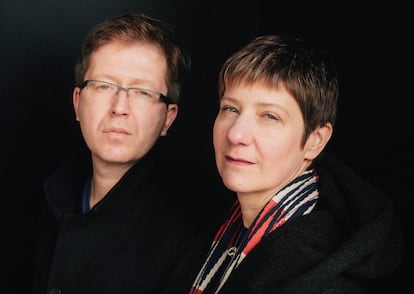

Their friendships crumbled as freedom in Russia crumbled. Journalists Irina Borogan (51, Moscow) and Andrei Soldatov (50, Moscow), who have been investigating the inner workings of the Russian security services for three decades, reflect in their latest book, Our Dear Friends in Moscow: The Inside Story of a Broken Generation, on how a well-educated, informed, and cosmopolitan generation embraced Putinism; and how democrats and authoritarians cannot coexist in the same society in the long run. Today, this couple lives in exile while their old friends have risen high within the Russian propaganda machine and government. A more comfortable life, but one tied to the future of the regime. And the future looks bleak: “The Russian intelligence services believe they are in an eternal war against the West, a struggle that will never end,” Borogan warns alongside Soldatov in a video conference interview.
Once the repressive machinery is unleashed, it will never stop on its own. This Monday, after this interview was conducted, the Russian justice system invoked its label of “foreign agents” to sentence Soldatov to four years in prison and prohibit him from managing the website of his own investigative platform. “This sentence is a clear attempt to silence me and force me to stop working as a journalist. I will continue to do so no matter what,” the expert told this newspaper by telephone.
Borogan and Soldatov have a deep understanding of the thinking of the silovichi, the elite of the Russian security forces. Founders of the Agentura website, they revealed Putin’s mass video surveillance in 2012 and, 10 years later, his partial purges within the Federal Security Service (FSB) and other espionage agencies for their failure to plan the invasion of Ukraine.
According to Russian intelligence logic, Moscow won against the West in its “centenary war” in the period between 1917 and 1945, then lost the Cold War when the USSR collapsed in 1991, and today is waging another battle against Europe that goes beyond Ukraine.
Both journalists emphasize that the army and the FSB (successor to the KGB) fell into disrepair after the Soviet collapse, and this trauma still haunts their leadership today. “They have a very bleak view of the future and don’t believe any positive scenario is possible for Russia. Even while acknowledging how terrible this war is, they think that stopping it or losing it will be worse than in 1991, and Russia will collapse,” Soldatov states during the interview.
The KGB and FSB’s great obsession has historically been British espionage, not American. When Soviet censorship ended, spy novels by Graham Greene, Ian Fleming, and John le Carré flooded Russian bookstores. And these works, especially Le Carré’s, became favorites of Russian intelligence chiefs and a propaganda weapon for the Foreign Intelligence Service (SVR), which has selectively leaked secret documents to Western filmmakers and novelists to construct its own narrative.
“The KGB feared a purge like the German Stasi, so they worked hard to create a completely false narrative that all intelligence agencies in the world were doing the same thing,” Soldatov points out.
“And this is false because Soviet intelligence agencies murdered, arrested, and took many people to concentration camps. European agencies did not,” he emphasizes, explaining the fundamental difference between Western and Russian espionage.
“The CIA’s primary task is not to protect the American political regime; there are other priority tasks, especially intelligence activities. For Soviet and Russian intelligence services, the main mission has always been to protect their political regime. The rest — intelligence gathering, warfare, and sabotage operations — are secondary,” the expert explains. “That’s why they are so aggressive and cruel; they believe any method is valid to protect it.”
Even so, whatever happens with the war in Ukraine, Borogan and Soldatov believe that Putin will not abandon his obsession with Europe and will maintain his hybrid operations against Germany, France, Poland, the United Kingdom, and especially the Baltic states. And the FSB now possesses a weapon the KGB lacked: the internet.
“Before, when an agent was recruited, they knew they were working for an intelligence service and were aware of the risks. Today, sabotage can be divided into several parts, and no one knows they are working for spies. One person is paid to scout the location, another to transport a package containing a hidden explosive device, and a third to press the button,” says Soldatov.
“[Russian espionage] can cause massive damage, set fire to a warehouse, without making any in-person contact. It organizes it through any secure messaging service, like Telegram, recruiting people who, if discovered, can only say that a stranger paid them to do it,” Borogan explains before emphasizing the low cost of these operations: “The KGB needed someone on the ground in the 1980s; it was extremely expensive and traceable. Today it costs €1,000 or €500 and leaves no trace. It’s fantastic for intelligence agencies.”
Telegram is currently facing enormous legal pressure in several countries, from France to Russia. The relationship between its founder, Pavel Durov, and the authorities is quite opaque, “but one thing is clear,” Soldatov points out, “Telegram has been actively used by many intelligence services: Russian, Ukrainian, Belarusian, and European, and each intelligence agency is trying to improve its standing there, even by exerting personal pressure on Durov.”
Several intelligence agencies operate in Russia: the FSB, the SVR, and the Main Directorate of the General Staff of the Armed Forces (GRU). According to Borogan, Putin has them all under his control.
“He’s a very intelligent man,” Soldatov adds. After a career in the KGB, Putin gained firsthand experience of corruption while working in the St. Petersburg mayor’s office in the 1990s. “Never before in history has a former KGB officer governed Russia or the Soviet Union. Even [Yuri] Andropov wasn’t a career officer. Putin is the first person from the system to lead the country.”
“He is the one who decides which operations are carried out and what their positions are. The situation is not like it was in the nineties, when an intelligence agency could use compromising material to change the president’s stance,” they point out.
Furthermore, “rivalry between agencies has diminished during the war because they receive ample resources. It’s not like during [Boris] Yeltsin’s time, when he pitted them against each other to maintain the balance. Now, all intelligence agencies are focused on the military effort and maintaining social stability through repression,” Borogan points out. “They have carte blanche and can use mechanisms they didn’t use before,” the journalist states.
The Kremlin keeps the military on a tight leash, especially after the arrest of several generals following the Wagner Group mutiny in 2023 and the replacement of Defense Minister Sergei Shoigu with a Putin-friendly economist, Andrei Belousov, in 2024. This purge has extended with the arrest of several members of the Shoigu clan since then, including his right-hand man, former Deputy Defense Minister Ruslan Tsalikov, in early March of this year.
“Belousov works closely with the FSB’s Military Counterintelligence Department,” Soldatov explains. “Even those who support the war but are dissatisfied with certain things on the front lines are very afraid to express their opinions. There are no more independent nationalist bloggers,” the expert adds. “Everyone has realized that it’s better to keep quiet.”
Russia can be a democracy
The two journalists debunk the myth that Russia can only exist under a strong leader. “It seems that the United States, France, or Spain can prosper on their own; but not Russia. Its people are supposedly useless, and there’s only one leader, Putin, who seems like some kind of incarnation of God on earth. That’s a lie. We’ve seen a fragile democracy in Russia, but a democracy nonetheless. I’m sure we’ll see more,” says Borogan.
When they both began their journalism careers in the early 2000s, there were no veterans of the Soviet era in newsrooms: they hadn’t found their place in democracy. Borogan and Soldatov believe this same threat looms over Kremlin-controlled media newsrooms today.
“Journalism presupposes the existence of ethical standards,” Soldatov states. “Many people probably won’t find their place in a democratic Russia because they simply don’t understand what journalism is. Journalism isn’t about serving the authorities and saying nice things about the Kremlin.”
The Ukraine war has trapped Russia, making the reintegration of its apparatus even more difficult than after the dissolution of the USSR. “The elite is under sanctions. They may face some kind of punishment [if there are major changes]. That’s why they believe they must unite around Putin; they have no future without him,” Borogan emphasizes.
Sign up for our weekly newsletter to get more English-language news coverage from EL PAÍS USA Edition









































