
Assassins, spies, and saboteurs in the eyes of the West; heroes in Russia
The Kremlin awards medals, positions, public appearances, and biopics to agents of its ‘illegal intelligence’ services that sow chaos in the West

Outwardly, for the Western audience, the Kremlin always denies violations of international law by its military and assassinations and sabotage by its spies on European territory, and labels any revelations about the chaos they sow as “Russophobia.” Behind closed doors, within Russia, Moscow proudly honors its “heroes” and guarantees them that they will want for nothing. Murderers who now sit in the State Duma as respectable deputies and family men who, when living abroad, never revealed to their children that they were Russian and now preside over companies linked to the Kremlin are some examples.
The Kremlin still denies having launched a wave of drones over Poland on September 10. In 2023, a pair of Russian Su-27 fighter jets shot down a U.S. drone over the international waters of the Black Sea. Moscow initially denied responsibility, saying the Reaper surveillance aircraft went down on its own due to “sudden maneuvers.” Days later, its defense minister admitted to the downing and decorated the pilots.
Every sabotage against the West is a source of pride for the Kremlin. “I heartily congratulate those who, having been away from their homeland for decades and without diplomatic or other cover, have defended the interests of our country and are today carrying out unique operations,” President Vladimir Putin said in a June 2022 speech marking the centenary of the Foreign Intelligence Service (SVR).
The Kremlin itself and its secret services often refer to the actions of its spies with the euphemism “illegal intelligence.” The February 2022 invasion of Ukraine had only just begun when the Russian leader laid a bouquet of flowers at the headquarters of this organization and asked its agents to “solve unconventional tasks” in their “fight” against the West. “I am sure you will serve Russia with honor, as your legendary predecessors did,” Putin concluded, in a clear allusion to the KGB.
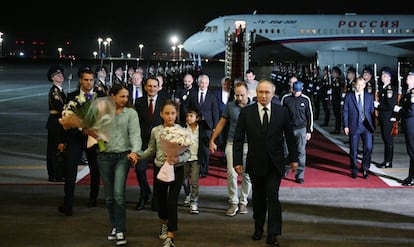
Some Russian spies take their mission in Europe to extremes. Sofía and Daniel thought they were two Argentine children whose parents had been detained without cause until Slovenian security forces put them on a plane with the spies Artiom Dultsev and Anna Dultseva last year. Upon landing as part of a massive exchange of Russian prisoners with the West, Putin greeted them with another bouquet of flowers.
Unlike other spies involved in that exchange, the Dultsev family gave an interview to the SVR’s official magazine, Razvedchik [Secret Agent]. “We had deep faith that we would return home safely. We knew for sure that the SVR would do everything possible to rescue us as soon as possible,” Anna said in the interview.
“People often approach us on the street and tell us they’re proud of us, proud that we’re Russian citizens. I think this will lead to more young people joining the intelligence service and wanting to do something great to defend our country,” added the spy, who says this experience strengthened them as a family and the SVR as a whole.
Putin awarded the Dultsevs the Order of Courage at the end of 2024 through a secret decree, although this recognition was revealed through the interview. It is unknown whether the Kremlin also rewarded other individuals released from that exchange, including Vadim Krasikov, the killer of a Chechen opposition figure in Berlin, and Pablo González, whose espionage case was reopened by Poland in August.
Moscow had maintained for years that Krasikov was an ordinary Russian citizen, but the pretense fell apart that day. “Krasikov is an employee of the SVR. In the Alpha unit, he worked alongside several members of the president’s security team. They congratulated each other yesterday when they saw each other, of course,” Kremlin spokesman Dmitry Peskov admitted after the exchange.
The Dultsevs were recruited in 2009. To enter the European Union without raising suspicion, they masked their identities through a third country: they both moved to Argentina in 2012 and obtained nationality with false papers. Five years later, they moved to Slovenia with their newborn children.
The family noted in the interview that their stay in Argentina was due to a change of plans following the arrest of 10 spies in the United States in 2010.
Andrei Bezrukov and Elena Vavilova were known in the United States as Donald Heathfield and Tracey Foley before their story as undercover FSB spies inspired the series The Americans. Returning to Russia in 2010 and linked to Igor Sechin, the head of the Rosneft oil company, Bezrukov is now president of the Association for the Export of Technological Sovereignty, a pro-Kremlin organization that lobbies for Russian intelligence software companies in Africa and Asia.
“Latin America has always been a key region for the legalization of Russian spies through the acquisition of passports and other means,” Andrei Soldatov, co-founder with journalist Irina Borogan of Agentura, a website specializing in Russian secret services, told this newspaper. “Serbia is another of its main countries because it is the only one that accepts Russian spies expelled from European nations,” adds the author of a book chronicling the transition of some Russian journalists to the intelligence services, speaking from exile.
The SVR isn’t the only Russian intelligence agency operating in Europe. The Fifth Department of the Federal Security Service (FSB) and the Army’s Central Intelligence Agency (GRU) are also active. “Their differences are now less pronounced than before the war. They tend to use the same methods in sabotage and hybrid warfare operations,” Soldatov adds.
The Litvinenko killers
Before the war, one in five Russian State Duma deputies had some connection to the security services or the military. A paradigmatic case of agents elevated to the status of “heroes” by the Kremlin is that of the killers of FSB defector Alexander Litvinenko, poisoned in London in 2006 with a dose of radioactive polonium.
Andrei Lugovoy, an FSB agent, is now a prominent State Duma deputy; and Dmitry Kovtun, a member of the GRU, was a successful businessman until his death in 2022 from Covid-19.
The polonium Lugovoy and Kovtun used left a radioactive trail across half of London, although the Kremlin denied responsibility. “We are not prepared to comply with this type of decision,” Putin’s spokesman said in 2021 when the European Court of Human Rights ruled that Moscow must compensate the widow.
Another famous Russian Duma deputy and agent is Maria Butina, sentenced in the United States in 2019 to 18 months in prison for pretending to be a student while simultaneously serving as a bridge between the Kremlin, the National Rifle Association, and Donald Trump’s Republican Party.
Butina, a regular contributor to Russian propaganda, has also been the face of some of the Russian regime’s most controversial legal initiatives. At the beginning of the war, she helped draft a law allowing for the closure of media outlets that “disrespect Russian society,” and in August of this year, she introduced another bill that would allow minors who disagree with the government to be sent to pretrial detention centers.
The Kremlin has built the myth of a martyr around Butina to boost its propaganda against the West. “This is the story of Maria Butina, of how to protect herself and keep her faith in God in inhumane conditions,” reads the Foreign Ministry’s review of the Prison Diary television series, a biopic about the deputy funded by the Internet Development Institute, an opaque, semi-public organization that has also funded other propaganda works about Chechen leader Ramzan Kadyrov and the invasion of Ukraine.
The threat of Russian spies is not new. Agents killed a Chechen independence leader, Zelimkhan Yandarbiyev, with a car bomb in Qatar in 2024. Sentenced to life imprisonment in the Arab country, they were eventually extradited to Russia to serve their sentences. The echo of applause in Russian propaganda had not yet died down when the Kremlin announced that its spies had “disappeared.”
Not all of Moscow’s agents are Russian. The independent outlet The Insider has revealed how the FSB has bought off European politicians of all stripes over the years, from MPs of Italy’s Northern League to representatives of the European parliament.
Last week, Nathan Gill, former leader of the British political party Reform UK, admitted to receiving bribes from Moscow to defend its views in the European parliament.
And seven years after Putin danced with her at her wedding, former Austrian foreign minister Karin Kneissl gave a lecture this week to about 100 Russian paratroopers in the city of Ryazan. “I now live in Russia and try to do my part. We need to define and rethink Russia’s national interests, understand the new geography, and see what went wrong in Europe,” the former head of diplomacy for a European Union country told the soldiers.
Sign up for our weekly newsletter to get more English-language news coverage from EL PAÍS USA Edition









































