
Ukrainian army lands in the Mediterranean to target Russian phantom fleet
Kyiv’s military personnel are operating drones from Libya to sink ships carrying Russian fuel and to support anti-Kremlin governments in Africa
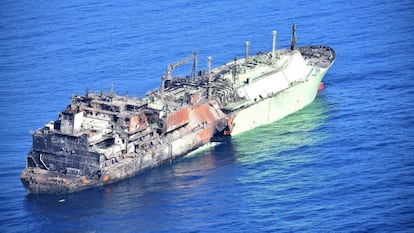

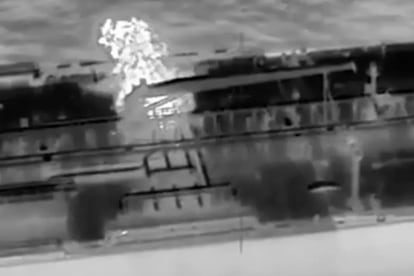
Ukrainian drones bombed the oil tanker Qendil on December 19, 2025. The Qendil sails under the Omani flag and is part of Russia’s so-called phantom fleet, the ships that transport Russian crude oil and gas in violation of Western sanctions imposed after the invasion of Ukraine. The Security Service of Ukraine (SSU) released a video proving they carried out the operation. The Ukrainian military frequently attacks Russian merchant and military vessels in the Baltic and Black Seas. What made the attack on the Qendil particularly significant was that it occurred in the Mediterranean Sea.
The Qendil was attacked in international waters between Malta and Greece. It was the first military operation acknowledged by Ukraine in the Mediterranean. Where did the drones take off from? The SSU did not disclose this information. A second attack, on March 3, revealed that Ukraine operates from the Libyan coast.
The second Ukrainian attack in the Mediterranean succeeded in destroying the LNG carrier Arctic Metagaz, a vessel transporting 60,000 tons of liquefied natural gas from Russia. Seven EU states, led by Italy, and environmental organizations such as WWF protested vehemently about the potential environmental disaster the sinking could cause. The Qendil, on the other hand, was sailing empty, allowing the SSU to boast that no spill had occurred.
The Kremlin accused Ukraine of destroying the Arctic Metagaz, claiming it was attacked from Libya with a naval drone. Kyiv has neither officially confirmed nor denied responsibility for the attack, but both Ukrainian military officials and media outlets consider it a fact. Images of the ship adrift with a hole in its hull suggest that a projectile struck there.
French radio RFI reported on April 2 that Ukraine has maintained drone launch sites in Libya’s coastal region of Zawiya since last November. RFI claims that more than 200 Ukrainian military personnel are stationed in Zawiya and Misrata. In Misrata, they share a base with forces from Western countries supporting Prime Minister Abdul Hamid Dbeibeh. His government controls the west of the country, including the capital Tripoli, while rebels led by Marshal Khalifa Haftar, with Russian support, control the eastern regions.
Special operations
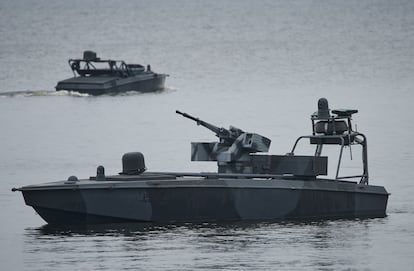
RFI reports that the drone that struck the Arctic Metagaz was a Magura. This unmanned bomb boat, in its most common configuration, has a range of 500 miles and can carry up to 300 kilograms of explosives. The Magura is a weapon used by the intelligence services of the Ukrainian Ministry of Defense (GUR). The SSU, on the other hand, operates Ukraine’s other flagship bomb-drone, the Sea Baby. The SSU admitted last December to having participated in operations in the Mediterranean. If RFI’s information is correct, this would indicate that the GUR may also be stationed in Libya. The SSU and the GUR have been responsible for most Ukrainian special operations on Russian territory.
The Arctic Metagaz was attacked in international waters, 150 miles off the Libyan coast. After it sank, another Russian LNG carrier, the Arctic Pioneer, changed course while sailing in the Mediterranean to return to Russia via the Red Sea and around Africa. This week it left the South African coast.
The Associated Press, citing anonymous sources within the Libyan military, published the same information as RFI on April 7. Kyiv has responded to these reports with silence. Igor Lutsenko, a well-known Ukrainian politician and military officer, confirmed the presence of his comrades in Libya on April 6 in the media outlet NV. He also indicated that a bilateral defense agreement exists between the Libyan and Ukrainian governments.
There is officially no bilateral security treaty between Ukraine and Libya. There is no record of Ukrainian President Volodymyr Zelenskiy meeting with Libyan President Ddeibah to discuss defense cooperation, unlike his meeting with Syrian President Ahmed al-Sharaa in April when he traveled to Damascus. Syria is another Eastern Mediterranean country still recovering from the ravages of civil war, where Russia played a decisive role in supporting dictator Bashar al-Assad. Zelenskiy and Al-Shara pledged to “work together to bring more security and development to our societies,” the Ukrainian president stated.
Libyan military training
The only publicly acknowledged diplomatic meeting between representatives of Libya and Ukraine took place in Tripoli in 2023 between the head of the Libyan Defense Minister’s office, Jibril Al-Shteiwi, and the Ukrainian embassy’s military attaché, Andriy Bayuk. Both representatives stated that their governments would explore ways to cooperate on security matters. Al-Shteiwi indicated that Libyan military personnel were already receiving training in Ukraine.
The next clue to Ukrainian activities in Libya came from a statement last August by Libya’s Attorney General, Al-Siddiq Ahmed Al-Sour, announcing an investigation into the alleged entry into the country from Algeria of Ukrainian drones that were subsequently sent to combatant groups in neighboring Niger, Mali, and Burkina Faso. These three countries are embroiled in conflicts where Ukrainian drones are believed to be used to arm groups opposed to the Russian-backed governments. That same August, Haftar’s rebel forces in Libya also claimed to have shot down three Ukrainian reconnaissance drones.
In Africa, as in Syria, Ukraine is seeking to counter Russian interests. Dallas Analytics, a Ukrainian research group that studies Russian military capabilities, explained to EL PAÍS that Russia is intensifying its satellite mapping of North and West Africa to increase “military operations on the continent.”
A spokesperson for Dallas, a group that works with the Ukrainian government, suggests that Kyiv “will maintain or expand its presence in the Mediterranean”: “This sea is a crucial arena for Russian logistics, energy exports, and arms trafficking — all legitimate objectives in Ukraine’s asymmetric campaign to limit Russia’s military capabilities.”
Dallas confirms there is a risk that Russia or its allies will take action against these Ukrainian outposts in Africa. Tensions surrounding the phantom fleet have escalated after the Kremlin confirmed on Thursday that it has deployed a warship to the English Channel to prevent its tankers from being intercepted by British authorities.
Sign up for our weekly newsletter to get more English-language news coverage from EL PAÍS USA Edition









































