
Russia intensifies its offensive against Ukraine’s railways, a vital infrastructure
Russia has carried out nearly 5,000 attacks targeting Ukraine’s railway system and caused damage to more than 25,000 pieces of infrastructure
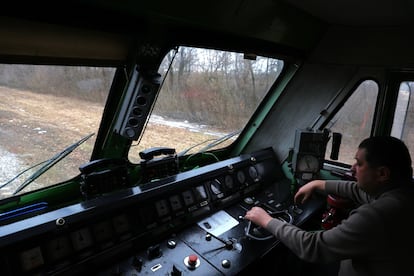

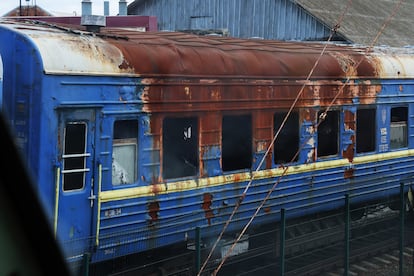
Andrii Hlemba, 48, sounds the horn of the veteran Czech-made locomotive as it passes the small level crossings that dot eastern Ukraine. The route through various villages is sometimes punctuated by cemeteries where multicolored flowers and national flags mark the graves of those who have fallen during the conflict. Through the window, bombed-out houses, charred train cars, and even the remains of Shahed drones launched by the Russians are also visible. The driver is sparing with words, but he doesn’t hide the pride he feels in being able to do this job, which he considers essential: “Ukrzaliznytsia is the lifeblood of the country; without this company, we couldn’t survive.”
Over the past four years, Russia has carried out nearly 5,000 attacks targeting Ukraine’s railway system and caused damage to more than 25,000 pieces of infrastructure. This system is a crucial pillar for the transport of people and goods of all kinds, including weaponry, in times of war. The refinement of drones allows Moscow to increasingly target not only stations, bridges, and tracks, but also moving trains, according to company officials, who have lost more than 1,000 employees during the Russian invasion launched in February 2022.
Since the winter, in response to the offensive, they have been forced to reinforce security protocols, a company spokesperson acknowledges. Ukrzaliznytsia is the country’s largest employer with some 230,000 workers, 15,000 of whom are serving in the military. At the same time, they have had to cancel services to some of the destinations closest to combat zones due to the increase in attacks.
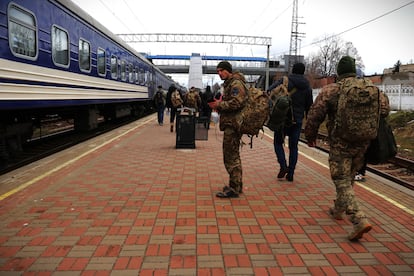
The authorities in Kyiv, led by President Volodymyr Zelenskiy, make no secret of the fact that trains are a prime target for Russian forces. EL PAÍS accompanied company employees and passengers, many of them soldiers on their way to the front, from Kyiv to Lozova (Kharkiv) along one of the most dangerous lines still in operation. The previous afternoon, a Russian drone had struck a carriage near Krivy Rig in southern Ukraine, killing one passenger.
The importance of trains “is no secret to the Russians,” acknowledges Oleksandr Pertsovsky, the company’s CEO, during a conversation in the capital. He predicts an increase in bombings during the spring. In any case, security is something that, when it works, no one pays attention to, he states. “Unfortunately, it sometimes fails for multiple reasons. The main one is that the enemy is constantly present and changes the frequencies at which the drones operate. We have hundreds of trains running every day,” and the protocol can be effective “in 99.9% of cases,” but when it fails, “we face a tragedy,” concludes Pertsovsky, who continues to answer calls and messages while responding to the questions.
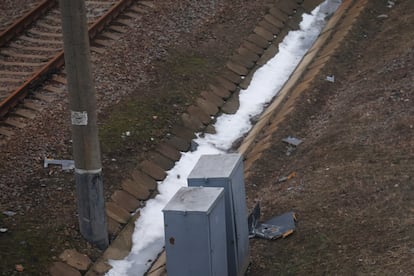
Faced with Russian pressure, trains ceased reaching the eastern Donetsk region at the end of 2025. Important stations such as Sloviansk and Kramatorsk, key Ukrainian strongholds in the eastern part of the country largely under enemy occupation, were then closed. In January 2026, a train crash killed six passengers in Barbinkove (Kharkiv), which had become the last station on that route. Now, the line ends about 40 miles earlier, in Lozova, from where passengers must continue their journey by minibus.
Silence reigns in the train cars, and many passengers are reluctant to speak. Svitlana — laughing instead of giving her age — is returning home to Kramatorsk, a prime target for the Russians, where “time will tell if we can continue living.” Sergey, a 47-year-old soldier, and Maxim, 24, are returning to their posts after spending two weeks of vacation with their families, as stipulated every six months by the military authorities.
“Beyond Lozova it’s too dangerous; there aren’t even any overhead lines,” warns Hlemba, a train driver for 22 years. When the train arrives in Poltava, alarms are raised about the possible arrival of Russian missiles, but after a few minutes at the station, the journey resumes as normal. From this point onward, the danger is potentially greater. As the head of the convoy, 41-year-old Iryna Petrushchak is responsible for making decisions such as stopping the train or even evacuating it. She is assisted by the command center, which constantly monitors, in real time, the potential threat of Russian drones, their direction, altitude, and distance from the track. The company does not consider it entirely useful for armed military personnel to travel on the trains.
“Being a manager right now means a huge responsibility for my life, for the lives of my colleagues, and for the passengers. In Kyiv, we live relatively safely, but this is something else entirely. We know how to proceed,” if something happens, says Petrushchak, who has held the position for almost two decades, sitting in one of the compartments. The workers receive training and psychological support. “At first, I felt some fear, but over time, the sense of responsibility took over. I have to do my job well and try to keep everything under control in front of everyone,” she adds, proud of having been hired by Ukrzaliznytsia at 18, the same company where her mother, sister, and husband are employed.
The rail company’s figures demonstrate its importance as a pillar of Ukraine. In these four years of war, it has transported more than 97.5 million passengers. With the airspace closed, it is the main lifeline to the rest of the world, whose leaders can reach Kyiv through the Iron Diplomacy program. It also allows President Zelenskiy and local officials to travel.
The Russians are aware of this and have carried out 4,775 attacks since February 2022. Among the more than 25,000 damaged pieces of railway infrastructure are 2,370 carriages and locomotives, as well as 73 stations, including Lozova. The number of workers killed has reached 1,038 — 38 while on duty, 832 on the front lines, and the rest in attacks on their homes — as well as 2,928 wounded, according to company data from early March.

The death of colleagues “is a great loss, something very painful. We are like a big family, but we have to keep going,” says Petrushchak. “Almost all of our workers have already attended the funeral of a colleague,” laments a spokesperson, who emphasizes the effort it takes for the railways to continue reaching destinations so exposed to the conflict, such as Zaporizhzhia, Kherson, and Sumy.
Faced with the difficulties posed by the war, Pertsovsky outlines five priorities for the company. First, to keep the trains running despite Russian pressure; second, to withstand the economic pressure and a significant debt that will be difficult to manage, along with a substantial loss in freight transport; third, to maintain the workforce necessary to keep the railway company and other companies in the country operating; fourth, to continue developing longer-term projects such as digitalization, artificial intelligence, train modernization, and opening lines to Europe; and fifth, to ensure that the railways remain a symbol of the country’s resilience.
The bombed-out heart of Lozova station welcomes the train eight hours after its departure from Kyiv. The station manager, Nina Zabela, 55, a railway employee for 32 years, recalls amid the ruins the early morning of August 5, when an attack by some 15 Shahed drones took place, which, she is grateful, caused nothing more than enormous material damage. Now, being the last stop for trains in the east of the country has increased the number of passengers, necessitating the construction of a new shelter for when alarms are triggered.
The passengers, many in uniform, disembark from the carriages while some 30 residents evacuated from frontline towns wait to be relocated to other areas of the country further west. The passenger list from the day before this trip, on March 3, included, in addition to the refugees, two dogs, a cat, a fish, and a parrot. “We leave no one behind,” a company spokesperson proudly asserts.
Sign up for our weekly newsletter to get more English-language news coverage from EL PAÍS USA Edition









































