
Iran war and Russia talks strain relations between Ukraine and the United States
The supply of US-made munitions for Ukraine’s air defense is at risk if the war in the Middle East continues much longer

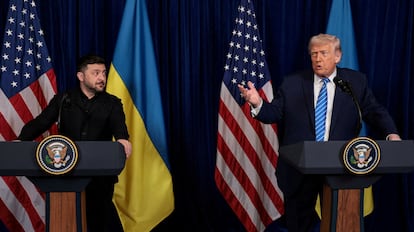
Volodymyr Zelenskiy has once again stood up to Donald Trump. It wasn’t a clash with the high-voltage tension of their on-screen confrontation in February 2025, when the Ukrainian president had his now‑famous exchange with Trump at the White House. Since that clash, Zelensky has been generous in his praise of Trump, seeking to repair relations with a theoretically key ally who is showing more support for Russia.
But that changed last week, when Zelenskiy and Marco Rubio, Trump’s secretary of state, accused each other of lying. The Ukrainian president added that Washington is setting unfair conditions for ending the war in Ukraine.
On March 23, Zelenskiy told Reuters that the United States is demanding Ukraine withdraw its troops from the Donbas region (in the east of the country) as a prerequisite for Washington’s so-called “security guarantees” — the military protection measures that the Pentagon would have to provide to Ukraine to ensure that Russia respects any potential peace agreement. Russian President Vladimir Putin is also demanding that Ukraine withdraw its troops from the part of Donbas it still controls.
In December, Zelenskiy said that he was prepared to withdraw his troops from the region if Russia also withdrew its troops. The Kremlin rejected this proposal, and the White House, according to Zelenskiy’s comments to Reuters, sided with Putin. Rubio denied this two days later during a visit to Paris: “It’s unfortunate he would say that, because he [Zelenskiy] knows that’s not true, and that’s not what he was told.”
“What he was told very clearly — and he should have understood it — is that the security guarantees come only after there is an end to the war,” Rubio told reporters. “But that was not attached to unless he gives up territory.”
Zelenskiy vehemently retorted on March 28: “Most of the iceberg is not visible, but believe me, I showed only the tip of it. I am being absolutely honest.”
The U.S.-brokered peace process is at a standstill, according to leading Ukrainian media outlets such as Ukrainska Pravda and Espreso. Zelenskiy denied this in a March 30 online meeting with journalists, but admitted that trilateral negotiations with Washington and Moscow have been “postponed because the U.S. is currently focused on Iran.” He added: “The ball is now in the court of both the United States and Russia.”
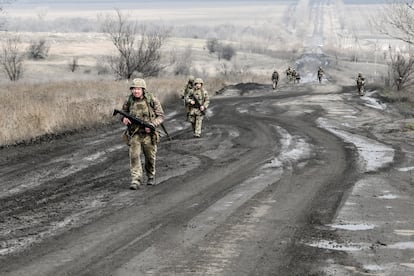
Ukraine is prepared for at least two more years of war, as Zelenskiy acknowledged last November. Russia has made it clear that it has no intention of ending the invasion, and Kyiv knows that negotiations achieve little, which is why it is already drawing up a plan to sustain resistance on the front for another three years. This information was communicated to lawmakers by Andriy Motovilovets, deputy head of the Servant of the People parliamentary group — Zelenskiy’s party — according to a March 24 report by Ukrainska Pravda.
Sources from Zelenskiy’s office warned EL PAÍS last January that this planning for a longer war includes the possibility that the United States may step back from efforts to secure peace or from its military support. Trump himself has suggested as much on several occasions during his year in office, using it as a way to pressure Kyiv to make concessions to Russia.
Trump’s decisions on Ukraine during the war with Iran have widened the rift even further. The main setback for Kyiv is the partial lifting of U.S. sanctions on Russian oil. The authorization, approved by Trump on March 12, is intended to contain the surge in oil prices caused by the war with Iran. Zelenskiy criticized the move, arguing that it allows Moscow to earn more revenue to fuel its war machine.
Another move by Trump that has caused significant unease in Ukraine is his repeated public support for Viktor Orbán’s bid to be re‑elected as Hungary’s prime minister in the April 12 parliamentary elections. Orbán, Russia’s main ally within the European Union, has spent much of his tenure putting obstacles in the way of Ukraine’s interests in the EU. U.S. Vice President J. D. Vance will visit Budapest next week, in the final days of the campaign, to support Orbán.
The war in Iran has also strained relations between Kyiv and Washington because the supply of U.S.-made munitions for Ukraine’s air defense is at risk if the war in the Middle East continues much longer. Zelenskiy admitted on April 2 that the supply of Patriot missiles is now in doubt because U.S. allies in the region reportedly need them.
“There are reports pointing to a reduction in [international] armaments for Ukraine,” Arseniy Yatsenyuk, former prime minister of Ukraine, told the conference of the Kyiv Security Forum (KSF) on April 3. “If Ukraine cannot defend itself, it would be a disaster for everyone in Europe and America.”
Yatsenyuk’s remarks coincide with the possibility — flagged by Trump on March 26 — that part of the U.S. weapons destined for Ukraine, previously purchased by NATO countries, could be redirected to the war in the Middle East.
“The lowest point in relations between the two countries was the discussion at the White House in February 2025, but since then, Kyiv has done everything possible to rebuild the relationship; now we are facing a moment of resolve from Ukraine, of persisting with Washington,” former CIA officer Ralph Goff, stationed in Ukraine, told EL PAÍS during the KSF conference. “Europe and Ukraine must continue working on their ties with the United States; we must try because there will come a time when these efforts will bear fruit.”
Yatsenyuk added that it was a mistake to put more pressure on Ukraine than on Russia to end the war. “Putting maximum pressure on Vladimir Putin and maintaining strong unity is the way to win.” Precisely the opposite of what Trump is doing.
Sign up for our weekly newsletter to get more English-language news coverage from EL PAÍS USA Edition









































