
Trump’s Iran war: A chaotic narrative with threats, contradictions, and onomatopoeia
The US president provides his version of the Middle East offensive daily through press conferences, interviews, and social media posts. ‘I can change my mind in seconds,’ he responds when inconsistencies are pointed out
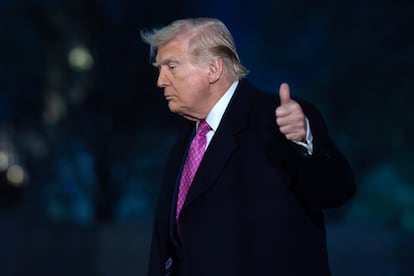

Donald Trump has missed no opportunity to recount — and distort — his version of the war he launched against Iran alongside Israel a month ago. Since February 28, he has given over 50 interviews, spoken at nearly 20 events, and answered media questions a dozen times aboard or at the steps to Air Force One, according to the archives of the American media outlet Roll Call, which compiles all of the president’s appearances on its website. At the same time, he has written more than 40 posts about Iran on his social network, Truth, shared favorable press articles about a dozen times, and reposted messages from officials who support his position.
In the war according to Trump, there has been a bit of everything. From praise for the “incredible” U.S. military and criticism of his predecessors, to repetitive reports of military coups and constant allusions to the assassination of Iranian General Qasem Soleimani in 2020 and Operation Midnight Hammer against Iran last June. There have also been threats to Tehran and overtures to or reproaches against NATO, whose members he directly called “cowards.” In addition, there have been announcements about the possibility (or impossibility) of negotiations, and a few gaffes. “They have to open up the Strait of Trump — I mean, Hormuz,” he said on March 27 in Florida, at a conference on the future of Saudi investment. “Excuse me. I’m so sorry. Such a terrible mistake,” he added. “The fake news will say, ‘He accidentally said’ — No, there’s no accidents with me, not too many. If there were, we’d have a major story." On the same day, Trump used onomatopoeia to describe the interception of Iranian missiles: “Fire, boom, fire, boom.”
Nor have his standard outbursts against the media been lacking. Especially when he has been asked about his next move or reminded that his original plans were different. “I can change my mind in a matter of seconds,” he told Fox News Radio when asked if he would take over Kharg Island.
This is Trump’s chronological account of the war.
February 28: The reasons for starting a war
A few hours after the start of Operation Epic Fury against Iran, Trump outlined its objectives:
“Our objective is to defend the American people by eliminating imminent threats from the Iranian regime. A vicious group of very hard, terrible people [...] They can never have a nuclear weapon.”
“When we are finished,” he told the Iranian people, “take over your government. It will be yours to take. This will be probably your only chance for generations [...] No president was willing to do what I am willing to do tonight. Now you have a president who is giving you what you want. So let’s see how you respond.”
March 1: “We have capability to go far longer”
At a White House awards ceremony, Trump extended the forecast for the duration of the war. “We projected four to five weeks, but we have capability to go far longer than that. We’ll do it. Whatever somebody said today — they said, oh, well, the president wants to do it really quickly. After that, he’ll get bored. I don’t get bored. There’s nothing boring about this.”
March 3: The allies and oil
A reporter asked what the worst possible scenario in the war would be.
“It would probably be the worse you go through this, and then, in five years, you realize you put somebody in who was no better.”
At that meeting, the president also drew up his first map of allies. “Some of the European nations have been helpful and some haven’t, and I’m very surprised. Germany has been great... others have been very good. The head of NATO, Mark Rutte, has been fantastic. Spain has been terrible [...] I’m not happy with the United Kingdom either; This is not Winston Churchill we’re dealing with.”
March 5: The new Iranian leader
Trump says he wants to influence the selection of Iran’s new leader, as he did in Venezuela. “One of the things I’m going to be asking for is the ability to work with them on choosing a new leader. I’m not going through this to end up with another Khamenei. I want to be involved in the selection. They can select, but we have to make sure it’s somebody that’s reasonable to the United States,” he stated in an interview with Time magazine.
March 6: “There will be no agreement short of unconditional surrender”
Trump asserts on Truth Social that “There will be no deal with Iran except UNCONDITIONAL SURRENDER!” “After that, and the selection of a GREAT & ACCEPTABLE Leader(s), we, and many of our wonderful and very brave allies and partners, will work tirelessly to bring Iran back from the brink of destruction, making it economically bigger, better, and stronger than ever before. IRAN WILL HAVE A GREAT FUTURE. “MAKE IRAN GREAT AGAIN (MIGA!)” On March 24, Trump announced a 15-point peace plan to negotiate with Iran and later postponed the negotiations twice to give Tehran time to decide.
March 7 and 9: Self-congratulation
On March 7, on Truth Social, he thanked himself, on behalf of the Middle Eastern countries, for the intervention. “They have said, ‘Thank you President Trump.’ I have said, ‘You’re welcome!’ Iran is no longer the ‘Bully of the Middle East,’ they are, instead, ‘THE LOSER OF THE MIDDLE EAST,’ and will be for many decades until they surrender or, more likely, completely collapse!”
Two days later, at an event in Florida, he continued his theme. “Isn’t Epic Fury a great name? Even better than Midnight Hammer, which was also pretty good.”
In an interview with CBS, he asserts that “the war is almost over.” “They have no navy, no communications, no air force. Their missiles have been scattered and destroyed. Their drones are being taken down everywhere, even their drone manufacturing facilities. If you look at it, they have nothing. Militarily, they have nothing,” he says, maintaining that the U.S. is “well ahead of schedule” in the offensive.
That day he attended another event in Miami, where he addressed the situation in the Strait of Hormuz. “I will not allow a terrorist regime to hold the world hostage and stop the globe’s oil supply,” he said. On Truth Social, he asserted that the increase in the price of crude oil was “a very small price to pay for the security and peace of the U.S. and the world” and that “only fools would think otherwise.”
Throughout March, Iran controlled the strait, and maritime traffic there fell by 90%. The price of oil skyrocketed.
March 11 and 13: War won in “first hour”
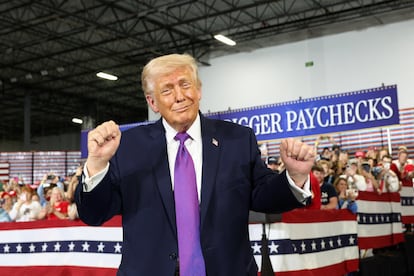
In a speech in Kentucky, Trump maintained that the war was won on February 28. “You never like to say too early you won. We won. In the first hour it was over."
Two days later, the press again asked him how long he thought the conflict would last.
— I can’t tell you that. I mean, I have my own idea, but what good could you do? It’ll be as long as it’s necessary.
That same day, in an interview on Fox News Radio, he asserted that, if he wanted, he could end the war in an hour. “We could hang up the phone and, within an hour, you’d be reading about the decommissioning of nuclear power plants or energy plants. We could do things that would be so bad that they could literally never rebuild as a nation again. We’re trying to be nice about it.”
March 14: Help to unblock Hormuz
On Truth Social, he asserted that the U.S. has already “beaten and completely decimated Iran,” but that countries receiving oil through the Strait of Hormuz must help take this step. “And we will help — A LOT! The U.S. will also coordinate with those Countries so that everything goes quickly, smoothly, and well. This should have always been a team effort, and now it will be.” In another post, he explicitly called for cooperation from “China, France, Japan, South Korea, the UK, and other countries.”
March 16 and 17: Rejects NATO aid
Trump decided he neither wants wars, nor NATO aid. “I want wars less than almost anybody. Peace through strength,” he says from the Oval Office.
Minutes later, he lashes out at the Alliance: “The problem with NATO is we’ll always be there for them but they’ll never be there for us.” A day later, he explodes on Truth Social: “Because of the fact that we have had such Military Success, we no longer “need,” or desire, the NATO Countries’ assistance — WE NEVER DID! Likewise, Japan, Australia, or South Korea. In fact, speaking as President of the United States of America, by far the Most Powerful Country Anywhere in the World, WE DO NOT NEED THE HELP OF ANYONE!"
March 21 and March 23: 48 hours to five-day deadline for Iran
During the previous week, Trump had suggested that Iran was seeking negotiations, but that the U.S. did not yet see that as a possibility. However, on March 21, he threatened to attack Iranian energy facilities “within 48 hours” if Tehran did not open the Strait of Hormuz.
On March 23, as the deadline approached, he granted five more days because Washington had initiated “very good and productive talks” with Iran. That day he told the press that there were already “major points of agreement.” He asserted that once an agreement was reached, “the price of oil will fall like a rock.”
March 26: A 10-day extension
Iran denied being in negotiations with the U.S. and rejected the 15-point plan proposed by Trump.
The president posts again on Truth Social. “The Iranian negotiators are very different and ‘strange.’ They are ‘begging’ us to make a deal, which they should be doing since they have been militarily obliterated, with zero chance of a comeback, and yet they publicly state that they are only ‘looking at our proposal.’ WRONG!!! They better get serious soon, before it is too late, because once that happens, there is NO TURNING BACK, and it won’t be pretty!”
Twelve hours later, “at the request of the Iranian government,” the U.S. extended the deadline to April 6. “Talks are ongoing and, despite erroneous statements to the contrary by the Fake News Media, and others, they are going very well,” Trump posted.
March 27: A great peacemaker
A month after the start of the war against Iran, during a conference on the future of Saudi investment, Trump summarized:
“We are achieving each and every one of the military objectives I set less than four weeks ago. In fact, we are about two weeks ahead of schedule. We call it a military operation, not a war [...] In two days, the damage was already done. Now we are just attacking the remaining targets.
“I would love my legacy to be made as a great peacemaker because I really believe I am a peacemaker. It doesn’t seem like it right now, but I think I am a peacemaker.”
Sign up for our weekly newsletter to get more English-language news coverage from EL PAÍS USA Edition









































