
Laura and Cristina, a Brazilian couple with four kids: ‘If Bolsonaro wins we will be a bunker of resistance’
Women, Black people, indigenous groups and the LGTBIQ+ community fear a rollback in rights and public policies if the far-right candidate emerges as the winner of the general election
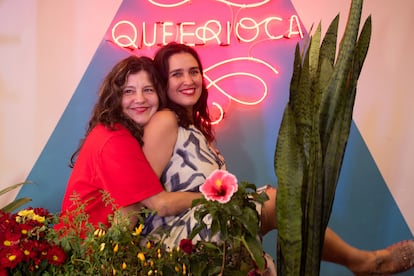
It’s Saturday night in Rio de Janeiro’s financial district and there are nothing but closed offices and dark streets, but around a corner, a three-story house lit in the colors of the rainbow appears. In front, a boisterous crowd is spread between tables, and there is even a sofa set out on the street. This is the atmosphere of Queerioca, a cultural center that has become the epicenter of Rio’s LGTBIQ+ community. There’s a DJ, laughter and caipirinhas, but also T-shirts bearing the face of President Luiz Inácio Lula da Silva, and some tension in the air. Brazil is holding general elections with the first round scheduled for Sunday, and the far right is knocking at the door.
Amid the bustle, the founders of this space, actresses Laura Castro and Cristina Flores, hide their nerves as best they can. They are a couple and the parents of four children: “We’re working happily, but with one eye on the polls, thinking that the absurd, the impossible, the unimaginable could happen,” they say. They launched the center as a meeting point for the rainbow community, where book launches, exhibitions, debates, film series and lively ballroom parties are held. The opening of the new headquarters took place a few days ago, with the national trans and travesti march and a strong presence of political representatives from the LGBTQ+ community.
For the promoters, political engagement is unavoidable: “These days we were saying that if Flávio [Bolsonaro, the far right candidate] wins our responsibility will be even greater. We have a house of resistance. No matter what happens, this house will have to keep existing,” says Castro. Until recently this large house had been a brothel. On the top floor there is a mattress and a small bathroom with a shower that the new owners now make available for artist residencies. “If necessary we’ll turn it into a bunker,” Flores says, half joking, half serious.
For them, as for many other Brazilians with dissident sexualities, the greatest fear is a regression of rights that now hang by a thread. Castro fears something similar to what happened in Italy, where Prime Minister Giorgia Meloni ordered the removal of non-biological mothers’ names from their children’s birth certificates. “That is my worst nightmare,” she sums up.
In Brazil same-sex marriage and adoption by same-sex couples have been legal since 2011, but only because the Supreme Court decided so. Homophobia and racism are crimes, but again by judicial decision. Congress, increasingly conservative, has never passed a law in defense of minorities.
This year’s elections are particularly delicate because the Senate majority is at stake; that majority gives the green light to appointments to the highest court. If former president Jair Bolsonaro’s son wins, and Bolsonarismo manages to control the upper chamber, it could form a majority of conservative judges. Everyone remembers that Bolsonaro senior appointed to the Supreme Court a judge he publicly presented as “terribly evangelical.”
Felipe Vianna and João Tonhá also have several reasons to be worried. Besides being a gay couple, they are the proud products of public education and work in the public health system. Tonhá works as a family doctor, specializes in improving care for LGTBIQ+ patients and is also training professionals in the Mais Médicos program, which sends health workers to isolated regions. When Bolsonaro senior came to power, one of his first moves was to end the program, which had been made up almost entirely of Cuban professionals. He fears that, once again, all the efforts will go down the drain.
In the last four years the number of doctors in remote villages and peripheral neighborhoods doubled, exceeding 26,000. “When the far right governs, it dismantles the whole state apparatus built by progressive forces,” Tonhá laments.
Vianna, who is Black and comes from a humble family, managed to attend public university thanks to scholarships and a policy that reserves spots for low-income students, Black students or those from public schools. It is a policy that, after some initial controversy, was consolidated across Brazil, has been in force for 14 years and has radically transformed Brazilian public universities: from an enclave reserved for the white elite to a real possibility for everyone. Vianna is one of those thousands of Brazilians who embody one of Lula’s campaign favourites: “The son of a domestic worker became a doctor.”
As a senator, Flávio Bolsonaro proposed changing the law to end reserved places for Black people and people with disabilities. In Santa Catarina, one of the most bolsonarist states, the regional government already tried to ban quotas in its universities, but the Supreme Court stopped the attempt. Vianna is now a renowned ENT specialist, but when his colleagues applaud his hard-won career he is always keen to cut short purely meritocratic narratives: “I would not have achieved my professional success without the opportunity provided by public policies,” he says firmly.
Also worried about the future of those policies is Janaína Peclat, a labor lawyer and the first university graduate in her family, also thanks to the quota system. As a Black woman she laments the absence of concrete ideas (at best) to confront the scourge of racism. Flávio Bolsonaro’s platform contains no concrete proposals. It is not an issue. After activists in the Black movement managed to make structural racism in Brazil a central political issue, reverting would mean going back to the era of “racial democracy,” the imaginary country where indigenous people, whites and Blacks coexist in harmony.
Another recurring nightmare: seeing Bolsonaro senior hurl insults on television again, humiliating a journalist or mocking Covid-19 victims. The veteran politician has spent months away from the spotlight because he is serving a 27-year sentence under house arrest for his role in the coup attempt, but lawyer Peclat does not doubt that, if Flávio wins, the clan leader will return to the field: “The first thing [Flávio] will do is pardon him, him and the other coup plotters. I think Bolsonaro II could be even more devastating for Brazil, because Flávio is not as grotesque as his father, but he sits at the business table with militias and with the United States.”
Far from the urban centers, environmental defenders and indigenous peoples are also worried. They fear that the strong alignment of Bolsonaro with the agricultural and livestock sectors and his willingness to satisfy the Trump administration’s thirst for rare earths and critical minerals will open the land up and undo the achievements of the last four years in the fight against deforestation. Paraphrasing his father, the senator warned a few months ago that the state will not return one more centimeter of land to native peoples: “If it depends on me, there will be no indigenous land demarcations.”
Sign up for our weekly newsletter to get more English-language news coverage from EL PAÍS USA Edition









































