
A fake story about the Virgin of Aparecida, patron saint of Brazil, marks the end of the presidential campaign
Lula, Bolsonaro, the Catholic bishops and the Supreme Court are drawn into a controversy nurtured by the left that could influence an extremely close election
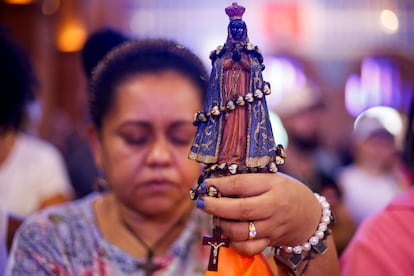

A fake story, with the Virgin of Aparecida, patron saint of Brazil, as an unwitting protagonist, has sparked a major controversy and poisoned the final stretch of the electoral campaign in Brazil. The contention, which harms Bolsonarismo, grew until it drew the direct intervention of the two leading candidates — President Luiz Inácio Lula da Silva and Flávio Bolsonaro — the Bishops’ Conference, and the Supreme Court. Since Thursday night there have been statements, official notes, mutual accusations, and conflicting judicial rulings. The falsehood, which continues to circulate on social media, could affect an election that promises to be extremely close.
At the center of the controversy is a baseless fake news item that stokes fears of religious intolerance, which stated Flávio Bolsonaro supported a bill to strip the Virgin of Aparecida of her status as patron saint of Brazil. He himself has posted several videos denying the story, which began circulating on Thursday night.
Various left-wing figures reposted the original post on social media, which read: “The militia family hates Black women so much that it attacks the Virgin of Aparecida,” and was shared by a comedian named Antonio Tabet. Although it did not mention the Bolsonaros, the reference was clear to Brazilians who follow current political events. Militiamen is a word used to refer to illegal paramilitary groups in the country.
The effects of the controversy are already visible in the polls. The latest Quaest poll, published Monday, points to a slight rise for Lula in the first round. Among other groups, he has improved his numbers among Catholics and evangelicals. That widens his lead over Bolsonaro (39% for the leftist president versus 34% for the far-right candidate), but in a potential runoff they remain locked in a technical tie (42% each). Brazilians are scheduled to vote on October 4. If no one wins an outright majority, a second round will be held on October 25.
https://english.elpais.com/international/2026-05-27/trump-receives-flavio-bolsonaro-in-the-oval-office-three-weeks-after-lula.html, who is an evangelical, fanned the controversy further by accusing the Bishops’ Conference of amplifying the falsehood. The Catholic Church in Brazil is widely seen as more aligned with the left. The bishops’ top representative body replied in a note, saying that “a lie is not fought with another lie.” At the same time, Lula’s running mate, Geraldo Alckmin, a devout Catholic, and other candidates allied with the Workers’ Party (PT) posted videos on social media addressed to Catholic voters.
The judiciary also stepped in. In this case, acting on a request from Bolsonaro, the candidate harmed by the publication. A conservative Supreme Court judge ordered the false content removed from social networks, only to be countermanded by another, progressive, magistrate whose ruling overturned his colleague’s decision and allowed the post to be restored.
The result is widespread confusion that, together with the polls, dominates much of the election debate in the decisive week. As analyst Hélio Schwartsman wrote on Monday in Folha de S.Paulo, “campaigns do not hesitate to embrace the fake news that benefits them.”
This tactic, now being exploited by the left, was used by Bolsonaro’s movement in the two previous elections. In 2018 they spread the falsehood that the Workers’ Party candidate, Fernando Haddad, who had replaced Lula after he was jailed on charges — later overturned — of passive corruption and money laundering, was going to distribute a so-called “gay kit” in schools; in 2022 they again stoked moral panic with the false claim that Lula would close churches.
At that time the PT cried foul and went to the electoral court to have the messages removed. Now it is Bolsonaro’s supporters asking for the same treatment while the left wraps itself in the banner of freedom of expression.
Both sides are aware that a handful of votes is likely to decide the election one way or the other. The percentage of undecided voters is minuscule. Meanwhile, the frontrunners are appealing to strategic voting in the hope of settling the election this Sunday, while the rest of the candidates are fading into the background.
The most consequential moment before the polls open will probably be the televised debate organized by Globo for Thursday. It is scheduled for 9.00 p.m., the primetime hour usually reserved for soap operas. Candidate Bolsonaro confirmed on Sunday his intention to participate. Lula has not yet responded officially, but a few days ago he indicated his willingness to attend. If he accepts, it will be the first time they have met face to face. Voters will be able to compare their opposing visions for Brazil, explained in their own words.
As is often the case with false stories, this one is based on a real fact. Almost 20 years ago an evangelical deputy introduced a bill to remove the Virgin of Aparecida’s status as patron saint of Brazil. The proposal was shelved the following year.
Sign up for our weekly newsletter to get more English-language news coverage from EL PAÍS USA Edition









































