
The day María Corina Machado gave her Nobel Peace Prize medal to Trump
The US president called the gift a ‘wonderful gesture of mutual respect’ but made no mention of the opposition leader’s possible involvement in the Venezuelan transition
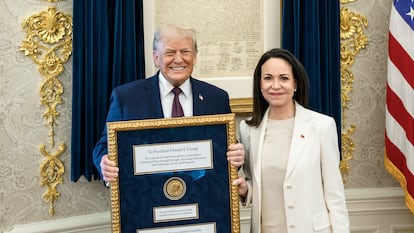
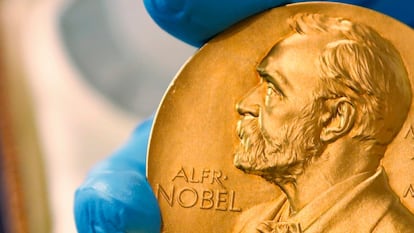
A gold-plated medal, weighing 196 grams and measuring 6.6 centimeters in diameter, was the star of the highly anticipated meeting between María Corina Machado and Donald Trump. As she had previously announced, the Venezuelan opposition leader presented her Nobel Peace Prize to the U.S. president in recognition of his assistance in Venezuela. It was the genuine article, not a replica. The gesture was intended to curry favor with the Republican president, who had openly acknowledged his desire to receive the award and who, just the day before, had praised Machado’s main adversary, Venezuela’s acting president Delcy Rodríguez. Trump confirmed that he had accepted the gift, which he described as “a wonderful gesture of mutual respect.”
“I presented the Nobel Peace Prize medal to the President of the United States,” Machado confirmed in a chaotic statement to the media outside the Capitol. For his part, Trump, who the day before had heaped praise on Rodríguez, made no mention of the content of his conversation with Machado, nor of the possibility that the opposition leader might play a role in Venezuela’s transition. He didn’t even refer to her as the leader of the opposition, even though his own government recognizes the movement led by Machado and Edmundo González Urrutia as the winner of the July 2024 elections.
Apparently in response to the anticipation surrounding the meeting between Trump and Machado, the Nobel Committee reminded everyone on social media this Thursday that the prize “cannot be revoked, shared, or transferred to others,” although the medal’s owner can do more or less as they wish with it. They can give it away, leave it to their heirs, or even auction it off. A well-known example is that of Dmitri Muratov’s medal, which was auctioned for over $100 million to support refugees from the war in Ukraine. But the Committee leaves no room for doubt: a medal can change hands, but the title of Nobel Peace Prize winner cannot.
Machado, who in November escaped from her hiding place in Venezuela to travel to Oslo to receive the award, had declared in an interview with Fox News television host Sean Hannity that she would offer to share the award.
What is the justification for what some—including Venezuela’s acting president, Delcy Rodríguez, who on Thursday accused Machado of “kneeling” before Trump—consider an act of subservience? According to the opposition leader, there is a historical reason dating back to the wars of independence in the Americas.
The Marquis de Lafayette, a French military officer who enlisted in the ranks of the American army during the American Revolutionary War, presented a medal to Simón Bolívar, the great hero of the independence of Venezuela and other Latin American countries, “200 years ago.” That medal bore the likeness of George Washington, who led the rebel troops and became the first president of the newly formed American nation. “Bolívar kept that medal for the rest of his life. In fact, when you see his portraits, you can see the medal,” Machado noted in her news conference.
According to Machado, Lafayette gave it to him as a symbol of brotherhood between the people of the United States and the people of Venezuela in the fight against tyranny. Two hundred years later, the people of Bolívar are returning a medal to the leader of Washington. In this case, the Nobel Peace Prize medal, “as a recognition for his unique commitment to our freedom.”
Whether the opposition leader would present him with her award was one of the great intrigues of Thursday’s meeting, which took place behind closed doors. Part of the conversation was held in the Oval Office. The rest, the lunch break, was in the small breakfast room adjacent to the Oval Office.
But White House Press Secretary Karoline Leavitt seemed to pour cold water on the opposition leader’s hopes of playing a significant role in the transition process, at least in its early stages. Machado is “a remarkable and brave voice for many of the people of Venezuela,” she noted. But Trump has decided to support the continuity represented by the government headed by Delcy Rodríguez, after concluding that the opposition leader could not guarantee the loyalty of the Armed Forces and other key institutions. In Leavitt’s words, Trump made a “realistic assessment” in supporting the continuity represented by Rodríguez. That assessment “has not changed at this time,” according to the press secretary.
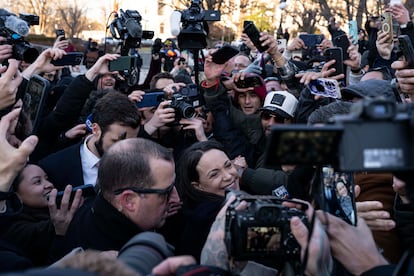
The “realities on the ground” discussed by the two leaders mattered little to the opposition leader’s supporters, dozens of whom gathered in Lafayette Square, across from the White House’s north entrance, to show their support with Venezuelan flags and chants. Upon leaving the presidential residence, Machado came out to embrace them and assure them that “we are counting on the president for the freedom of Venezuela.”
The same warmth was shown to her by her supporters after the event that concluded her activities for Thursday in Washington: a meeting with U.S. senators and congressmembers from both parties at the Capitol. The crowd was so large that it prevented Machado from reaching the designated spot for a news conference. While her supporters begged her for a photo, a remark, just one more glance, the Capitol Police and her personal security detail guided her through a river of people toward her vehicle and drove off without any further statements from Machado.
Sign up for our weekly newsletter to get more English-language news coverage from EL PAÍS USA Edition









































